Dendra Mycenaean Cemetery: tombs, horses and a warrior’s armour
A cemetery in the landscape of Midea
At Dendra, in Greece’s Argolid, the architecture turns downwards. Long approaches descend towards burial chambers cut into the hillside, taking the visitor away from the raised profile usually associated with Mycenaean citadels. The cemetery lies west of Midea’s acropolis and belonged to the world of that palace centre. Here, the people connected with a powerful settlement invested labour and valuable objects in spaces designed to hold their dead.
The official archaeological account identifies one tholos, or corbel-vaulted tomb, and sixteen rock-cut chamber tombs. These are different forms of burial architecture, not a collection of identical domed monuments. The distinction is visible in the relationship between a built circular chamber and rooms excavated in the softer local rock. Reading the approaches and doorways first makes the cemetery easier to understand than simply looking for its most famous find.
The Ephorate of Antiquities of Argolida places the cemetery’s principal use in the fifteenth and fourteenth centuries BCE. Its connection with Midea provides the essential setting: Dendra was part of an organised Bronze Age society, not an isolated gathering of mysterious graves. Excavations have also revealed that imposing architecture and valuable offerings did not belong to one tomb type alone. Chamber tombs, too, could contain extraordinary material.
Approaches, chambers and repeated burial
The tholos was constructed around 1400 BCE. Its approach, the dromos, is almost eighteen metres long, leading to a circular chamber roughly 7.3 metres across. The vault was built by progressively bringing courses of stone inwards. The surviving fabric allows the visitor to consider an engineering problem in a funerary setting: how to enclose a substantial space and give it a monumental entrance without reproducing the form of a palace hall.
Four burial pits in the chamber floor contained male and female burials with rich offerings. The official account highlights precious-metal cups, including one decorated with an octopus, jewellery, seals, weapons and ostrich eggs. These objects speak of skilled production and access to valued materials. They do not supply biographies for every person buried here, but they make the scale of investment in funeral practices unmistakable.
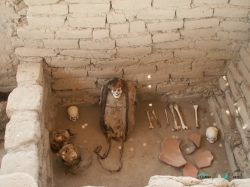
The chamber tombs had their own descending approaches and enclosed burial rooms. Additional pits were sometimes cut into floors and entrances, while repeated interments kept these spaces in use. The excavators interpret such reuse in relation to families or dynasties, although the architecture cannot by itself establish every kinship. Horse burials outside the tombs add another ritual dimension, extending the cemetery’s significance beyond the objects placed directly beside human remains.
The armour that changed the conversation
Dendra’s most celebrated object is the bronze panoply discovered in 1960 during the work of Greek archaeologist Nikos Verdelis and Swedish archaeologist Paul Åström. It came from chamber tomb 12, not from the tholos. The combination of its elaborate defensive equipment and its comparatively modest architectural setting complicates any easy division between grand tombs for important people and chamber tombs for everyone else.
How such armour functioned has remained a serious research question. Its enclosing form can appear cumbersome to a modern observer, encouraging the idea that it was primarily ceremonial. A study published in PLOS ONE on 22 May 2024 tested that assumption with a replica. Thirteen male members of the Greek armed forces took part in an approximately eleven-hour simulated combat protocol; the experimental measurements had been collected in 2019.
The participants were able to complete the programme, supporting the practical possibility of extended use. The researchers combined physiological measurements, historical interpretation and numerical modelling. Their protocol drew partly on analysis of the Iliad, a much later epic, and should not be mistaken for a direct record of a Bronze Age battle. The findings strengthen an argument about the equipment’s capabilities; they do not identify its original wearer or prove the details of that person’s military career.
Connecting the tombs with the museum
The original armour is displayed at the Archaeological Museum of Nafplio, not left in its excavated grave. The museum occupies the Venetian building on Syntagma Square, constructed in 1713 as a naval warehouse. Its official collection description dates the Dendra armour to the end of the fifteenth century BCE. Visiting the cemetery and museum as separate stops therefore connects the terrain that held the burial with the object that made it internationally known.
Midea is the other useful geographical connection: its acropolis and Dendra’s cemetery belong to the same regional story, although access arrangements must be checked for each place. Confirm the cemetery’s current opening days and any admission requirements with the Ephorate of Antiquities of Argolida, whose published contact is +30 27520 27502. The approaches are archaeological features on sloping ground; follow signs and barriers rather than assuming every chamber is open for entry.
Allow time to notice differences in scale, construction and the treatment of entrances, and carry water and suitable footwear for an outdoor site. Dendra’s most memorable lesson is the movement between two kinds of evidence: the spaces that survive in the hillside and the portable objects now protected in museum rooms. Together they bring a Mycenaean community into focus, while leaving room for questions that new methods can still answer differently.