About Chauchilla Cemetery
A desert necropolis south of Nasca
About 30 kilometers south of the city of Nasca, in the district of Vista Alegre in Peru’s Ica region, the Chauchilla Necropolis preserves a funerary landscape rather than a single monumental tomb. The national tourism inventory places it on the left bank of the Las Trancas River and describes an archaeological area extending roughly two kilometers in length and half a kilometer in width. The journey leaves the better-known town and its desert geoglyph routes for a quieter setting where the evidence is burial architecture, human remains and objects placed with the dead.
Chauchilla is often marketed as a “Nazca cemetery,” but that shorthand can hide the site’s longer chronology. Peru’s Ministry of Foreign Trade and Tourism, through its inventory, identifies remains associated with three periods: the Middle Horizon Wari culture, dated there to 700–1200; the Late Intermediate Poroma tradition, 1200–1476; and the Late Horizon Inca period, 1476–1534. These dates are the inventory’s cultural framework, not a claim that every grave belongs to one group or that all the dead were buried at the same moment. The cemetery is better understood as a place used across successive centuries.
What the tombs and offerings reveal
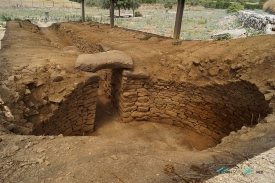
The Mincetur description records tombs of different shapes and sizes, built with rectangular adobe bricks. Some stand alone; others form clusters described as funerary nuclei. The inventory notes burial bundles containing complete bodies, in some cases with long hair, braids, cloth headbands and textiles. It also lists objects and food placed in graves, including ceramics, slings, shellfish, maize and pallar beans. These details turn a walk through the site into more than a display of preserved bodies: they point to careful burial practices and to the material provisions that communities considered meaningful beyond death.
Those finds should be approached with restraint. A tourism description can summarize what has been recorded, but it cannot tell a visitor the identity or personal story of each individual. Nor does the presence of an object by itself prove exactly how it was used. The site’s value lies in evidence that archaeologists can compare, document and interpret; the ethical response is to treat human remains as ancestral people, not props for dramatic photographs. Visitors should remain on authorized paths, follow staff guidance and avoid touching tombs, bundles, textiles or other archaeological material.
Research beyond the familiar label
Research at Chauchilla also corrects the impression that the cemetery can be explained by one famous culture alone. A study published in the archaeological journal Ñawpa Marca examines funerary contexts and tomb structures at the site, including evidence of construction and later modification. Archaeological interpretation depends on such context: the relationship between a burial, its architecture, associated objects and the history of disturbance. Removing any one element from that setting can weaken what researchers are able to learn.
The national inventory describes Chauchilla as one of the largest cemeteries identified in the Nasca valleys and records coordination between the municipality of the Valle de las Trancas settlement and Peru’s Ministry of Culture for maintenance. Its own administrative notes say upkeep is carried out as needed and includes the coverings over tombs. That practical work matters in a dry environment where sun, wind and dust expose fragile materials. The site is not a frozen tableau; it is a protected archaeological place whose presentation and conservation depend on continued local stewardship.
Plan carefully and verify the details
Official visitor listings do not fully agree on hours. The Mincetur inventory—whose recorded last intervention is dated November 26, 2022—lists year-round visits from 8 a.m. to 4 p.m., ticketed entry, and historical rates of S/8 for adults and S/4 for children. A 2023 PROMPERÚ guide gives a different schedule, 6 a.m. to 6 p.m. Because these are dated publications and disagree, neither should be treated as a guaranteed current timetable or price. Before setting out, confirm opening, admission and payment directly with the local site administrator, the municipality or a current authorized tour provider.
The same Mincetur route record estimates 21 kilometers, or about 25 minutes, from Nasca’s main square to the Pan-American Highway at kilometer 469; the final seven kilometers follow an unpaved road, estimated at 13–15 minutes. Those are planning figures, not real-time road conditions. A tour vehicle or local driver is useful for the last stretch, and travelers should allow extra time if the track is rough. Nasca town is the practical base for arranging transport, guides, food and lodging; the inventory lists those services in Nasca or nearby Vista Alegre rather than promising them at every point inside the necropolis.
For a more informed visit, pair Chauchilla with a museum or guide who can explain how Wari, Poroma and Inca-period evidence is distinguished, while resisting the temptation to reduce the site to a single “mummy story.” Bring water and sun protection, stay on designated routes, and ask before taking close-up photographs of human remains. Most importantly, recheck access details shortly before travel: the official records provide useful orientation, but their conflicting schedules show why local confirmation matters. Chauchilla rewards visitors who look carefully at its adobe architecture and layered chronology—and who remember that its tombs are the resting places of people, not merely a desert spectacle.