Old Cemetery of Loyasse, Lyon: history, notable graves and visiting hours
On Fourvière hill, the Old Cemetery of Loyasse is a place to encounter Lyon’s history at a quieter pace. Opened in 1807, it was one of the city’s first modern cemeteries and developed into an outdoor record of local architecture, sculpture and public life. Its chapels and monuments are not arranged like a museum exhibition; they remain part of a working burial ground. A visit is therefore both a heritage walk and a moment that calls for discretion.
A cemetery shaped by changing ideas about burial
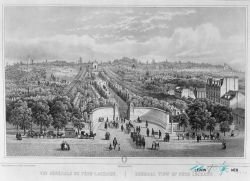
The City of Lyon dates the cemetery’s opening to 1807, and says the municipal council began granting burial concessions there in 1813. Its establishment offered families a place for individual or family graves, in contrast to the parish burial arrangements that had preceded it. The original plan, drawn by Joseph Jean Pascal Gay, used a radiating layout with a central sacred focus. As the grounds expanded, a Latin-cross plan was added.
The site also reflects the changing relationship between public institutions and religion. Lyon says a monumental cross was removed in 1881 under the law requiring cemetery neutrality. A monument honoring firefighters was later erected at the center of the added cross-shaped section, giving the redesigned space a civic rather than exclusively religious emphasis. The visible layout can thus be read as a record of evolving attitudes toward death, faith and the public realm.
Loyasse is especially notable for its funerary architecture. The municipality highlights nineteenth-century chapels and monuments associated with Lyon sculptors and architects including Joseph Chinard, Pierre Bossan, Paul Chenavard, Henri Prost and Charles Dufraine. The city’s guide to the cemetery maps individual works and explains details such as classical columns, sculpted figures and symbolic motifs. Rather than treating every ornament as a generic decoration, visitors can use the guide to notice how families expressed memory, status and belief through stone.
The cemetery also brings together people whose lives intersected with Lyon’s history. The city lists mayors Édouard Herriot and Antoine Gailleton, physicians Marc-Antoine Petit and Amédée Bonnet, General Mouton-Duvernet, Jean-Baptiste Willermoz and Nizier-Anthelme Philippe, known as Maître Philippe, among those buried at the old cemetery. A separate municipal brochure provides a map and biographical notes for selected graves. Names are a starting point, not a complete account of the city: the wider landscape includes families, occupations and communities that shaped Lyon beyond its most recognizable figures.
The municipality has also changed how the grounds are managed. In partnership with the Rhône delegation of the League for the Protection of Birds (LPO), the city describes habitat and biodiversity measures and identifies Loyasse as the first cemetery in Lyon to receive the organization’s refuge label. That initiative adds another layer to the visit: the cemetery remains a place of remembrance while also supporting living habitats within the urban landscape.
Hours, location and respectful visit planning
The city publishes seasonal opening hours for the Old Cemetery of Loyasse. From November 3 through April 30, it is open every day from 8 a.m. to 5 p.m.; from May 2 through November 2, hours are 8 a.m. to 5:30 p.m. The municipality lists annual closures on May 1 and July 14. Check the city’s current notice before travelling, because exceptional closures or site work may affect access.
The address is 43 rue Cardinal Gerlier, 69005 Lyon. The city’s page links to public transport and Vélo’v information but does not specify a single route that suits every visitor; check the current journey planner. The hillside setting can make access more demanding than a flat city walk. Lyon says vehicle entry may be possible for people with reduced mobility, subject to authorization. Contact the cemetery or city service in advance about the process and current access arrangements rather than assuming a car can enter freely.
Do not confuse the old cemetery with the New Cemetery of Loyasse. The latter opened for burials in 1853 and lies across rue Cardinal Gerlier; the city gives it a separate address, 46 rue Cardinal Gerlier. The two grounds share the Loyasse name and are close together, but they are distinct sites. Confirm which cemetery contains a grave you plan to find before setting out, and use the municipal maps when available.
A municipal guide and virtual-visit material can help prepare a route, particularly for visitors interested in architecture or particular Lyonnais figures. The city page does not advertise a standard paid guided tour or admission ticket, so do not assume such a service is available on a chosen date. Treat the lanes as active cemetery space: keep noise low, avoid disturbing mourners, do not touch or climb on monuments, and follow any restrictions around funerals or maintenance.
Loyasse is most rewarding when approached as more than a list of famous graves. Its 1807 origins, changing plan, nineteenth-century art, civic memorials and modern biodiversity work reveal how Lyon has cared for memory and land over time. Check the seasonal hours, distinguish the old and new cemeteries, and leave room for quiet observation. The result is a thoughtful encounter with a living place of remembrance and a distinctive part of the city’s cultural landscape.