About Kuelap
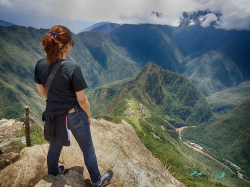
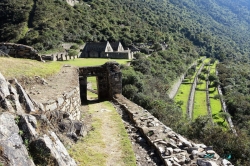
Kuélap, also spelled Cuélap, is one of Peru’s most significant pre-Inca archaeological monuments. Built by the Chachapoya culture in the northeastern Andes, the site rises above the Utcubamba Valley at around 3000 meters above sea level. Its commanding location atop Cerro Barreta, combined with its massive stone architecture, reflects both engineering mastery and deep sociopolitical importance. Kuélap is dominated by a vast artificial platform nearly 600 meters long, enclosed by towering perimeter walls that reach up to 19 meters in height. Archaeological evidence places its construction around the 11th century, during the flourishing of the Chachapoyas, with occupation continuing until the mid-16th century.
Despite its monumental scale, Kuélap remained largely unknown to outsiders until 1843. The region’s persistent cloud forest, steep slopes, and difficult access kept the complex hidden until Judge Juan Crisóstomo Nieto documented it after being guided by local residents—an episode often identified as its “discovery.” Later researchers, from Adolf Bandelier to Louis Langlois, examined its structures, but the most extensive investigations were carried out by Peruvian archaeologist Federico Kauffmann Doig, whose work helped define Kuélap’s place within Chachapoya cultural development.
Architecture, Sacred Centers, and Political Power
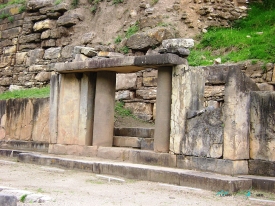
The site’s internal complexity reveals a highly organized settlement combining administrative, ceremonial, and residential functions. Hundreds of circular buildings occupy the platform, while key zones highlight the site’s ritual and political importance. The main entrance, adorned with symbolic stone blocks depicting sacred animals and mythological beings, served individuals of elevated status. Its narrow, ascending passageway preserves layers of construction fill that document the site’s growth over centuries.
Among Kuélap’s most striking structures is the Templo Mayor, a truncated inverted cone with a 13.5-meter diameter. Excavations uncovered evidence of complex ceremonial practices, including human bones intentionally placed inside its inner chamber, forming a large ossuary. Around it, offerings and burials appear to originate from regions as diverse as the northern coast, Ayacucho, and Cajamarca, confirming long-distance cultural connections.
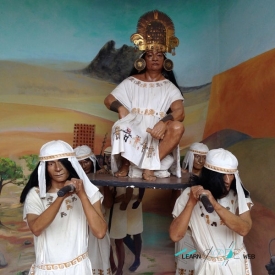
Closely linked to the temple is the Circular Platform on the southern wall. Archaeological data indicate that this area hosted a high-status figure charged with overseeing the temple’s functions. The platform also preserves evidence of a dramatic and violent episode—an internal conflict resulting in a massacre that affected only men, followed by a destructive fire. This event likely marked the final moments of Kuélap’s occupation, around 1570, coinciding with the Spanish imposition of the reducción system.
In the northern and western sectors lies Pueblo Alto, a walled area divided into three sectors. It contains both earlier Chachapoya architecture and later Inca structures, including a finely crafted tomb of an adolescent accompanied by luxury goods. This burial may represent a Capacocha-type offering, a ritual known in important ceremonial centers of the Inca Empire. The area also includes a large rectangular Callanca—an Inca-style building used for ceremonies or lodging—and the Torreón, a solid tower-like ceremonial structure containing hundreds of stone projectiles, likely used in ritualized practices rather than warfare.
Daily Life, Rituals, and the Chachapoya World
Kuélap’s form and layout connect it with broader patterns of Chachapoya settlement organization. The Chachapoyas, who inhabited the cloud-forest region between AD 800 and 1470, built compact communities centered around small open spaces and circular dwellings. As evidenced both in Kuélap and nearby sites such as Purum Llacta de Cheto (documented in the attached academic report), public patios served as controlled environments where feasting, political negotiation, and social cohesion played central roles. Excavations in similar secondary patios reveal ceramic vessels with serpentiform decorations, cooking traces, and elite-managed banquet contexts—patterns also relevant for understanding Kuélap’s own ceremonial activities.
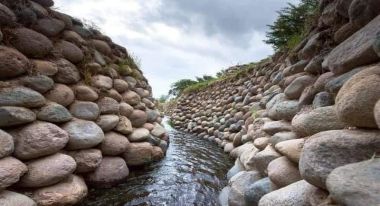
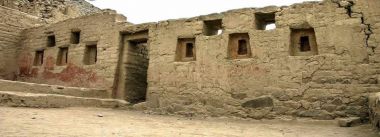
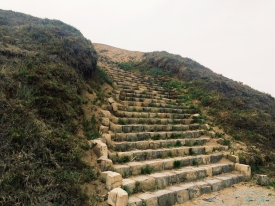
The Chachapoya architectural tradition relied on semi-shaped stone blocks joined with mortar, as seen in Kuélap’s walls, terraces, benches, and platforms. Their monumental constructions fulfilled more than defensive roles. Although Kuélap’s imposing walls and narrow entrances suggest strategic planning, many researchers argue that it functioned primarily as a religious and political sanctuary, where elite groups administered food production, conducted rituals, and mediated relations with the supernatural forces believed to control climate and agricultural cycles.
Decline, Conservation Challenges, and Modern Access
Kuélap’s abandonment remains partly unresolved. The combination of internal conflict, the expansion of the Inca Empire, and the later arrival of the Spanish likely accelerated its depopulation. Modern conservation challenges stem from the site’s age, climate, and structural complexity. Since 2013, Kuélap has suffered progressive deterioration, culminating in the collapse of a section of its perimeter wall in April 2022. Emergency conservation measures, supported by Peruvian and international experts, aim to understand the causes of these failures and prevent further losses.
Despite these challenges, Kuélap has become increasingly accessible. Traditionally reached by steep trails from El Tingo or mountain roads from Leimebamba and Nuevo Tingo, the site has been reachable by cable car since March 2017. This improvement has opened the citadel to broader tourism while raising questions about balancing access, preservation, and long-term site sustainability.
Understanding Kuélap’s Legacy
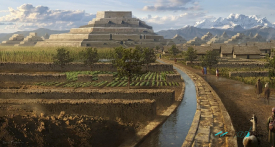
Kuélap stands today as one of the most extraordinary achievements of the Chachapoya civilization. Its vast platform, towering walls, ceremonial centers, and residential zones demonstrate a complex society capable of monumental planning and sophisticated ritual life. Although uncertainties remain—from the logistics of transporting massive stone blocks to the exact water-management methods—ongoing archaeological research continues to refine our understanding of the site’s chronology, functions, and transformations.
Interpreted variously as a fortress, refuge, sanctuary, or political center, Kuélap likely embodied several of these roles across different periods of its long history. What is clear is that it served as a powerful symbol of Chachapoya identity and authority—an elevated world in the clouds where ritual, community, and power converged.