About Caral
A city on the desert edge of the Supe Valley
Caral rises from a dry terrace above the green Supe Valley, about 184 kilometres north of Lima by road. The contrast between desert ground and cultivated valley is part of the site’s meaning: this was not an isolated monument but an urban centre connected to a wider landscape. UNESCO describes the Sacred City of Caral-Supe as a 626-hectare archaeological property dating to the Late Archaic period of the Central Andes, roughly 3000 to 1800 BCE.
That chronology makes Caral one of the earliest known centres of civilization in the Americas, but its importance is not a simple contest over who was first. The city forms part of a wider group of 18 settlements in the area. Its scale, planning and long development provide evidence for a complex society in the Supe region, while the surrounding settlements show that urban life was distributed across a valley rather than confined to one ceremonial hill.
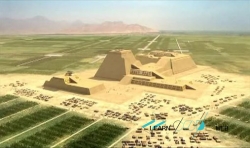
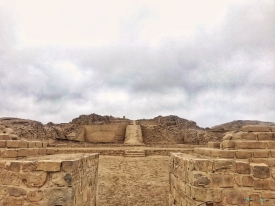
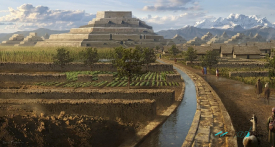
UNESCO highlights six large platform mounds and sunken circular courts among the city’s most striking features. Built from stone and earth, the monumental structures dominate an urban plan that also included residential areas and open spaces. A quipu, a system of knotted cords used to record information in the Andes, was found at the site. It is a tangible reminder that the people of Caral developed ways to organize and transmit information long before written alphabetic records.
What the architecture can—and cannot—tell us
The platform mounds are often described as pyramids, but their design makes more sense when viewed as part of a complete civic and ceremonial plan. Terraces rise above lower courts; routes lead between large structures; and open plazas create spaces for gatherings. UNESCO identifies ceremonial functions in the plan and architecture, while also noting residential areas. The remains support interpretation of public authority and ritual, but they do not disclose every belief or political arrangement of the people who built them.
Caral’s location helps explain the relationship between city and subsistence. The Supe Valley offered agricultural land and access to the Pacific coast, and Peru’s official tourism description presents the society as one of farmers, fishermen and seafarers. That setting encourages a more grounded account than the old claim that the city was sustained by a single spectacular invention. Archaeology documents a settlement and its structures; wider claims about every trade route or social custom should be made only when the evidence supports them.
The site also carries the history of modern research. Work in the Supe Valley expanded under Peruvian archaeologist Ruth Shady and the state archaeological project that became the Zona Arqueológica Caral. The authority’s public material says that investigation, conservation and public interpretation remain ongoing. The excavation story is not a tale of one sudden “discovery” in the 1990s: researchers have built knowledge through fieldwork, dating, comparison among settlements and continuing conservation.
From archaeological research to a visitor route
A visit is structured rather than self-directed wandering. The Peruvian government service page says visitors must register and follow a circuit accompanied by an authorized local cultural interpreter. Group circuits are limited, and the complete experience usually takes about two hours. The route is adapted for wheelchair users, a useful detail for planning, although visitors should confirm current access conditions before setting out because paths and site operations can change.
The official visitor page places the entrance near kilometre 184 of the North Pan-American Highway in the Supe Valley, district of Supe, province of Barranca. It advises arriving no later than about 3 p.m. to complete the circuit comfortably. The page checked on 8 October 2026 lists public entry from 9 a.m. to 4 p.m. daily and closure at 5 p.m. A separate PROMPERÚ listing labels its hours and prices as referential and gives different weekend hours, so verify the current schedule directly with Zona Arqueológica Caral before making the long drive.
The government service sheet also lists a general adult admission of S/11, with reduced categories for students, children and other groups, as of the information reviewed for this article on 8 October 2026. These are not guaranteed future prices. The same official page describes payment at the site and provides contact details for questions; check the current terms, accepted payment methods and any route advisories before leaving Lima. Do not rely on a third-party itinerary for a date-specific entrance rule.
Why the visit rewards a slower pace
Caral is most legible when visitors give the scale time to register. The main platform structures, sunken courts and open ground make more sense as a planned civic landscape than as isolated photo stops. A local interpreter can explain what researchers know, distinguish evidence from hypothesis and point out how the structures relate to one another. The point is not to leave with a legend about a lost empire, but with a clearer view of how an early urban society organized space.
The desert setting makes practical preparation worthwhile. Bring sun protection, water and comfortable footwear, and allow for the road journey from Lima and Barranca. Because the site is exposed and the archaeological circuit has controlled entry, arriving close to closing time is a poor plan. Visitors with mobility needs should contact the authority in advance even though an adapted circuit is listed; that is the most reliable way to confirm what assistance is available on a particular day.
Caral’s significance lies in the combination of age, design and evidence—not in sensational comparisons or unsupported claims. The six platform mounds and circular courts, the valley setting and the quipu all invite questions about how communities built institutions and shared knowledge. A careful visit leaves those questions open while grounding the story in archaeological findings. In that balance between what the site reveals and what research is still clarifying, the ancient city becomes more compelling than any simplified “first civilization” slogan.