Tambo Colorado, Peru: an Inca adobe center in the Pisco Valley
In the dry landscape of Peru’s Ica region, Tambo Colorado stands out not because it is made of stone, but because its earthen walls still carry color. The archaeological complex near Humay, in Pisco Province, is one of the coast’s notable Inca centers. Its name is associated with the strong red paint that remains visible alongside white and yellow tones. Rather than a single temple, the site is a planned settlement of rooms, courtyards and administrative spaces, positioned above the Pisco Valley. A visit helps explain how the Inca state organized movement and authority far from its Andean heartland.
A coastal center in the Inca world
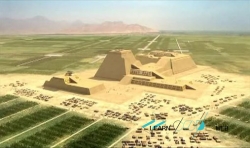
Peru’s national tourism inventory dates Tambo Colorado to the fifteenth century, around 1450, during the rule of Túpac Yupanqui. It identifies the complex as an important coastal administrative and military center associated with the Qhapaq Ñan road network. The compound’s functions were differentiated: some spaces accommodated officials, messengers known as chasquis and a military contingent. The layout suggests a place that supported administration and travel as well as residence, rather than a structure built for one ceremonial purpose alone.
The names recorded by the inventory include Puka Llacta and Puka Huasi; “puka” means red in Quechua, an apt reference to the painted walls. The buildings were constructed from adobe and tapia, or rammed earth. Their survival is striking in a region where earthen architecture can be vulnerable to weather and seismic forces. The inventory describes the complex as well preserved and notes that the Ministry of Culture maintains it. This is not a promise that every surface remains untouched: conservation is ongoing, and visitors should follow barriers and staff guidance.
Reading the plan and its colors
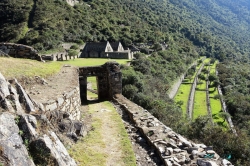
A trapezoidal plaza forms the organizing center of the complex. Around it are several structures, including storage rooms, residences and the principal building commonly called La Fortaleza. The doorways and wall niches use trapezoidal forms associated with Inca architecture. These details are easier to notice on site than in a distant photograph: openings frame views, walls create connected rooms, and the buildings make a legible sequence around the plaza. The colored surfaces are part of the architecture, not decorative additions to an otherwise plain ruin.
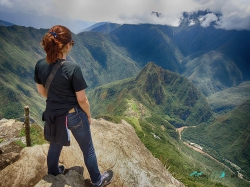
The location also helps explain the settlement’s position. The complex stands on the right bank of the Pisco River valley, near the town of Humay, in a small recess among nearby hills. Peru’s inventory notes that the elevated outlook takes in much of the fertile valley stretching toward the sea. The setting links agriculture, travel corridors and administrative presence. It is tempting to reduce Tambo Colorado to a photogenic red ruin; looking across the valley instead encourages a broader question about why an Inca center was placed here and how it related to routes along the coast.
What to see at the exhibition room
The Ministry of Culture’s exhibition room, created in 1995, adds context before or after a walk through the archaeological complex. Its collection presents a cultural chronology of the Pisco Valley and includes fragments of objects recovered during investigations at Tambo Colorado and its surroundings, along with replicas, photographs, maps and explanatory graphics. The material helps visitors connect the site’s architecture to the region’s longer history. It is a modest interpretive space rather than a large museum, so allow time for the ruins themselves as well as the displays.
Published visitor listings are not fully consistent about the weekly schedule. The Ministry of Culture’s museum page lists Tuesday through Sunday, 9 a.m. to 5 p.m.; the national tourism inventory lists 9 a.m. to 5 p.m. throughout the week. Because the entries differ, confirm the day’s opening directly with the local cultural office before making a special trip. The inventory lists an adult admission price, but it does not provide a clear current tariff date; do not rely on old prices without checking. Group and school reservations are also noted by the Ministry’s museum page.
Getting there and planning responsibly
Tambo Colorado is in Humay District, Pisco Province, Ica Region, along the Los Libertadores Wari road. The tourism inventory estimates the site at 47 kilometers from central Pisco, with a drive of about 50 minutes, and gives a longer route from Ica city. These are directory estimates, not a guarantee of present road conditions or travel time. Confirm your route locally, allow extra time and arrange transport in advance, especially if you are not traveling with a tour. Services such as meals and lodging are more readily listed for Pisco and Humay than at the archaeological site itself.
Bring water, sun protection and sturdy footwear, and avoid climbing on walls or touching painted surfaces. The earthen architecture is a fragile cultural resource, and a responsible visit helps preserve the colors that make the complex distinctive. Tambo Colorado rewards close observation: its plaza, trapezoidal openings, red-painted adobe and commanding valley setting show how an Inca administrative center could adapt to a coastal landscape. The site’s significance lies not only in its surviving walls, but in the network of people, roads and institutions those walls once served.