About Amalfi Coast
A coast, not a single resort town
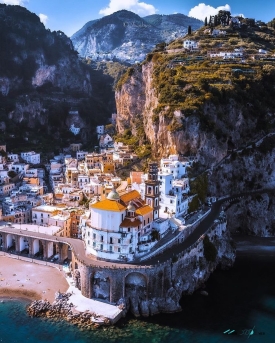
The Amalfi Coast is a region of southern Italy, not just the town of Amalfi or a strip of beach. UNESCO describes the listed cultural landscape as 11,231 hectares embracing 15 municipalities, agricultural land and three nature reserves along the southern side of the Sorrentine Peninsula. Cliffs descend toward the Tyrrhenian Sea, while settlements, terraces and narrow roads occupy the slopes. The scenery is dramatic, but the coast is also a working inhabited landscape whose identity has been shaped by farming, trade and the difficult relationship between land and sea.
The World Heritage designation recognizes that interaction between nature and human effort. Steep terrain limited flat building sites, so residents shaped terraces for vineyards and fruit cultivation and used higher ground for pasture. The coast’s villages sit at different elevations and have distinct street patterns; they are not interchangeable stops with one central promenade. Planning around the geography—rather than trying to cover every town in a day—helps visitors appreciate how the landscape fits together and reduces time spent in traffic.
Amalfi’s maritime past and the wider landscape
UNESCO records intensive settlement from the early Middle Ages and highlights the maritime power of the Republic of Amalfi, especially between the ninth and eleventh centuries. The region’s architecture reflects exchanges across the Mediterranean; some churches and buildings combine eastern and western influences often described as Arab-Norman. Amalfi itself became a significant port and commercial centre, while nearby communities developed their own histories around fishing, agriculture and access to the sea. The coast should therefore be read as a network of places, not as a backdrop belonging to one famous town.
The protected landscape includes Amalfi and Atrani, Positano, Praiano, Cetara, Ravello, Scala, Tramonti, Furore and other communities named in UNESCO’s description. Each offers a different encounter with the terrain: a harbour settlement, a hill village, a beach, a church or a footpath between districts. The designation was inscribed in 1997 and applies to a broad cultural landscape, not to a single monument with a ticket gate. Visitors can move through public streets and viewpoints, while individual churches, museums, beaches and trails may have their own hours, fees or restrictions.
Choose a route that fits the coast
Amalfi is a practical transport hub because buses and ferries connect it with other coastal communities, but the journey is shaped by narrow roads and steep topography. The official destination portal lists SITA Sud regional buses and sea services by Travelmar and Alicost, and advises travellers to check current schedules. The Praiano tourist information office publishes autumn timetables effective September 14, 2026, including routes for Amalfi–Maiori–Salerno and Amalfi–Scala–Ravello. Timetables are seasonal documents, so download the version for your travel date instead of relying on an old screenshot.
A local mobility consortium also advertises reserved-seat direct connections: its Green Line links Positano and Amalfi, its Blue Line connects Maiori and Amalfi, and its Orange Line serves Ravello and Amalfi. The listed frequencies and prices belong to that operator and can change; confirm availability and booking terms before relying on them. Ferries can offer a useful alternative when services are operating, while buses are important throughout the year. In peak periods, both may be crowded. A flexible plan—with fewer stops and time for delays—is more realistic than attempting a rapid coast-wide circuit.
Walking paths, beaches and everyday etiquette
Walking reveals a side of the coast that road travel can miss. The Path of the Gods, or Sentiero degli Dei, links Bomerano in Agerola with Nocelle above Positano and is known for long views across the peninsula and sea. A regional trail guide updated in September 2026 describes a roughly seven-kilometre route and reports it open at that time; conditions can change after weather, maintenance or local closures. The trail is not a level promenade: expect uneven ground, exposed sections and a demanding walk, and verify status locally before setting out.
Coastal beaches and coves are often small and connected to towns by stairs or steep lanes. Access, beach services and seasonal operation differ from place to place, and not every shore is a wide public beach. Carry water, wear suitable footwear on steps and trails, and avoid leaving litter in fragile areas. The region’s terraces and paths are part of a lived landscape, sometimes crossing private land or working farms; follow signs and do not trespass. Respect for residents and local access rules makes a visit more sustainable than treating every view as an unrestricted photo stop.
Practical planning for a 2026 visit
Start by choosing a base that matches your priorities. Amalfi offers transport connections and access to the cathedral complex; Positano is steep and heavily visited; Ravello sits above the coast and has a different pace; smaller towns may be quieter but require more timetable planning. The official Amalfi portal notes that high-season traffic controls can include one-way systems, alternate-plate measures and vehicle-size limits, while Amalfi’s historic centre is a restricted-traffic zone. Check the current municipal rules before bringing a car, and do not assume that hotel parking permits unrestricted driving.
For a short stay, combine one town with a nearby walk or boat trip rather than racing between all the famous names. Check bus and ferry operators directly on the morning of travel, particularly outside the main season, and leave a buffer for connections. UNESCO status explains why this coastline matters; it does not guarantee that a specific trail, church or transport service is open on a given day. The Amalfi Coast is most rewarding when its history, cultivation and everyday life receive as much attention as its panoramic photographs.