Huaca Pucllana: Lima’s ancient ceremonial center inside Miraflores
An archaeological landscape in the middle of Miraflores
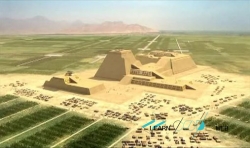
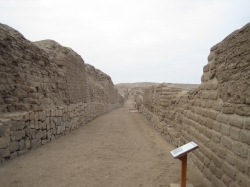
In Miraflores, Huaca Pucllana rises above modern streets as a broad adobe monument. Its stepped mass is an unmistakable reminder that Peru’s capital was already a place of settlement and ceremony long before the colonial grid and today’s high-rises. The site is not a lone pyramid isolated from the city: it is an archaeological complex where excavated structures, open ground and a small museum make the past legible within a living neighborhood.
The ceremonial center was built by the Lima culture on Peru’s central coast, with the principal construction dated by official sources to approximately 450–650 CE. That period falls within the wider span of Lima cultural development, conventionally placed around 200–700 CE. Rather than treating those dates as a single moment of construction, it is more accurate to understand Pucllana as a place that changed through successive phases and uses, recovered gradually through archaeological research.
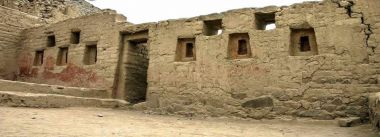
The surviving pyramid and surrounding spaces reveal an organized monumental setting. Adobe is central to that impression: earthen architecture links the stepped mass of the ceremonial monument with the wider excavated complex. Walking around it, the striking contrast is between the ancient construction and the streets of Miraflores immediately beyond the site. The visit brings archaeology into an everyday urban setting, rather than requiring a journey to a distant landscape separated from the capital.
From Lima builders to later users of the huaca
Pucllana’s importance did not end when the Lima culture’s main period declined. Official visitor material describes later Wari use of the summit as a burial place, including elite interments, and a subsequent Ychsma presence associated with offerings and burials. These are not merely names on a timeline: they show how a prominent ancestral monument could acquire new meanings as communities across the central coast changed and interacted over many centuries.
Archaeologists have worked to investigate, conserve and present the complex since a research and conservation project began in 1981. The site museum opened in 1984 and displays cultural material recovered through those excavations. Its institutional account identifies research, architectural conservation and education as connected responsibilities. What visitors see is therefore not only an ancient structure but also the outcome of continuing fieldwork, restoration decisions and public interpretation.
The museum’s displays help connect artifacts to the landscape outside. A visit can move between an exhibition room, the archaeological circuit and a native flora-and-fauna area. That arrangement encourages a more grounded reading of the site: the objects are not detached curiosities, and the huaca is not simply a dramatic backdrop. They belong to a wider effort to study how people lived on Lima’s arid coast and how cultural heritage can be protected in a rapidly changing city.
What to notice on the visitor circuit
Begin with the scale and the relationship between the monument and the surrounding streets. The stepped adobe construction is visible from several points on the circuit, while excavated spaces and display materials offer context for the different occupations. Take time to observe how the site is bounded by contemporary Miraflores: the contrast is striking, but it is also a reminder that archaeology here exists amid traffic, residences and active urban development.
The museum does not present every unanswered question as settled fact. Excavation is a process: layers are recorded, objects are compared, and interpretations can change as new evidence appears. The story of Pucllana is thus not just a narrative of ancient rulers or dramatic rituals. It includes the practical work of documenting mud-brick architecture, caring for fragile remains, explaining archaeological methods and sharing findings with a public that may be seeing a pre-Columbian monument for the first time.
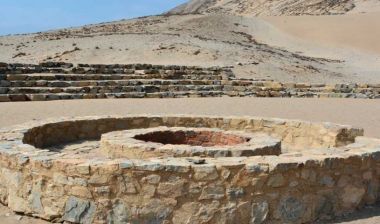
Because the site is in a coastal desert environment, the material itself is part of the experience. Adobe is made from earth, and its survival depends on careful management of exposure and water. Visitors should stay on authorized paths and follow staff instructions rather than climbing onto walls or approaching protected structures. The circuit is designed to make the monument accessible without treating its fragile fabric as an unrestricted viewpoint.
Planning a visit in Lima
At the time of research on 9 October 2026, the Ministry of Culture’s museum page listed the site at Calle General Borgoño, block 8, Miraflores, with daytime visits Wednesday through Monday from 9 a.m. to 5 p.m. It also listed a Wednesday-to-Sunday evening visit from 6:45 to 9 p.m., except the first Sunday of each month. These are dated details, not a promise for a later trip: verify the official calendar and any reservation requirement before travelling, especially for evening access.
The same official record listed daytime admission at S/15 general and S/7.50 reduced, and evening admission at S/17 and S/8.50 respectively. PROMPERÚ’s visitor information describes free first-Sunday entry for Peruvian citizens and foreign residents with valid identification, while the museum page provides contact details for questions. Prices, eligibility, closures and payment options can change; confirm them directly with the museum rather than relying on an old travel post.
Allow time for the guided archaeological circuit and the museum rather than treating Huaca Pucllana as a quick photo stop. Its location makes it possible to combine the visit with other Miraflores plans, but the site deserves attention on its own terms. The most compelling impression is not a sensational legend: it is the presence of a carefully studied Lima-culture monument, later reused by Wari and Ychsma communities, still being researched and conserved at the heart of modern Lima.