
Khenchela Province | Algeria | Africa

Hammam Essalihine

-

ABOUT Hammam Essalihine


Among the pines and cedars of the Aurès, a Roman bath nearly 2,000 years old - Hammam Essalihine - continues to welcome visitors. Its hot water, rich in minerals, and its two pools - one circular and the other rectangular - tell a unique story of continuity. Hammam Essalihine (Arabic for "the bath of the righteous"), known in Roman times as Aquae Flavianae, is located in the district of El Hamma, province of Khenchela, Algeria. Most of the bibliography places its origin or reconstruction in times of the Flavian dynasty (69-96 A.D.), which harmonizes with inscriptions cited by secondary sources and with the local tradition about its Roman exploitation.

The site is located in the Aurés mountains, a wooded and cool environment that contrasts with the temperature of the water. The location - just a few kilometers from the town of Khenchela - means that the complex continues to be integrated into the daily life of the region: families, the elderly and travelers share the waters as they did centuries ago. Continuity of use is one of its most cited features and, although it is not the only active historical bath in the world, Essalihine stands out for maintaining its Roman layout and public function.
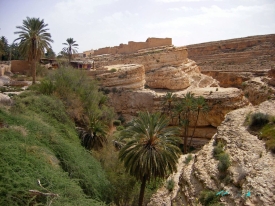
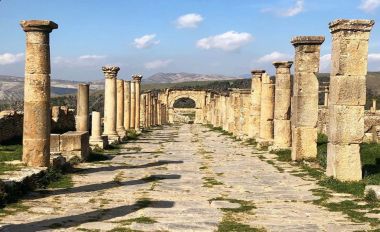
The complex retains two main geometries: a circular pool and a rectangular pool, a feature visible in historical and current photographs of the site. These two typologies favored differentiated immersion circuits and staggered gauging, as well as facilitating drainage and replacement. Today they remain the heart of the hammam.

Historical baths and their survival

Various sources and studies indicate that the spring of Hammam Essalihine is rich in minerals and of great purity, with high temperatures at source that are moderated before reaching the pools. Values close to 60-70 °C at the point of emergence are mentioned; in the bathing basins, naturally, the water is mixed and cooled for human bathing. Such characteristics explain its fame for rheumatic and dermatological affections, in addition to its recreational use (as any health practice, it is advisable to consult a professional).

The Flavians and the Severian repairs

The Latin toponymy Aquae Flavianae suggests work or patronage in the Flavian period. In addition, there are secondary mentions of interventions under Septimius Severus (beginning of the 3rd century), consistent with an imperial practice of maintaining thermal infrastructures. Although specific epigraphic evidence is not always accessible online, this contextual reading is supported by repertories and scholarly notes on Severan building programs in the Empire.

A living heritage: tourism, social use and photography

Today, Hammam Essalihine appears in travel guides and heritage platforms such as Archiqoo or Tripadvisor, in addition to informative articles. Its appeal is not only archaeological: the experience of bathing in an active Roman environment - with steam, echoes and conversations - distinguishes the site from modernized spas. For the visitor, the golden moment is usually on weekday mornings, when there are fewer visitors; at sunset, the light on the Aurés landscape yields memorable photographs.

Architecture and operation

Although the enclosure has undergone modern adaptations, the scheme perceived by the visitor maintains the hydraulic logic: hot spring catchment, conduction channels, decanting and distribution to the basins. The alternation of pools not only regulates the temperature, but also manages the capacity. Elements such as resistant pavements, drains and raised edges respond to thermal and safety needs already addressed by the Romans in their thermae.

Essalihine recalls that, beyond the urban luxury of large thermae, rural or semi-urban springs were nodes of health and sociability in the Empire: they connected secondary roads, markets and sanctuaries. Their modern survival makes Essalihine a "living document" where to observe millenary bathing habits integrated into contemporary life.

"In Essalihine, time does not stand still: it flows with the water, between invisible columns, reminding us that history is also lived, not just studied."

The Best Pictures of Hammam Essalihine

Hammam Essalihine ancient Roman bath.jpeg
Hammam Essalihine
Hammam Essalihine
Hammam Essalihine
Hammam Essalihine
Hammam Essalihine
Hammam Essalihine

Videos of Hammam Essalihine

The Only Roman Bath Still Used Today Hammam Essalhine: A Roman Bathhouse Still In Use After 2,000 Years The Roman baths Hammam Essalihine – Algeria Hammam Essalhine #Khenchela: La piscine romaine Algeria & Tunisia 2025: Day 14 – Timgad & Hammam Essalihine