About Amphitheatre of the Three Gauls
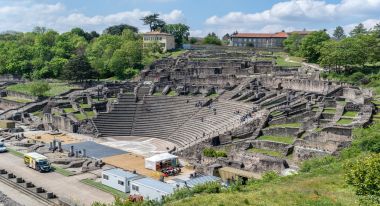
On the slopes of Lyon’s Croix-Rousse hill, fragments of stone walls sit within the Jardin des Plantes, a quiet setting that can make the Roman Amphitheatre of the Three Gauls easy to overlook. Yet this was once a major public building in Lugdunum, the Roman city that became a center of imperial administration in Gaul. The surviving remains do not recreate an arena in full; they invite visitors to read the city’s ancient landscape through what archaeology has actually uncovered.
From a Roman arena to a place of memory
The City of Lyon dates the amphitheatre’s completion to 19 CE and describes it as the oldest Roman amphitheatre in Gaul. It stood within the federal sanctuary of the Three Gauls, a religious and political complex associated with the worship of Rome and Augustus by representatives of 60 Gallic nations meeting at Lugdunum. Its position on the hillside connected a monumental gathering place with the broader Roman settlement below and around it.
The original building was later enlarged. Lyon’s heritage account says that the second-century structure could hold as many as 20,000 people. That figure describes the expanded ancient venue, not the capacity of the archaeological remains visible today. The arena hosted spectacles and public games, but the site’s place in history is also linked to events that gave it a different meaning in later memory.
In 177 CE, Christians in Lyon were persecuted. The city says that 48 early Christian martyrs of Gaul were condemned and executed, most of them at this location; Blandina and Pothinus are among those named. The account should be read with care: it is the city’s historical summary of the martyrdoms, not a claim that every later tradition about the event can be established from the stones themselves.
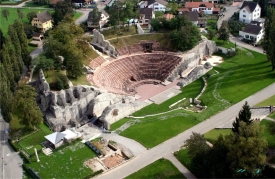
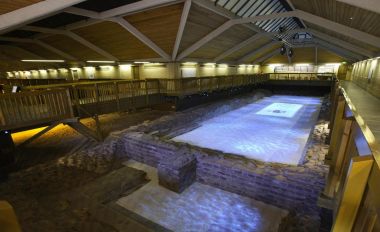
Centuries of urban change buried or absorbed much of the structure into the modern neighborhood. Excavations beginning in 1956 brought important remains to light. The city describes surviving support walls covering roughly half the amphitheatre’s footprint, now integrated into the Jardin des Plantes. What visitors encounter, therefore, is a partial archaeological site, not a restored bowl with its seating and stage recreated.
This fragmentary condition is part of the visit’s value. Instead of relying on a complete monument to tell its story, the site asks the eye to connect the masonry, the slope and the surrounding city. Looking at the remains alongside the city’s account helps explain both the scale of ancient Lugdunum and the limits of what is still visible. It is a rewarding stop for travelers interested in archaeology, but expectations should be different from a visit to a large, fully excavated Roman arena.
Planning a visit on Croix-Rousse
The municipal heritage listing gives the address as Rue Lucien Sportisse, Lyon 1st arrondissement, postal code 69001. It identifies bus lines 13 and 18, with a stop at Mairie du 1er, and lists the city’s Vélo’v bicycle-share service as another access option. Check the current public-transport network before setting out, since routes and service can change. The hill setting also means that a map is useful when combining this stop with other places in the Croix-Rousse district.
Do not plan around an assumed museum-style schedule. The city’s location page provides historical information and directions but does not publish ordinary daily visitor hours or a standard ticket price for the remains. Guided visits have appeared as separate, dated events organized by the municipal archaeology service; those listings are not evidence of a standing tour every week. Confirm access and any current event directly with the City of Lyon before making a special trip.
The amphitheatre is an outdoor archaeological remnant within a planted urban setting, not an attraction with the facilities of a staffed museum. The available municipal information does not promise visitor amenities, indoor interpretation or a full reconstructed route. Allow time to observe the walls and their relationship to the garden, and consult a current city map or heritage notice for any temporary work or access restrictions.
It is also useful to distinguish this monument from Lyon’s larger Roman theatre and odeon on Fourvière, now presented alongside the Lugdunum museum. They belong to the same ancient city, but they are separate archaeological places with different visitor arrangements. Combining them can make a fuller day of Roman Lyon, provided you check the specific opening details for each site rather than assuming one ticket or schedule covers both.
A thoughtful visit begins with modest expectations and close observation. The amphitheatre’s surviving walls are a small part of a venue that once accommodated a vast crowd, yet their setting connects archaeology, Roman civic life and Lyon’s later history in one compact place. Check current access with the municipality, follow on-site guidance and take time to imagine the landscape without confusing that interpretation with the fragment that remains.