About Roman walls of Lugo
A Roman defence that still belongs to the city
In Lugo, north-west Spain, the old Roman boundary is not a ruin set apart from daily life. The wall encloses and frames a working city: residents cross its gates, meet along the circuit and use the upper walk as a public route. UNESCO describes it as the most complete surviving example of late Roman military architecture in the Western Roman Empire. Its appeal lies not only in age or scale, but in the rare fact that an ancient defence still shapes how a modern town is experienced on foot.
The circuit was built in the later third and fourth centuries to defend Lucus, the Roman town from which Lugo takes its name. It runs for 2,117 metres in an elongated rectangle and encloses about 1.68 hectares. The masonry combines slate and granite facings with a core of stone fragments and lime mortar. UNESCO records walls 8 to 10 metres high and normally 4.2 metres wide, widening to about 7 metres at some points. Those measurements help explain why the structure reads as a continuous urban edge rather than a thin ceremonial barrier.
The surviving line retains 85 external towers and ten gates. Five gates are considered original and five were opened in modern times as the city expanded. Four stairways and two ramps lead to the wall walk; UNESCO also records 21 tower staircases identified within the structure. Restoration and change are part of the story, not evidence that the monument is simply untouched. The circuit keeps its Roman layout while showing how later generations adapted entrances, repaired fabric and incorporated the fortification into a growing city.
Reading the circuit from above and below
A walk on the adarve, the top of the wall, turns the monument into a way of reading Lugo’s plan. From above, the rounded towers, long curtains of masonry and changing roofline make the defensive logic legible. Below, the ten gates connect the enclosed historic centre with streets and neighbourhoods outside. The Provincial Tourism service recommends using the circuit as a starting point for a wider Roman heritage walk, rather than treating the wall as an isolated photo stop.
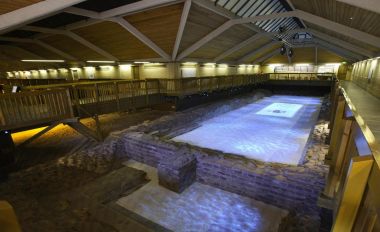
Among the nearby remains it identifies are the Domus del Mitreo, a Roman house and sanctuary dedicated to Mithras; the Casa de los Mosaicos; a Roman pool at Praza de Santa María; and aqueduct remains at Praza de San Marcos. The Provincial Museum of Lugo also holds an archaeological collection. These places are separate visits, and their opening schedules are not the same as access to the wall walk. Linking them on foot helps explain how a fortified perimeter related to homes, religious life, water supply and later urban streets.
The wall’s long afterlife is visible in the gates themselves. Some openings preserve older routes; others were altered or created when new institutions and traffic needs changed the city. Turismo de Galicia describes, for example, the Santiago gate and the nineteenth-century Obispo Aguirre gate, whose opening required changes to the wall. The point is not to assign every stone to a single Roman moment, but to notice the structure as a palimpsest: a Roman defensive system continuously negotiated with the needs of later Lugo.
UNESCO status and the value of an inhabited monument
Lugo’s walls were inscribed on the UNESCO World Heritage List in 2000 under criterion four, recognizing an exceptional example of a type of architecture and construction. UNESCO notes the intact circuit, defensive towers, gates, stairways, moat and archaeological remains as parts of the property’s significance. The designation does not freeze the centre as a museum. Its distinctive setting is precisely that the fortification remains embedded in urban life and is used by residents as well as visitors.
That relationship also creates practical conservation responsibilities. UNESCO identifies traffic infrastructure, water and relative humidity among the pressures affecting the walls, while describing them as minor and under control in the assessment available on its profile. The Xunta de Galicia is the owner and competent heritage authority; the municipality manages measures in the walled area and its surroundings. Plans to reduce traffic pressure and improve pedestrian space show why visiting on foot is more than convenient: it aligns with the effort to protect a monument whose surroundings are part of its meaning.
The experience changes with the pace of the walk. A full circuit gives a sense of the enclosed footprint, while short sections make it easier to pause at a gate, look into the old town or compare a tower with the streets beyond. There is no need to turn the visit into a race around the perimeter. Lugo’s wall rewards attention to transitions: where a ramp meets the walkway, where stone gives way to a view of a church roof, and where an opening joins two sides of the contemporary city.
Practical planning: the wall walk and interpretation centre
The wall walk is an urban public route, but the interpretation centre is a separate indoor visit with its own hours. The Concello de Lugo lists the Centro de Interpretación de la Muralla at Praza do Campo 11, in the historic centre, and states that admission is free. Its four floors are arranged around different periods; videos and interactive screens explore the monument’s construction, history and influence on everyday civic life. The format lets visitors choose how long to spend, making the centre a useful introduction before walking the circuit or a place to add context afterwards.
At the time checked in October 2026, the municipality’s published winter schedule was 10:00–14:00 and 16:00–18:00 daily from January through May and from 15 October through December, except for special holiday periods. The summer schedule, from 1 June to 14 October, extended the afternoon opening to 20:00. Easter and Christmas have separate arrangements, and the centre lists closures on 24, 25 and 31 December and 1 and 6 January. Because these are changeable operating details, check the municipal page before travelling, especially around festivals and holidays.
Turismo de Galicia identifies the slope at Porta Miñá as the only access to the adarve suitable for visitors with reduced mobility. Conditions can change if maintenance or temporary works affect an entrance, so confirm locally if step-free access is essential. Wear shoes suitable for stone paving and allow time for the centre’s seasonal schedule as well as the walk. Lugo is best approached as a connected heritage district: the Roman circuit gives the outline, while its gates, nearby remains and living streets fill in the story.