About Augusta Raurica
Augusta Raurica: The Roman City That Still Lives by the Rhine
Just ten kilometers east of Basel lies one of the most evocative Roman sites north of the Alps. Augusta Raurica, once a thriving colony of the Roman Empire, stretches today across the Swiss municipalities of Augst and Kaiseraugst. What survives is not just a scattering of ruins but the skeleton of a real Roman city: streets, workshops, temples, theaters and the footprint of a bustling urban center that reached its peak nearly two millennia ago.
A colony at a crossroads of empires
Augusta Raurica — literally “the city of Augustus in the land of the Raurici,” the local Celtic tribe — was formally founded in 44 BC. Although archaeological remains from this earliest phase are scarce, the settlement took shape during the reign of Augustus, after the Roman conquest of the Central Alps around 15 BC.
The location was carefully chosen. Built from scratch on a plateau overlooking the Rhine, the colony stood at a strategic intersection of trade and military routes.
A north–south axis connected Italy via the Great St. Bernard Pass and the key city of Aventicum.
An east–west road linked Gaul with the provinces of Raetia and Pannonia.
The Rhine itself was a vital waterway, carrying goods, soldiers and ideas across the frontier regions of the empire. With a commanding view, fertile land and reliable water supply from the Ergolz and Violenbach streams, the site offered the perfect balance of defense and prosperity.
A planned Roman city with 10,000 inhabitants
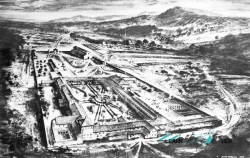
At its height around AD 200, Augusta Raurica housed around 10,000 people, making it the largest settlement in the region. Designed as a planstadt, the city featured an orthogonal street grid laid over the plateau of the “Upper Town” (Oberstadt). The main north–south axis, the cardo maximus, was slightly rotated to fit the terrain and intersected the decumanus maximus at the forum. The resulting insulae averaged 56 by 66 meters.
A second urban zone developed in the lower area by the Rhine (Unterstadt). Unlike the regimented grid above, its long, narrow plots resembled the layout of a vicus: workshops, houses, gardens, sheds and industrial installations such as pottery kilns and glass workshops.
Temples, theaters and an active public life
Augusta Raurica boasted a rich architectural landscape. The main forum formed the civic heart: a spacious public square bordered by shops, a sacred area with a podium temple, a basilica for legal and administrative proceedings, and a curia for local governance. Its block-like arrangement is characteristic of the “Gallic forum” type.
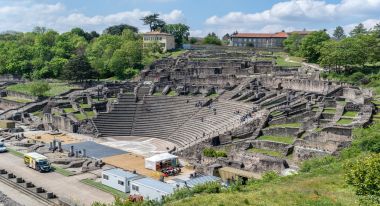
The city also featured two major performance buildings: A theater in the center, which went through three distinct phases — from an arena-theater, to a semi-amphitheater for animal hunts and gladiatorial shows, and finally into a classic theater that could seat up to 10,000–12,000 spectators.
A true amphitheater on the southern edge, built into a natural depression, with an arena ringed by high walls, gates and animal holding chambers.
During the 4th century, yet another amphitheater arose near the late Roman fortress — the youngest such structure known from the entire Roman world.
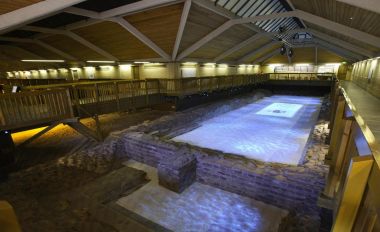
The city included multiple bathing complexes. The so-called Women’s Baths occupied an entire insula and featured cold, warm and hot rooms, exercise areas and a large courtyard pool. The Central Baths extended across several insulae along the cardo. Beyond the urban grid, a healing sanctuary at Grienmatt combined ritual architecture with a bath linked to Roman health cults.
Prosperity, crisis and the shifting edge of empire
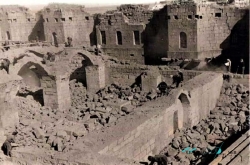
The 1st and 2nd centuries brought rapid growth, stone construction and economic stability. But the 3rd century plunged Augusta Raurica into a period of turmoil. Empire-wide military conflicts, frontier pressure and economic instability were keenly felt: workshops were abandoned, waste accumulated in streets, fires went unextinguished and parts of the city fell into ruin. By around AD 280, the settlement was largely devastated and depopulated.
A reduced community retreated to a naturally defensible spur of the Upper Town, fortifying it with material scavenged from monumental buildings. Soon after, around AD 300, a new chapter began with the construction of the Castrum Rauracense, a heavily fortified stronghold on the Rhine. It housed Roman troops for roughly a century and marked the strategic shift of the frontier.
Within this late Roman context, a magnificent treasure of 58 kilograms of silver — plates, bowls, spoons and coins — was buried and never recovered by its owners, offering a vivid window into a moment of crisis.
As the Early Middle Ages took shape, Augusta Raurica lost its regional role to the rising city of Basel. Yet this decline preserved the Roman layout: with little medieval overbuilding, much of the ancient city remained intact beneath the soil.
Augusta Raurica today: an open-air archaeological park
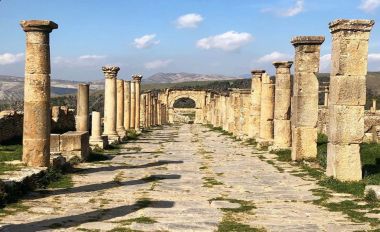
Modern Augusta Raurica is a vast, freely accessible archaeological park — one of Switzerland’s most significant cultural heritage sites. Visitors can wander among the foundations of temples, stroll down ancient roads, climb into the restored seating of the theater and trace the outlines of workshops, houses and baths.
The Augusta Raurica Museum, established in the mid-20th century, brings the site to life with finds from decades of excavations. Its star attraction is the spectacular late Roman silver hoard. Nearby, the Roman House (Römerhaus) — a full reconstruction based on southern Alpine models — offers an immersive look at everyday life: living quarters, food preparation areas, craft rooms and furnishings.
Excavations continue today, though on a smaller scale, focusing on rescue archaeology and targeted research. Each discovery contributes another detail to the portrait of a vibrant Roman community.
The site hosts temporary exhibitions that connect Roman material culture with modern themes, exploring everything from dining traditions to waste, status and social life.
The Römerfest: Switzerland’s largest Roman festival
Every year on the last weekend of August, Augusta Raurica bursts into life during the Römerfest, the largest Roman-themed festival in Switzerland. For two days, the archaeological park fills with legionary reenactments, gladiator demonstrations, craft workshops, mosaic and writing stations for children, performances, food stalls and historical shows.
It is the closest one can get to experiencing the city as it may have felt in antiquity: noisy, crowded, colorful and full of movement.
A Roman city worth the detour
For travelers staying in Basel, Augusta Raurica makes an ideal half-day or full-day excursion — easily reached, immersive and rich in stories. Its blend of well-preserved ruins, reconstructed spaces, museum exhibits and lively programming creates an experience that appeals to families, history enthusiasts and casual visitors alike.
Two thousand years after its founding, Augusta Raurica remains very much alive: in its stones, in its rediscovered objects and in the way it continues to fascinate everyone who walks through its ancient streets.