The Colosseum in Rome: history, architecture and visitor guide
A Roman landmark with more than one life
The Colosseum is the familiar name for Rome’s Flavian Amphitheatre, but the monument is more than a surviving shell of imperial spectacle. Built in the first century CE for public events, it has been successively damaged, adapted, quarried, inhabited, studied and restored. The Archaeological Park of the Colosseum presents it as a complex structure in a larger archaeological landscape, where ancient engineering and Rome’s changing needs remain visible.
Its name came from the colossal statue that once stood nearby, not from an official ancient title. The amphitheatre was commissioned under the Flavian emperors and became a major venue for gladiatorial contests and animal hunts. The monument’s scale, circulation systems and elaborate arena machinery were designed to move crowds and performers efficiently. The building itself was part of the event: its architecture staged power while organizing a large public audience.
Visitors often arrive expecting a single story about gladiators. Yet the stone surfaces, broken arches and excavated interior also record repairs, reuse and changing beliefs. The original monument was more richly finished than the exposed masonry seen today: marble, coloured plaster and stucco once covered important parts of the interior. What remains is evidence of a structure continually reshaped by two millennia of urban life.
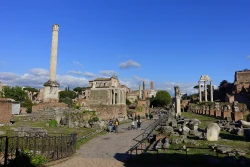
The Colosseum is best read with its setting in mind. It stands beside the Arch of Constantine and is linked by archaeological routes to the Roman Forum and Palatine Hill. These places formed a connected political and ceremonial centre, rather than a collection of unrelated attractions. Seeing the amphitheatre as part of that landscape makes its size and function easier to understand.
Flavian construction and the arena’s design
Official park material dates the building to the first century CE and associates its construction with the Flavian dynasty. The project began under Vespasian and the amphitheatre was inaugurated by his son Titus; work continued under Domitian. This sequence matters because the monument was a dynastic project in a highly visible urban site. Its construction transformed ground formerly occupied by Nero’s palace complex and artificial lake into a public venue.
The elliptical plan allowed spectators to view the arena from tiered seating arranged around its centre. Multiple entrances and corridors helped distribute visitors through the building, while the stacked exterior arcades presented a monumental face to the city. Beneath the arena floor, service spaces and lifting mechanisms supported the movement of scenery and animals. Today, visitors can see parts of the underground arrangement, although access depends on the ticket type and current route.
Ancient spectacles included gladiatorial combat and animal hunts, but modern interpretation should avoid turning every popular detail into certainty. The park’s own account emphasizes the complex machinery and audience services; individual reconstructions of how a particular show unfolded are still interpretations of material and written evidence. The ancient sources do not answer every question. Responsible writing distinguishes what the excavated fabric demonstrates from what historians infer about specific performances.
The building’s original appearance was also different from the bare stone familiar in photographs. The Colosseum Archaeological Park describes marble coverings, coloured plaster and stucco decoration that have largely disappeared through weathering and reuse. These surfaces mattered: they changed the visual experience of the interior and signalled status. Looking at traces of decoration and conservation work helps visitors imagine not just the arena’s outline but the crafted environment that once surrounded its audience.
From spectacles to reuse and conservation
The amphitheatre’s function changed over time. The archaeological park notes that gladiatorial games were abolished in 438, after which the building entered a long period of decline. It did not simply become an empty ruin. During the Middle Ages it contained homes, workshops and animal shelters; parts of its fabric were also taken as building material. Stone from the monument was reused in Rome, including in major construction projects, leaving the losses visible in its uneven exterior.
Christian associations and devotional use developed gradually rather than in one uninterrupted event. In the eighteenth century, Pope Benedict XIV prohibited further desecration and dedicated the arena to the memory of Christ’s Passion and Christian martyrs. The park’s historical account places this within a wider effort to protect the building and regulate uses of the surrounding area. The present cross and religious associations therefore belong to the monument’s later history, not to its original design.
Systematic excavation and restoration became increasingly important in the modern period. The Colosseum is now managed as a fragile monument within a dense urban environment, and conservation has to balance research, visitor access and structural care. The park reports that millions of people visit each year, a level of interest that makes maintenance and controlled routes essential. Recent restoration work also reveals the original floor levels and materials, while reminding visitors that archaeological interpretation continues to develop.
That ongoing work is one reason to resist the idea of the Colosseum as a finished illustration of ancient Rome. New excavations and studies examine how the monument was built, decorated and reused, and displays may change as findings are interpreted. The site’s public-facing official pages are useful for understanding what is open now, while archaeological reports explain why some areas remain restricted. Preservation is not separate from the visitor experience; it determines which parts can safely be seen.
Tickets, access and planning a visit
As checked on 8 October 2026, the official ticket page said sales open 30 days before a visit and that entry to the Colosseum requires a reserved time slot. Tickets are nominative, and visitors must carry identification matching the booking. These are practical rules that can change, so check the official Archaeological Park website for the date you intend to go rather than relying on a reseller or an old itinerary.
Ticket types do not all cover the same spaces. The standard combined option described by the park allows one Colosseum entry and one visit to the Roman Forum and Palatine within its validity period; other “Full Experience” options can include the arena, underground spaces or upper levels. These routes have different access conditions and time commitments. Read the official description carefully so that the ticket matches the areas you actually want to see.
Opening hours vary by season, daylight and exceptional closures. The park may also restrict access to individual monuments or routes, and special visits have separate schedules. A ticket for the Colosseum is not automatically permission to enter every underground or upper-level area. Visitors with mobility needs should review the park’s accessibility information in advance; the site has lifts and accessible services, but ancient surfaces and changes in level still affect movement.
The official address is Piazza del Colosseo. The park lists the Colosseo stop on Metro line B and Colosseo–Fori Imperiali on line C, as well as several bus routes and tram 3. Allow time for security, timed entry and the distance between the amphitheatre, Forum and Palatine. A calmer plan is to choose one or two areas, pause to look at the structure from outside, and leave room for the park’s current rules to shape the route.