About Polonnaruwa Ancient City
A capital shaped by water and political change
In Sri Lanka’s North Central Province, Polonnaruwa preserves the remains of a city that became the island’s second major capital after Anuradhapura. UNESCO dates that transition to the aftermath of Anuradhapura’s destruction in 993, while the Central Cultural Fund traces the area’s importance further back. A Brahmi inscription from the second century BCE records a cave shelter donated to Buddhist monks.
For centuries, Polonnaruwa served as a strategically important provincial centre. Around the middle of the eleventh century it rose to capital status, and the city flourished under rulers including Vijayabahu I, Parakramabahu I and Nissanka Malla. The medieval capital endured for roughly two and a half centuries, but its monuments reflect a political and agricultural system whose reach extended far beyond the royal court.
Water management was central to that system. King Vijayabahu I restored irrigation works damaged during earlier invasions, and Parakramabahu I built the vast reservoir known as Parakrama Samudra, or “Sea of Parakrama.” The Central Cultural Fund connects these works to an agricultural economy that supported the kingdom. The reservoir is not just a scenic backdrop: it helps explain why a capital could prosper in Sri Lanka’s dry zone.
The UNESCO account describes Polonnaruwa as a garden city of the twelfth century, alongside Brahmanic monuments associated with the Cholas. This history is more layered than a single dynastic story. The site holds evidence of successive political powers and religious traditions, and its remains should be read as a city shaped by exchange, rebuilding and changing authority.
Walking the royal and sacred precincts
The ancient city is spread across a broad archaeological area rather than concentrated in one building. A visit commonly links the inner citadel, former royal spaces and the outer city, where religious monuments and civic structures were distributed. Brick ramparts and moats once marked the urban boundary, while gates opened toward a street network. The distances make transport and a route plan useful.
Within the Sacred Quadrangle, a compact group of buildings demonstrates how closely architecture and religious practice were connected. The Vatadage, a circular shrine, is distinguished by its raised platform, carved stonework and slender pillars. Nearby structures make it possible to compare different forms of Buddhist worship and architectural design within a concentrated area of the former capital.
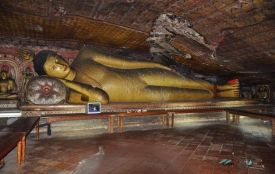
Gal Vihara is among Polonnaruwa’s most visited monuments, known for its rock-cut Buddha figures. The Central Cultural Fund presents the sculptures as a central achievement of the city’s artistic legacy. Take time to observe the scale and placement of the figures without touching them or treating a sacred place as a backdrop for casual posing. Quiet attention is more fitting than rushing from one photograph to another.
Other landmarks broaden the story: the Alahana Parivena monastic complex, the great stupas of Rankot Vehera and Kiri Vehera, the image houses of Lankatilaka and Tivanka, and the Lotus Pond. The CCF also describes Hindu shrines built in South Indian traditions. Together, these remains show that medieval Polonnaruwa was not a single-purpose Buddhist complex but a diverse urban and religious landscape.
Architecture, sculpture and a city’s long afterlife
Polonnaruwa’s builders used brick extensively, particularly in vaulted buildings known as gedige. The CCF notes that brick construction made it possible to erect many buildings within a comparatively short period. Large image houses such as Lankatilaka, Tivanka and Thuparama preserve the scale of that ambition, while the city’s stupas continued a monumental tradition also seen at Anuradhapura.
The royal palace attributed to Parakramabahu I is among the site’s most striking remains. Its massive brick walls survive to a height of about two storeys. Historical chronicles describe a seven-storey building with a thousand rooms, but that account is a textual tradition, not a full structure visible today. The contrast between the surviving masonry and the historical description invites visitors to separate physical evidence from written accounts.
Artistic forms also reveal connections across traditions. The CCF describes Hindu shrines built according to South Indian architectural practices and Hindu figures incorporated into sculptural programs. Buddhist image houses can carry ornament influenced by Hindu temple design, while Polonnaruwa’s sculpture includes both Buddhist and Hindu subjects. These features point to a complex cultural setting rather than a neatly divided religious landscape.
The city declined from the mid-thirteenth century amid invasions, political turmoil and environmental factors. Interest in recovering the monuments grew in the nineteenth century, and the Archaeological Department was established in 1890. Since 1980, the Central Cultural Fund has taken part in conservation, site management and archaeological research. The modern visit is therefore also an encounter with an ongoing effort to document and protect the ruins.
Tickets, opening hours and respectful travel
The CCF’s current visitor information lists Polonnaruwa’s heritage site as open daily from 7 a.m. to 5 p.m., with online booking available and admission valid for a single entry. The ticket counter follows the same published hours. Schedules and procedures can change, so check the Central Cultural Fund’s official ticket page shortly before travel and confirm the latest instructions for collecting or displaying tickets.
Ticket prices are updated frequently and vary with exchange rates, according to the CCF; use the current pricing page rather than a fixed amount copied from an older travel article. Online orders are valid for a stated period, but site entry is subject to the conditions shown when you book. The Polonnaruwa Museum is listed as open from 8 a.m. to 5 p.m. and included with the site ticket.
Give the archaeological area enough time. The monuments are separated, and the dry-zone climate can make walking tiring, especially around midday. Plan water, sun protection and transport between clusters. If you are traveling in a group or have mobility needs, check available services in advance; do not assume that every path has shade, seating or step-free access.
Polonnaruwa is both an archaeological landscape and a place of religious meaning. Follow posted instructions at sacred monuments, do not touch sculptures, and avoid disrespectful poses or turning your back to Buddha images for photographs. The CCF requires prior written permission for professional filming and drone use; commercial photography should also be confirmed with the authority. The ruins reward patient attention: their story emerges through reservoirs, brick, sculpture and the communities that continue to care for them.