About Parinirvana Stupa
A stupa beside one of Buddhism’s most important pilgrimage sites
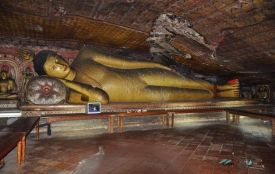
In Kushinagar, in Uttar Pradesh, the Parinirvana Stupa stands beside the shrine that houses a monumental reclining Buddha. Buddhist tradition identifies this region with the Buddha’s final passing into parinirvana, making it a place of deep religious meaning for pilgrims. The stupa and shrine are closely related in the visitor’s experience, but they are distinct monuments: the image is inside the Mahanirvana Temple, while the stupa rises next to it. Keeping that distinction clear helps a traveler read the site rather than treating every structure as one building.
The district administration’s account describes the stupa as a major archaeological monument excavated under A.C.L. Carlleyle in 1876–77. The nearby reclining Buddha image, recovered during the same work, is 6.1 metres long and carved from a single block of sandstone. An inscription associated with the statue records it as a religious gift from Haribala. These are archaeological and inscriptional details reported by the district source; they should be kept separate from the religious tradition about the Buddha’s final days, which is a matter of faith and sacred memory.
The stupa is not simply a backdrop for the reclining figure. The district guide gives its height as 19.81 metres and notes that the temple and stupa assumed their present form in 1956, during the 2,500th anniversary observances of Buddha Jayanti. The principal stupa and the shrine in front of it share a raised platform. Seen together, they show how excavation, restoration and devotional use have shaped a pilgrimage landscape over time.
What the excavations revealed—and what they cannot prove
The ruins gained renewed attention in the nineteenth century, when archaeological surveys and excavations began to identify and expose Buddhist remains. The district’s Hindi history recounts that Alexander Cunningham and later C.L. Carlleyle worked at the site; Carlleyle’s 1876 excavation exposed the main stupa and found the long reclining Buddha image. Archaeology can document structures, inscriptions and objects, but it does not independently verify every element of a religious narrative. A careful visit can hold both ideas together: the site is sacred to Buddhists, and its physical history is studied through evidence.
The reclining Buddha is especially important because of its scale, material and setting. The figure rests on its right side, with the head supported by the right hand, and is displayed within the temple. The government description interprets the west-facing image as possibly suggesting the sunset of the Buddha’s life; that interpretation is presented as a possibility, not a proven intention of the sculptor. Visitors should distinguish the original image from the structure that now protects and displays it.
After the main nineteenth-century excavations, Kushinagar also became a functioning pilgrimage destination again. The district history says the Burmese monk Chandra Swami came to India in 1903 and made the Mahanirvana Temple a living shrine. This is a useful reminder that archaeological discovery did not replace religious practice. The temple and stupa continue to occupy a place in Buddhist devotion, and visitors should give worshippers room, keep noise low and follow rules on photography or access.
Nearby monuments and a broader Kushinagar visit
Matha Kunwar Shrine is a separate nearby monument, not another name for the Parinirvana Stupa or the Mahanirvana Temple. The district’s official guide places it southwest of the Parinirvana shrine, about a furlong away, and describes the Buddha image there as a 3.05-metre sculpture dating to the tenth or eleventh century. It is carved from a single blue stone said by the guide to come from the Gaya region. Excavation found the shrine within a larger monastic complex measuring about 34.75 metres square, with seals dated to the tenth and eleventh centuries.
Another important place in the wider Kushinagar pilgrimage landscape is Ramabhar Stupa, traditionally associated with the Buddha’s cremation. It is a different site, not part of the Parinirvana shrine compound. The district’s tourist-place listings identify it separately. Because accounts of sacred geography are shaped by religious tradition and archaeological interpretation, use the word “traditionally” when describing that association rather than presenting it as a modern excavation finding.
A thoughtful itinerary can take in the Mahanirvana Temple and Stupa, Matha Kunwar, and other Buddhist temples in town, while allowing time to pause at each. The broader district has temples representing several Buddhist communities and countries, but each has independent opening arrangements. Do not assume they share a single ticket or timetable. The central site is powerful partly because it combines a major sculptural image, a stupa, excavated remains and ongoing acts of pilgrimage within a compact area.
Access, hours and practical planning
The Kushinagar district’s official visitor pages provide location and access information but do not publish a consolidated, clearly current daily schedule or admission fee for the shrine and stupa. This article therefore does not state a definite opening time or ticket price. Check with the district administration or local site staff before traveling, especially around religious observances, public holidays or maintenance periods. Online listings from older years may no longer reflect current practice.
The district source gives Gorakhpur Airport as approximately 53 kilometres from the site and Deoria Sadar as the nearest railway station, about 35 kilometres away. These are approximate distances, not door-to-door journey times; traffic, road conditions and transport availability vary. The district pages mention access by road and buses from Gorakhpur and Deoria, but do not provide a current timetable. Confirm transport options locally and allow extra time rather than planning around an unverified departure schedule.
Kushinagar is in eastern Uttar Pradesh, and the district’s official tourism material uses Hindi as well as English. Travelers can use the locality name कुशीनगर when arranging transport or asking for directions. For the temple visit, dress modestly, speak quietly and follow instructions about footwear, photography and movement around worshippers. If you have limited mobility, ask locally about the surface and access route; the official information consulted does not provide detailed accessibility specifications.