About Angkor Wat
Angkor Wat is the temple most travelers picture when they hear “Angkor,” but it is only one monument within a much larger archaeological landscape. The temple stands in Siem Reap province, Cambodia, and remains an active sacred place as well as a major visitor destination. Understanding that distinction changes how a day here feels: the great towers and galleries are not an isolated backdrop, but part of a Khmer cultural landscape still connected to worship, local communities and ongoing conservation.
A Khmer royal temple that remained sacred
The official Khmer-language Angkor Enterprise guide says Angkor Wat was built in the early twelfth century under King Suryavarman II, as a state temple dedicated to Vishnu. It was conceived during the Khmer Empire’s rule, when Angkor was a royal center. The temple later became Buddhist, a transition the same official account places by the late twelfth century. That history is visible not as a simple change from one era to another, but in a monument that has continued to hold religious meaning.
UNESCO lists Angkor as a World Heritage property, but its listed landscape is much wider than the one temple. The property covers roughly 400 square kilometres and includes remains of successive Khmer capitals, waterworks, routes and settlements. Angkor Wat itself occupies about 162.6 hectares, according to the official Cambodian ticketing site. Keeping those scales separate matters when planning: an Angkor pass is for the wider archaeological park, not a timed ticket that reserves a particular hour inside this single temple.
The place’s international status also has a history. Angkor was inscribed on the World Heritage List in 1992 and was removed from the List of World Heritage in Danger in 2004 after conservation work and management measures. UNESCO describes the site as inhabited, with villages and communities living within the wider park. Its meaning therefore cannot be reduced to a collection of ancient stones; preservation must account for both monuments and the people whose lives remain connected to them.
For visitors, that living context is a reason to slow down. Angkor Wat is still used as a place of worship, and conservation is an ongoing responsibility rather than a completed restoration story. The Cambodian APSARA National Authority asks guests to be considerate of worshippers and monks, dress appropriately, avoid touching or climbing the structures, and take rubbish away. Following those rules is not a side issue: it is part of visiting a sacred and protected landscape well.
Architecture shaped around a sacred landscape
The Khmer-language visitor guide describes Angkor Wat as combining the temple-mountain plan with galleries arranged in rising rectangular enclosures. Five towers stand at the center, a design associated with Mount Meru in Hindu cosmology. The composition draws the eye inward and upward, from the broad moat and outer wall toward the central sanctuary. The design is monumental, but its effect depends on a carefully ordered sequence of thresholds, courtyards and elevated galleries.
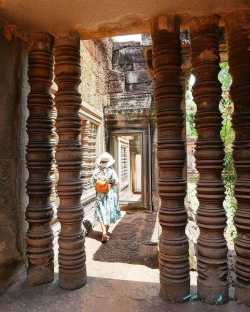
The official account gives the outer wall a length of about 3.6 kilometres and describes three ascending gallery levels. Visitors often focus on the central towers, yet the long corridors and carved bas-reliefs are equally important to understanding the complex. The reliefs and repeated figures reward patient observation: instead of rushing from one photograph to another, pause to notice how narrative, ornament and architecture share the same stone surfaces.
Angkor Wat faces west, unlike many other Angkor temples. The Cambodian guide notes that researchers have offered different explanations for this orientation, so it is better not to present one theory as settled fact. The temple’s history of Hindu dedication, later Buddhist use and continued sacred role adds layers to the visitor’s experience. Look closely at the whole plan rather than searching for a single symbolic explanation that would make the monument simpler than the evidence allows.
Sunrise is famous here, but it is not the only rewarding time to visit. Early arrivals can encounter crowds around the western approach and reflection pools; later hours can offer more time to notice the galleries and bas-reliefs. Conditions vary by season and day. The important preparation is to check the current route and site notices from APSARA and the official ticketing service, then allow enough time to move respectfully through a large, busy religious complex.
Tickets, timing and a more considered visit
Angkor Enterprise is Cambodia’s official online ticket service. When checked on 3 October 2026, its page listed a one-day Angkor Temples Park pass at US$37, a three-day pass at US$62 and a seven-day pass at US$72. It stated that the three-day product expires after seven days and the seven-day product after 30 days. The same page listed general park entry from 5:00 a.m. to 6:30 p.m. Prices, access rules and temple-specific hours can change, so confirm them before paying.
The ticket covers access to the archaeological park and many temples; it does not guarantee that every chamber or upper level is open at every moment. Conservation work, religious observances, weather and safety arrangements can affect access. The official pass site reported 508,007 purchases by foreign tourists from 1 January through 28 September 2026. That is a dated count of park passes, not a headcount for Angkor Wat alone, and it signals why popular points can feel busy even when the wider park is extensive.
Give yourself time to see the temple as architecture, not just a sunrise viewpoint. Comfortable footwear helps on long routes and uneven stone; modest clothing and a light layer can make an early start easier. Carry water, use marked paths and follow staff instructions around restricted areas. If you are visiting other temples in the park on the same day, plan transport between them rather than assuming the whole Angkor complex is within a short walk.
Most of all, let the site set the pace. The strong impression comes not only from the towers against the sky, but from the way a royal Khmer monument has remained part of Cambodian religious and cultural life. A thoughtful visit leaves room for silence, for careful looking and for the people who still come here to worship. Angkor Wat’s scale is extraordinary; its continuity is what makes the encounter stay with you.