About Gangō-ji
Gangō-ji: the remains of a foundational Buddhist institution
Gangō-ji stands within Naramachi, but its history begins at Asuka-dera, also known as Hōkō-ji, traditionally regarded as Japan’s first full-scale Buddhist temple. When the capital moved to Heijō-kyō in 710, the institution was transferred and rebuilt in Nara under the name Gangō-ji. Its original precinct once occupied a far larger part of today’s neighbourhood.
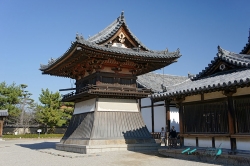
Fires, political change and urban growth reduced that complex over centuries. The surviving Gokurakudō hall and Zen room preserve the memory and material of the monastic quarters rather than the vanished monumental core. Both are National Treasures, and the precinct forms part of UNESCO’s Historic Monuments of Ancient Nara.
Ancient timber, roof tiles and popular devotion
Rows of early roof tiles remain visible on the temple buildings. Some were carried from Asuka and have been studied as unusually old surviving roofing material. Timber and bracket elements also help researchers trace construction practice across the capital’s transfer. Visitors should look at these details instead of expecting the scale of Tōdai-ji.
The treasure collection includes a miniature five-storey pagoda, Buddhist images and objects linked with Pure Land devotion. Stone memorials and Jizō figures in the grounds record later popular practice. Gangō-ji is therefore not a ruin frozen in the eighth century but a religious place repeatedly adapted by monks and townspeople.
- Begin with the Gokurakudō and examine the contrasting roof tiles from the courtyard.
- Follow photography rules around sacred images and special exhibitions.
- Keep voices low; worship continues during public visiting hours.
- Combine the temple with a respectful walk through Naramachi rather than rushing onward.
Verified 2026 visitor information
The temple’s Japanese and English guide lists opening from 9:00 a.m. to 5:00 p.m., with final entry at 4:30. Admission is ¥700 for adults, ¥500 for junior-high and high-school students and ¥300 for primary pupils. During the autumn special exhibition, the respective prices rise to ¥800, ¥600 and ¥400. Disability reductions and group rates are defined by the temple.
Gangō-ji is at 11 Chūin-chō, approximately 15 minutes on foot from Kintetsu Nara Station and 20 minutes from JR Nara Station. City buses stop within a short walk. A small free car park exists, but central Nara traffic and limited capacity make walking or public transport preferable.
Choosing the correct Gangō-ji
Naramachi also contains a separate temple at the historic pagoda-site precinct, with its own weekend-focused schedule. Travellers searching maps must use the official address and website for the World Heritage Gokurakubō complex described here. Do not combine the two sets of hours.
Gangō-ji rewards close attention. Old tiles, reused structural members and compact monastic halls make the transfer of Buddhism into Japan’s first planned capitals tangible. Its modest scale is precisely what allows architecture, continuing faith and the surrounding town to remain in the same story.