About Yakushi-ji Temple
A vow for healing that became a Nara landmark
Yakushi-ji’s origin is tied to a personal crisis in the imperial household. In 680, Emperor Tenmu vowed to establish a temple and make an image of Yakushi Nyorai, the Buddha of healing, for the recovery of his consort, who later became Empress Jitō. The official temple chronology records the principal image’s consecration in 697, before the compound moved from Asuka to the new capital of Heijō-kyō. The story links the temple’s founding to a vow for health, but the site that visitors see today also reflects centuries of religious practice, fire and reconstruction.
Yakushi-ji became one of the major state temples associated with the Nara capital. Its layout and sculpture expressed more than imperial patronage: the temple served as a place of worship, learning and ritual centered on the Yakushi Triad. Yakushi Nyorai is flanked by the bodhisattvas Nikkō and Gakkō, associated with the sun and moon. The group gives the main hall its spiritual focus, while the symmetrical arrangement of halls and pagodas makes the precinct legible as a planned sacred landscape.
The temple belongs to the Hossō school of Japanese Buddhism and remains an active religious institution. That continuity matters when visiting. The grounds are a heritage destination, but they are also used for prayer, ceremonies and daily temple life. Approaching Yakushi-ji as both a historic monument and a functioning place of practice helps explain why its architecture is carefully maintained and why visitors should follow local guidance rather than treating every space as a museum gallery.
The East Pagoda and a precinct rebuilt over time
The East Pagoda, Tōtō, is the one major structure that survived from Yakushi-ji’s founding-era precinct. It is a National Treasure and a rare architectural witness to the temple’s early history. Its appearance is unusual: the stacked rooflines create the impression of six levels, although the tower is structurally three stories with smaller roofs between the main tiers. This visual rhythm, often described as a “frozen” or “frozen music” effect, is an interpretation of the pagoda’s form rather than a documented statement by its builders.
The West Pagoda, Saitō, is not an ancient twin surviving unchanged. It was destroyed in a fire in 1528 and reconstructed in 1981, restoring the paired composition of the precinct. The contrast between the older East Pagoda and the rebuilt West Pagoda makes Yakushi-ji a place to consider conservation as an ongoing choice: rebuilding can recover a spatial idea, while the surviving original carries material evidence from an earlier era. Neither story should be mistaken for a single untouched view of the eighth-century temple.
The Kondō, or Main Hall, houses the Yakushi Triad, while the Daikōdō and other buildings organize the broader precinct. Buildings have been rebuilt at different times, and access to individual halls may change with ceremonies, maintenance or special schedules. The official visitor information describes what is included in regular admission; check the temple’s latest notices if a particular building or object is essential to your visit. The site is best explored slowly, looking across the axial arrangement as well as at the sculpture within.
The Yakushi Triad and the meaning of the visit
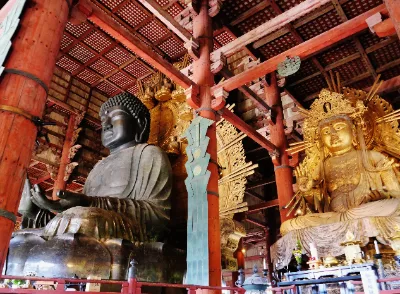
At the heart of the main hall is Yakushi Nyorai, whose name is commonly rendered as the Medicine Buddha. In Buddhist devotion, Yakushi is associated with healing and the alleviation of suffering. The statue is accompanied by Nikkō and Gakkō, bodhisattvas linked to the light of the sun and moon. The group is more than a centerpiece: its arrangement invites visitors to understand the hall as a place of prayer and a setting for Buddhist teachings about compassion, illness and care.
Yakushi-ji’s official history ties the image to the founding vow of Emperor Tenmu and the recovery of his consort. This is the temple’s historical account of its origin; it should not be confused with a modern medical claim or a guarantee of healing. Visitors may come for religious reasons, artistic interest or both. A respectful visit leaves room for those different purposes and recognizes that the images remain sacred to worshippers.
Yakushi-ji offers visitors a chance to slow down, but it is not necessary to arrive with specialist knowledge. Read the temple’s interpretation, notice the difference between original and reconstructed structures, and allow a few quiet moments in the precinct. The temple FAQ estimates that a standard visit to the halls takes about 30 minutes; that is a practical minimum, not a recommendation to rush. Additional time is worthwhile for the pagodas, the museum or a guided explanation if available.
Opening hours, fees and how to plan
Yakushi-ji’s official visitor page currently lists the paid precinct as open from 9 a.m. to 5 p.m., with last admission at 4:30 p.m. The stated general admission is ¥1,000 for adults, ¥600 for middle- and high-school students, and ¥200 for primary-school children. The standard ticket includes access to the Kondō, Daikōdō and Tōindō as specified by the temple; special exhibitions or event arrangements may differ. These are the figures published when this article was checked, so confirm the official page before travel.
The temple FAQ says a basic visit through the halls takes around 30 minutes. That estimate can help fit Yakushi-ji into a Nara itinerary, but it does not include travel to the site, time to read exhibits, or waiting during a busy period. Visitors with a particular interest in Buddhist sculpture or the East Pagoda should plan longer. The official FAQ also notes that the temple does not itself provide a monastic guided tour; volunteer guide arrangements may be available, but should be checked in advance.
Before setting out, check current opening notices, admission details and any ceremony-related restrictions. Give yourself time to enter before the final-admission cutoff, and dress and behave respectfully in halls where worship takes place. Yakushi-ji is compelling because its story joins a vow for healing, a remarkable early pagoda, a rebuilt counterpart and a living Buddhist community. The most memorable visit is not just a checklist of buildings, but an encounter with how a sacred landscape has been preserved and renewed over more than a millennium.