About Palace of Diocletian
A Roman palace that became part of Split
In Split, Croatia, Diocletian’s Palace is not a freestanding ruin beyond the city. Its walls and ancient spaces are woven into the old town, where homes, shops, cafés and religious buildings occupy the historic complex. The emperor Diocletian commissioned the residence near Salona, the Roman provincial centre close to his birthplace. Split’s tourist board dates the beginning of construction to 293 and describes a building project of about a decade; other official descriptions place the completed complex around 305, when Diocletian retired from power.
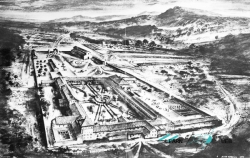
The palace was planned as both a luxurious imperial residence and a fortified compound. The Croatian-language city guide describes a roughly rectangular plan about 215 by 180 metres, divided into four sectors by two principal streets. The southern part was intended for the emperor’s apartment and ceremonial functions; the northern part accommodated the guard, servants and storage. Towers and gates formed part of the defensive design. These divisions help visitors read the site, although centuries of rebuilding have changed many individual structures.
Diocletian’s retirement gave the complex a personal dimension unusual in Roman imperial history. He left the throne in 305 and moved to the residence, rather than returning to rule after the political system he had established began to falter. Later residents did not preserve the building as a sealed archaeological exhibit. They adapted its rooms and walls to new purposes, and the city expanded around and within them. That continued use is why Split’s old centre feels inhabited rather than staged.
Peristyle, cathedral and the underground halls
The Peristyle, the palace’s ceremonial courtyard, remains one of the clearest places to understand its original scale. The principal streets meet in this central area, and the surrounding architecture connects imperial and religious spaces. The former mausoleum of Diocletian later became the Cathedral of Saint Domnius. The Split tourist board describes the change as a striking historical reversal: a building associated with an emperor who persecuted Christians became a Christian cathedral by the seventh century. The transition is visible in the reused Roman structure, not just in a museum label.
Nearby, the Temple of Jupiter and the substructures beneath the southern part of the palace add other dimensions to the visit. The Split City Museum explains that these lower halls helped level the southern side of the site and supported the emperor’s apartments above. Their plan preserves evidence of the upper residence that has been more heavily altered over time. In the Middle Ages, debris from the upper buildings accumulated below; restoration and conservation later made sections accessible, with the western halls opening to visitors in 1959 and the eastern halls in 1996.
The palace should not be mistaken for a perfectly preserved single-period reconstruction. The protected area includes remains from Roman, medieval and later centuries, and the museum’s own account describes a sequence of building, reuse, filling and restoration. Look for the way old stonework meets later façades, and for the change in atmosphere between the open Peristyle and the enclosed lower halls. The attraction is not only an emperor’s residence, but the evidence of a city that kept using the same urban core.
UNESCO status and the city around the monument
UNESCO inscribed the Historical Complex of Split with the Palace of Diocletian on the World Heritage List in 1979. The designation concerns more than the palace’s Roman remains: UNESCO’s description includes the medieval cathedral made from the ancient mausoleum, Romanesque churches, medieval fortifications, Gothic palaces and Renaissance and Baroque buildings in the protected area. The official title is therefore a useful reminder that the heritage site is a layered urban district, not a single structure isolated from the life of Split.
That layering is apparent in ordinary movement through the old town. Streets and squares are part of the modern city’s circulation, with residences and businesses close to historic features. Visitors share the area with people who live and work there. Be considerate around doorways and religious spaces, and do not assume that every courtyard or building is a public museum. A walk through the lanes can be rewarding without turning the visit into a race from one named monument to the next.
Split’s tourist board presents the palace as a foundation of the city’s historical identity, while its own short history describes later political periods and the growth of a town around the ancient residence. The result is a compact route through several eras: imperial Rome, a medieval Christian centre, later urban life and the contemporary Adriatic city. Understanding the monument means noticing the joins between those periods, rather than treating every later addition as a distraction from the Roman plan.
Hours, tickets and practical planning
The palace complex does not operate as one museum with a single entrance ticket. Public streets and squares pass through the historic centre, while particular museums, churches, towers and exhibition spaces set their own access terms and hours. The Split City Museum’s page for the substructures listed daily opening from 8:30 a.m. to 8 p.m. when checked in October 2026, with last admission 30 minutes before closing. Schedules can change seasonally or for events, so check the museum’s current notice before planning around the underground halls.
The museum distinguishes the substructures from its other sites, some of which close on Mondays or public holidays. It offers guided tours in Croatian and other languages for individuals and groups, subject to arrangements. The official pages consulted here did not provide a reliable current admission price for the substructures, so this article does not guess one. Confirm tickets, any combination offer and closures directly with the Split City Museum. Admission to one site should not be assumed to cover the cathedral, bell tower or other attractions. For a comfortable visit, start early or later in the day if possible, and leave time for both the Peristyle and the underground halls. The compact core can feel crowded when groups arrive together, while the lower spaces have a different atmosphere from the busy streets above. Wear suitable shoes for old paving and stairs; if mobility is limited, check access details in advance.
Diocletian’s Palace rewards a visit that is both curious and realistic: it is an archaeological monument, a UNESCO-listed historic complex and part of a living coastal city. Read the Roman plan in the gates and streets, then follow later history through the cathedral, substructures and surrounding buildings. Check each attraction’s current hours and price separately, and make room for ordinary city life between the highlights. Split is not merely built beside the palace; it grew through it.