Eltz Castle: nine centuries of family history in the Moselle hills
A castle rooted in the Eltzbach valley
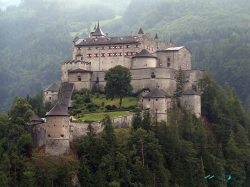
Eltz Castle rises above the Eltzbach stream near Wierschem, in the wooded hills between the Moselle and the Maifeld. Its setting is part of the experience: the approach follows a narrow valley before the buildings appear on a rocky spur, and the irregular outline reflects construction on a confined site. The family’s official history traces the first recorded mention to 1157, when Rudolf of Eltz witnessed a document issued by Emperor Frederick I Barbarossa. The castle grew over centuries rather than emerging as a single finished monument, so its courtyard brings together different building phases and family residences.
In 1268, Rudolf’s descendants divided the castle and estate among three branches, which continued to live together as joint heirs. Their shared arrangement, known as a Ganerben community, shaped the architecture: multiple houses and towers crowded into the available space, and formal agreements regulated common life and upkeep. The result is not a symmetrical palace but a dense cluster of towers, half-timbered façades and rooflines. Visitors see the material record of a complicated household as much as a defensive stronghold, with buildings that accumulated as each branch expanded its own rooms.
Conflict, continuity and a family home
The castle’s survival was not automatic. During the Eltz Feud of 1331–1336, the lords of Eltz opposed the expansion of Balduin, Archbishop of Trier. The official history says a siege castle, Trutzeltz, was built nearby and the fortress was attacked with catapults and heavy stone balls; the conflict ended in surrender in 1333 and a peace treaty in 1336. The defeat reduced Eltz’s fortifications, but the family’s residence was not destroyed. Later, diplomacy and careful stewardship helped the complex pass through periods when many medieval castles were neglected.
Ownership gradually consolidated. In 1815, the Eltz-Rübenach branch sold its share to the Eltz-Kempenich counts, who became sole owners. The family says the castle opened to visitors around 1820, at the beginning of modern tourism in the area. It remains in the hands of the 34th generation, while a professional castle team manages preservation and visitor services. That continuity is unusually tangible: the site’s history is not only presented in rooms but also reflected in the family’s ongoing responsibility for a lived-in heritage property.
Inside the courtyard and treasury
The guided visit introduces selected rooms and the castle’s architectural layers; the official site says tours last about 35 to 40 minutes and begin at regular intervals in the upper courtyard. German tours are the regular format, while English and French tours can be arranged. Visitors may request a free printed tour text in several languages, including Spanish, Chinese and Japanese. The ticket also covers the inner courtyard and Treasury, which can be visited independently. Exhibits are labelled in German, with a free English explanatory flyer for international guests.
The Treasury adds a collection-focused stop to the architectural tour. The official visitor information describes it as accessible with the castle ticket and lists a separate visiting window, while the castle’s rooms and courtyard are experienced as part of the guided route. In 2026, restoration work is underway on timber, plaster and paintwork at the Kempenich House in the inner courtyard and on the carriage house in the outer bailey; the castle notes that some structures are scaffolded. The work is a useful reminder that a medieval site requires continual care, and it may affect the appearance or route during a particular visit.
Season, tickets and ways to arrive
The castle’s 2026 visitor page gives a season from March 29 through November 1, with last admission at the gate at 5 p.m. The standard adult ticket is listed at €14; reduced categories and a family ticket are also available, and children under six enter free. The page says the ticket includes a guided tour, courtyard and Treasury. Its separate tour section says visits last 35–40 minutes and gives a last-tour time of 5:30 p.m., later than the stated 5 p.m. last admission. Because those details conflict, confirm the day’s final entry and tour time with the castle before making a late arrival. Prices and seasonal dates can change in future years.
By public transport, the official site describes a train to Hatzenport followed by regional bus 365 to the castle car park; during its listed season the bus runs twice an hour. The castle is also approached on foot from Moselkern, about 2.5 kilometres and 45 minutes by the published route, or from Karden, around six kilometres and two hours. These are walking estimates, not a promise that every route suits every visitor. The site lists a restaurant and shop in the outer bailey, prohibits animals inside the castle rooms and forbids drones. Check transport timetables, trail conditions and current restoration notices before setting out; Eltz rewards the journey when it is planned as carefully as the visit itself.