Krásna Hôrka Castle: medieval stronghold, Andrássy museum and restoration update
A hilltop castle with three connected chapters
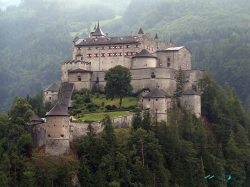
Krásna Hôrka rises above Krásnohorské Podhradie in eastern Slovakia, near Rožňava. It is not a single uniform building but a complex of Upper, Middle and Lower Castle, each with a different architectural and historical development. The Slovak National Museum describes the Upper Castle, on a rocky summit, as the oldest section; its Gothic tower and palace, later additions and artillery terrace show how a medieval stronghold accumulated new layers. The three parts matter today because restoration must address them as a connected site while treating their distinct structures carefully.
The castle began in the thirteenth century as a guard post on an important trade route from Transylvania through Košice toward Spiš and Poland. The Bebek brothers began building it after acquiring extensive lands in Gemer. A short interval of control by the Máriássy family interrupted Bebek rule, which lasted from the middle of the thirteenth century to 1566. After the Bebeks died out in the male line, the estate passed to the royal court and was administered by captains appointed by the Hungarian king.
From a border stronghold to an Andrássy residence
Peter Andrássy became castle captain in 1578. His grandson, also named Matthias, obtained Krásna Hôrka and its estate as hereditary property in 1642 from Ferdinand III, king of Hungary and Holy Roman Emperor. The Andrássys expanded the castle over time, turning a fortified seat into a more elaborate noble residence. Its architecture therefore records shifting needs: defence, administration, family life and, eventually, museum display.
One striking transformation took place in a large bastion. After 1770, the family built a castle chapel there, with a classical interior, and established an Andrássy family tomb nearby. The result was not simply a decorative addition: a military structure became a religious and commemorative space. The contrast between thick defensive masonry and intimate memorial rooms is one reason the castle’s separate wings and levels tell different stories rather than forming one period-perfect design.
A museum before the modern restoration story
The site’s museum history began in the nineteenth century. After 1857, Count György Andrássy arranged a family museum in several rooms, using surviving furnishings, weapons and armour. The Slovak National Museum says visitors could see the collections from 1867. In 1904, Count Dionys Andrássy expanded the museum section and created the Francis Museum in honour of his wife, Františka Hablawetz, displaying her personal belongings. These details make the castle more than military architecture: it also became a place where a noble family organized and presented its own past.
Krásna Hôrka was declared a national cultural monument in 1961 and became part of the Slovak National Museum in 1996. Its long museum use helps explain why the 2012 fire was a cultural loss as well as a building emergency. The fire caused substantial damage, particularly in the Upper Castle, where it affected structural elements and historic interiors. The museum’s current account emphasizes the different damage and conservation needs across the three connected sections; it does not support reducing the event to a simple story about one cause or one repair.
What the 2026 restoration update says
In an update dated 6 August 2026, the Slovak National Museum said its work during 2025 and 2026 was focused on structural assessments, design documentation, specialist research and defining the remaining scope. It reported that rubble and construction waste had been removed from the Upper Castle in spring 2026. The same notice said further archaeological research was planned for summer 2026; it did not report the completed results of that work, so this article does not assume what it found.
The museum reported that about 80 per cent of the construction and conservation interventions planned for the Middle and Lower Castle for 2022–2025 had been completed. That figure applies only to those planned works in those two sections, not to the entire castle complex. The Upper Castle still needs extensive exterior, interior and technical work, including coordinated fire protection. The museum says the overall project was reorganized as one coordinated restoration because roof structures, structural engineering and the sequence of building and conservation work affect one another.
Why restoration is being coordinated across the complex
The stated aim is to remove interventions from the second half of the twentieth century that are considered unsuitable for the heritage site and to bring the castle as close as possible to its appearance in 1903–1905, when the Andrássys carried out a major reconstruction. The museum says traditional craft methods, historically appropriate materials and specialist research will guide the work. Modern systems are also planned, but are to be integrated carefully to improve fire protection, operational safety and visitor comfort without compromising heritage values.
The project also anticipates better visitor facilities in the area below the castle, including parking, an information centre, provisions for people with reduced mobility, refreshments and other services. These are elements of the planned project, not services visitors should assume are already open. The museum has said that a reliable construction and reopening timetable can be set only after public procurement and handover of the work to a contractor. Its August 2026 notice did not give a reopening date.
Visiting now: treat the castle as closed
The Slovak National Museum’s visitor page states that Krásna Hôrka Castle is closed to the public because of reconstruction. There are consequently no current castle opening hours or ordinary admission arrangements to plan around. Do not set out expecting to tour the interiors, chapel, museum rooms or upper fortifications. Before travelling to Krásnohorské Podhradie, check the museum’s official notice for any change in access; construction schedules and site restrictions can change as work advances.
For now, the most useful way to approach Krásna Hôrka is as a conservation project whose history remains visible in its layered architecture. The medieval trade route, Bebek and Andrássy ownership, the family museum and the fire all belong to different periods, and the restoration has to reconcile them without pretending the castle can be returned to a single untouched moment. When the museum publishes a confirmed timetable and visitor information, those details will determine how a future visit can be planned. Until then, the honest travel advice is simple: learn the story, verify the closure, and wait for official confirmation before expecting entry.