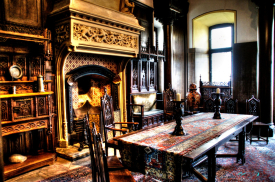
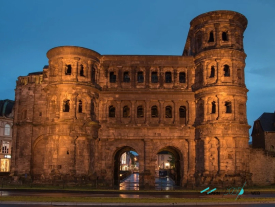
Eltz Castle rises above the Eltzbach stream near Wierschem, in the wooded hills between the Moselle and the Maifeld. Its setting is part of the experience: the approach follows a narrow valley before the buildings appear on a rocky spur, and the irregular outline reflects construction on a confined site. The family’s official history traces the first recorded mention to 1157, when Rudolf of Eltz witnessed a document issued by Emperor Frederick I Barbarossa. The castle grew over centuries rather than emerging as a single finished monument, so its courtyard brings together different building phases and family residences.
In 1268, Rudolf’s descendants divided the castle and estate among three branches, which continued to live together as joint heirs. Their shared arrangement, known as a Ganerben community, shaped the architecture: multiple houses and towers crowded into the available space, and formal agreements regulated common life and upkeep. The result is not a symmetrical palace but a dense cluster of towers, half-timbered façades and rooflines. Visitors see the material record of a complicated household as much as a defensive stronghold, with buildings that accumulated as each branch expanded its own rooms.