Royal Palace of Madrid: history, art and how to visit
Madrid’s royal palace, still a stage for state life
The Royal Palace of Madrid is often approached as a monumental façade at the western end of the city centre. Its role is more layered: it is the official residence of Spain’s head of state, but the royal family lives at the Palace of Zarzuela, and the larger palace is used chiefly for ceremonies, receptions and other formal occasions. Patrimonio Nacional, the public institution responsible for royal sites, administers it and opens much of its interior to visitors when state business allows.
The scale can be hard to picture from the plaza. Patrimonio Nacional describes a building of roughly 135,000 square metres and 3,148 rooms. A public visit follows a selected route rather than giving access to the entire complex. The palace remains part of the country’s representational life, and a ceremony can change access even when the published calendar shows ordinary opening hours.
Its location makes the palace easy to connect with a wider walk through historic Madrid. The main entrance faces Plaza de la Armería; Plaza de Oriente and the Teatro Real lie to the east, while the Campo del Moro gardens descend behind it toward the Manzanares. The Ópera metro station is a practical arrival point, and the surrounding streets help frame the palace as a working ceremonial institution.
For travellers, that combination is the key to planning. The palace’s official ticket service provides the current calendar, visiting rules and available tours; those details can change for official events or operational reasons. Use a date-specific ticket rather than an old guidebook or search snippet, and arrive with time to appreciate the approaches and surrounding squares.
From the Alcázar to the Bourbon palace
The present building occupies a site associated with Madrid’s earlier fortress-palace, the Alcázar. The medieval stronghold developed from an Islamic-era defensive settlement and became a royal residence after the Christian conquest of Madrid. When Philip II established his court in Madrid in 1561, the city’s political importance rose sharply, and the Alcázar served as a central royal residence for generations.
A fire on 24 December 1734 devastated the old Alcázar. Philip V ordered a new palace, and construction began in 1738. The architect Filippo Juvarra prepared an ambitious design; after his death, his pupil Giovanni Battista Sacchetti adapted the project to the existing site. Other architects and craftsmen contributed as the building took shape.
Charles III began living in the new palace in 1764, giving the building a residential role that lasted until the early twentieth century. Alfonso XIII was the last monarch to live there permanently. Manuel Azaña, president of the Second Republic, later occupied rooms as head of state, when the palace was known as the Palacio Nacional. The succession reflects changes in Spain’s political institutions as well as royal taste.
The palace’s official status has continued although the monarch does not live there. It accommodates state ceremonies while operating as a heritage site on visitor days. A room may be presented through its historic decoration, yet the building still carries protocol and public symbolism. The difference between an official residence and the royal family’s home is central to understanding the palace now.
Rooms, collections and what to notice inside
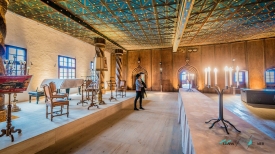
The visitor route reveals an interior designed to communicate authority through architecture, surface and art. Grand staircases and reception rooms establish a formal sequence, while painted ceilings, tapestries, mirrors, carved wood and stone create changing effects from one chamber to the next. Notice how scale and decoration guide visitors from public ceremonial spaces toward more private court settings.
Among the collections are works associated with Diego Velázquez, Francisco de Goya and Caravaggio, alongside frescoes by Giovanni Battista Tiepolo and Anton Raphael Mengs. The Royal Armoury, porcelain, clocks, furniture and silverware broaden the story beyond painting, showing how a court assembled and displayed material culture.
Patrimonio Nacional has recently expanded the experience. Its 2025 annual report records that the antechapel and sacristy, closed to the visitor route for more than four decades, opened on 26 March 2025, and that the office of Charles III opened on 9 September 2025. These rooms add context to the Royal Chapel and the eighteenth-century monarch’s world; check whether they are included on your visit date.
A useful visit does not require rushing through every room. Notice the materials and the relationship between court life and government ceremony. An audio guide or guided visit can help separate original functions from later interpretation. Photography rules, room access and temporary closures are set by the site, so follow staff instructions.
Planning a visit without relying on outdated details
When checked on 8 October 2026, Patrimonio Nacional listed winter hours from October through March as 10:00 to 18:00 Monday to Saturday and 10:00 to 16:00 on Sundays; summer hours from April through September were 10:00 to 19:00 Monday to Saturday and 10:00 to 16:00 on Sundays. Ticket-office and entry access end one hour before closing. These are a dated snapshot, not a promise for a later trip: confirm the official calendar for your exact day, especially around holidays and ceremonies.
The ticket portal lists full or partial closures and warns of additional closures for official events. It offers self-guided and guided formats, while combined tickets may have separate conditions for the Gallery of the Royal Collections. Check what a ticket includes before paying and use the official Patrimonio Nacional booking site.
Allow time for security and keep luggage modest. The ticket information advises against large backpacks, suitcases or bulky packages during improvement work. If you also want to see the exterior, gardens and plazas, plan a broader visit: the self-guided rooms alone are estimated at about 45 minutes, excluding queues and security.
The Royal Palace is most rewarding when its ceremonial present and layered past are read together. It is a vast eighteenth-century project built on a site of earlier power, filled with art and objects gathered by a court, and still used for public functions. The most responsible travel advice is simple: verify hours, prices, access and room availability immediately before departure, then let the building’s scale and changing history set the pace of the visit.