Acinipo near Ronda: a Roman theatre on the mesa of Ronda la Vieja
A city on a high limestone tableland
Acinipo stands on the mesa known as Ronda la Vieja, in the uplands of Málaga province. The Andalusian government describes a limestone plateau reaching about 999 metres, with wide views toward the provinces of Málaga, Cádiz and Seville. From this elevated position, the settlement overlooked routes between the Guadalhorce and Guadalete river basins. The landscape is not a backdrop added to the ruins: its defensible height, water sources and nearby mineral resources help explain why people occupied this place for thousands of years.
Archaeological evidence cited by the regional heritage authority reaches back to the Copper Age, around the third millennium BCE. The plateau later came into contact with Phoenician communities on the Málaga coast, was abandoned near the end of the seventh century BCE and was occupied again during the Iberian period from about the fifth century BCE. These layers caution against describing Acinipo as a city that began fully formed under Rome. Its Roman phase emerged from an older and changing settlement.
Roman presence in the area is recorded from 206 BCE. The city grew in the following centuries, acquired monumental public buildings and minted its own coinage, according to the Junta de Andalucía. Its location connected agricultural territory, mineral resources and overland routes. The site is therefore valuable not only for its theatre but for the evidence of a community that adapted to new political powers and used the plateau as an urban setting.
The theatre and the buildings around it
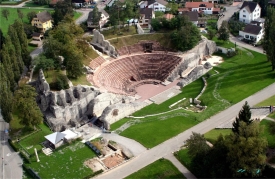
The theatre is Acinipo’s best-known structure and the clearest reason to visit when access is available. The regional government dates its construction possibly to the middle of the first century BCE. Its seating area, or cavea, takes advantage of the natural slope, with parts cut into the rock rather than built on a level plain. The setting makes the relationship between architecture and terrain unusually visible: visitors can see how the builders used the mesa itself to support the audience space.
Acinipo is more than a theatre. The Junta’s visitor material also describes a domus and baths. The baths included a palaestra, a rectangular exercise courtyard bordered by columns. The building was constructed around the turn of the era or earlier, abandoned in the middle of the third century and later reused; in the fourth century, a glass workshop occupied the ruins. These changing uses are a reminder that Roman buildings did not simply disappear when the city’s political importance declined.
The city’s decline is visible in a sequence of reuse and abandonment rather than one sudden end. The official heritage account says the theatre was abandoned around the late second or early third century CE. The domus shifted from private residence to craft use, while the baths were repurposed for industrial activity late in the third century. Administrative control moved to nearby Arunda, now Ronda. From the sixteenth century the ruins became known as Ronda la Vieja, a name that still helps distinguish the ancient site from the modern city.
Reading the landscape and visiting responsibly
The site’s open terrain also calls for practical care. The official visitor leaflet warns that routes cross natural ground, with loose stones and steep sections that may be difficult for people with reduced mobility. It cautions visitors not to approach the precipice edge, especially in windy conditions, and recommends sun protection in summer. After heavy rain, mud can make paths difficult. Do not remove objects, disturb grazing animals or put hands between stones, where the leaflet notes a risk of bites.
At the time the Junta’s live directory was checked for this article in October 2026, it carried a temporary closure notice because of a collapse on the access road. The same official page says the opening calendar is published monthly on the enclave’s Facebook page and gives a telephone contact for updated status. This is a time-sensitive warning, not a prediction of when the road will reopen. Check the current notice and route before setting out; an older leaflet or map cannot confirm that the site is accessible on your travel date.
A Junta visitor leaflet available during research lists free entry, a self-guided route, no on-site guide service and no public transport service. It gives a one-hour estimate for the full walk and 30 minutes for a shorter theatre-only visit, but current access and hours take precedence over those older planning details. If the site is open, arrive with enough time before the last-entry cutoff and consider contacting the tourism office in Ronda for practical updates. Do not plan a visit around a fixed schedule until it has been confirmed.
Planning a trip from Ronda
Acinipo lies outside Ronda, and the Junta’s guide describes access via the MA-7402. Because the live government page has reported damage to the access road, do not rely solely on that route description; confirm the road status and any detour with the relevant authorities before driving. The official leaflet states that there is no public transport to the archaeological zone, so visitors generally need to arrange a car or another confirmed transfer. Avoid assuming that a taxi or bus will serve the site without checking in advance.
Opening hours have been published in an official information leaflet, but the live directory directs visitors to a monthly calendar and warns that access can change. Treat any timetable found in an older guide as provisional. The regional authority’s listed phone number and the current monthly notice are better sources just before departure. Entry has been described as free in the visitor leaflet, but even free admission does not mean the site is open on a particular day.
Those coming from Ronda can combine Acinipo with the town’s other heritage, but the plateau merits its own time. The theatre, landscape and signs of later reuse reward attention; rushing from viewpoint to viewpoint can obscure how the settlement worked. Since facilities and services are limited, bring water, sun protection and suitable footwear if the site is confirmed open, and take all belongings back with you.