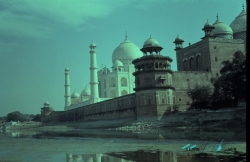
Amber Palace rises on a hill near Jaipur, its sandstone and marble buildings gathered above Maota Lake. From a distance, the walls suggest a fortress; within them, the experience changes into courtyards, audience spaces and royal rooms. That movement between protection and display gives the monument its character. Amber was a seat of government and domestic life as well as a defended height, and its best details reward a slower approach than the distant view suggests.
Also known as Amer Fort, the palace stands roughly eleven kilometres from central Jaipur. India’s national tourism authority dates its commission by Man Singh I to 1592. Successive rulers expanded the complex, so the date marks an important beginning rather than the completion of everything now visible. The sequence of gates and courts records a residence that grew with the needs and ambitions of a ruling household.