Wartburg Castle: Luther’s chamber, Romanesque stone and a remembered Middle Ages
A castle above Eisenach, with more than one past
Wartburg rises on a wooded hill south of Eisenach, its courtyards and roofs gathering above the paths that climb from the town. The setting offers a familiar image of a German castle, but the building rewards a more questioning eye. Medieval masonry, rooms associated with the Reformation and nineteenth-century decoration occupy the same ensemble. Looking for their differences makes the visit richer than imagining an untouched fortress handed down from a single age.
UNESCO inscribed Wartburg in 1999, recognizing both its architecture and its cultural associations. The palace, or Palas, built in the second half of the twelfth century, is an important surviving secular building of the Romanesque period. Later reconstruction gave much of the ensemble its present arrangement. The castle therefore preserves medieval work while also revealing how another century chose to remember, interpret and present that past.
Begin with the relationship between the outer and inner courtyards, then follow the permitted interior route. The Palas, museum rooms and Luther chamber bring together different uses rather than one continuous royal apartment. Each deserves its own historical frame. A room can be important because an event happened there, because its fabric survives, or because later generations made it a place of commemoration; Wartburg contains all three kinds of interest.
The room where a translation became history
Martin Luther stayed at Wartburg in 1521–1522, protected in hiding during the conflict surrounding his religious teaching. Here he translated the New Testament from Greek into German. The work belongs to the history of the Reformation and to the wider circulation of texts in German. It is more precise to identify that particular translation than to suggest he completed an entire German Bible within the walls during this one stay.
The Lutherstube was part of his accommodation, with an adjoining sleeping chamber. The foundation identifies it as the room he occupied, while also explaining that it became a pilgrimage destination during the sixteenth century. The chamber’s importance thus began to develop soon after his departure. Its later life as a place of memory is inseparable from the historical residence, even though the two are different things.
Give the room time without expecting every visible object or arrangement to be an untouched survival from Luther’s working day. The museum route places it within a longer history of preservation and interpretation. The modest scale provides a useful contrast with the great palace rooms: an internationally consequential act of translation is attached to a comparatively contained domestic setting, not to the castle’s most theatrical interior.
Elisabeth, painted memory and the nineteenth century
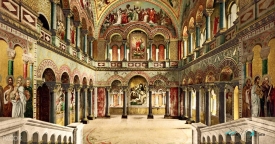
Saint Elisabeth of Thuringia gives Wartburg another powerful association. In the Elisabeth Gallery, her life and the works of mercy unfold in painted scenes. Moritz von Schwind made these frescoes in 1854–1855. Their date matters: they portray a medieval religious story through nineteenth-century art. Describing them simply as medieval wall paintings would erase one of the most interesting layers of the visit.
The gallery invites attention to the relationship between narrative and architecture. Scenes guide the eye along the room, turning memory into a sequence rather than leaving it as a name on a label. They belong to the same broad period of renewed interest that helped shape Wartburg’s present appearance. The castle became a place where history, religious devotion and ideas about cultural identity could be expressed together.
UNESCO’s account emphasizes that nineteenth-century reconstruction is part of the monument’s significance. This makes it worth comparing the older palace fabric with later decorative choices, rather than dismissing everything recent or accepting every surface as medieval. The museum and the rooms are strongest when read together: surviving architecture gives the history a setting, while later art shows how people wanted that history to be understood.
Planning the climb and the winter change
The foundation lists ticket hours of 10 a.m.–5 p.m. through 1 November 2026. From 2 November 2026 to 25 March 2027, they change to 9:30 a.m.–3 p.m. The outdoor grounds have longer hours: 8 a.m.–8 p.m. in the first period and 9:30 a.m.–4:30 p.m. in winter. These are different schedules. Reserve the desired interior visit or audioguide arrangement, and check special-day exceptions before traveling.
Eisenach’s main station connects with bus line 3 to the Wartburg parking area. The final approach includes an uphill route of roughly five hundred metres; an independently operated paid shuttle also runs between parking and castle. Walking paths lead up from the town for those choosing a longer approach. Allow for the climb instead of treating arrival at the parking area as arrival at the interior entrance.
Inside, the Palas, museum and Luther chamber involve three floors, spiral stairs and many steps, with no lift. Outdoor wheelchair access is possible but includes gradients and different surfaces; consult the foundation about individual requirements. Check the exact route and current conditions, then leave time to connect the architecture with its stories. Wartburg’s appeal lies in the encounter between a medieval residence, a reformer’s room and the later generations that gave both a lasting public memory.