Vajdahunyad Castle: Budapest’s walk through history
A castle made to remember a millennium
Crossing from Budapest’s City Park toward Széchenyi Island, a visitor sees towers, a chapel and palatial wings that appear to belong to different centuries. They do. Yet Vajdahunyad Castle is not a medieval fortress slowly enlarged over time. It was conceived by architect Ignác Alpár for the Hungarian Millennium Exhibition of 1896, when the country used architecture to narrate a thousand years since the Magyar arrival in the Carpathian Basin. The result is a deliberate composition of historic forms. Knowing that makes the walk more rewarding: each shift in style is part of an argument about memory, identity and the buildings chosen to represent them.
The first ensemble was temporary, built for the exhibition in materials suited to a fair. Its success led to a rebuilding in durable materials, completed in 1908 according to the City Park authority. The name Vajdahunyad comes from the dramatic castle section, with features recalling the Hunyadi stronghold in present-day Romania. But the ensemble borrows from many buildings across the former Kingdom of Hungary. It is neither a faithful copy of one castle nor a random fantasy. Alpár assembled recognizable architectural fragments into a route through several eras, making an exhibition that visitors could walk through.
There is a useful paradox here. The buildings appear old, while their role as a public attraction and museum is modern. A visitor who knows only the photograph of the Gothic towers can miss the more ambitious story: the castle was built twice because Budapest’s residents and institutions wanted an ephemeral historical display to remain in the city. Its continued use shows that the Millennium Exhibition left more than a commemorative object. It produced a place where the capital still interprets Hungary’s past, even as ideas about that past continue to change.
Reading the architecture, one façade at a time
Start with the Romanesque section and the Ják Chapel. Its portal draws on the church of Ják, a landmark of medieval architecture in western Hungary, while other details in the ensemble refer to historic sites far beyond Budapest. The chapel is not evidence that this island held a medieval abbey. It is a carefully designed quotation. That distinction makes the doorway more interesting: Alpár wanted visitors to recognize a style and a cultural inheritance while standing in a new public park. Pause at the carved forms before moving toward the more martial towers.
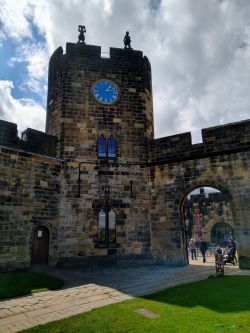
In the Gothic group, the castle-like mass evokes Hunyadi history and the romance of fortified architecture. The City Park authority lists references not only to Hunyad but also to buildings in places such as Brașov and Bardejov. The sources belong to a historical geography that crosses today’s national borders. Rather than trying to identify every borrowed window, notice how the experience changes between bridge, gate, courtyard and tower. The sequence creates the sensation of entering a fortified world, although the complex was always designed as a museum setting.
Renaissance and Baroque elements soften the defensive image into the language of palaces. The park authority points to motifs from Gödöllő and Alba Iulia among the architectural references. The combination is striking because the styles are clearly separated yet held together as a single walk. It is tempting to call the whole building a castle and move on. The better question is why a nineteenth-century exhibition selected these specific forms to stand for a much longer history. The answer is visible in the contrasts: sacred portal, chivalric wall and courtly façade arranged side by side.
Inside: the history of land and work
The Hungarian Museum and Library of Agriculture occupies the ensemble. Its collections give the building a subject quite different from its romantic exterior. According to the City Park authority, permanent and temporary displays address farming, forestry, hunting, fishing, vineyards and wine, domestication, plants and the history of horse keeping. Those themes make sense of the museum’s presence in a park as well as in a historicist monument. They ask how people used land and animals, not simply how rulers represented themselves. Check the current exhibition list before choosing which rooms to prioritize.
The museum’s anniversary in 2026 gives another way to see the site: the institution has been associated with Vajdahunyad for generations, so the castle’s meaning comes from accumulated visits as well as from Alpár’s original scheme. Temporary exhibitions and guided programmes may focus on particular halls or towers. The City Park programme advertises castle discovery tours that examine spaces and stories usually passed by on an exterior stroll. If you want such a tour, book the specific event rather than assuming a general museum ticket includes it.
Outside, give the complex a second circuit after the galleries. From the water and paths of Városliget, the architecture returns to a series of separate silhouettes. The change of perspective helps distinguish the carefully composed exhibition from a genuine defensive castle. It also makes clear why the setting matters: bridge, island, trees and façades were designed to work together. The encounter is free to begin outdoors; entry to the museum and special spaces follows their own arrangements.
Planning a Budapest visit
Vajdahunyad Castle is in Városliget, Budapest’s City Park, on Széchenyi Island. The park’s published guide presents the castle and Ják Chapel as linked landmarks. A useful visit can combine a slow exterior walk with time inside the Agricultural Museum. Museum.hu currently lists the museum’s usual schedule as Tuesday to Sunday 10:00–17:00 from March through October, with shorter weekday hours in winter and Monday closure. Because exhibitions and tower tours can have separate conditions, confirm the current day, ticket and programme with the museum before relying on that schedule.
There is no need to chase every legend associated with the grounds. The statue of the hooded chronicler Anonymus is a familiar landmark, but claims that touching his pen gives a writer inspiration are folklore, not visitor information. More useful is to follow the architectural route: Ják-inspired portal, castle-like Gothic wing, then the calmer palace façades. If time allows, cross the bridge again and look back across the water. The image changes with the light, but the historical point remains the same: this is a twentieth-century permanent building born from a nineteenth-century celebration.
Budapest has many older monuments. Vajdahunyad’s value lies precisely in being younger than it looks. Its borrowed walls reveal what the 1896 exhibition wanted people to remember, while the agricultural collections bring other histories of land and work into the rooms. Visit it as a conversation between the past and the moment that chose to reconstruct that past. The castle’s most convincing feature is not an illusion of age, but how openly it invites you to compare eras.