ABOUT Vajdahunyad Castle
The Vajdahunyad Castle: An Architectural Journey through a Thousand Years of Hungarian History
Crossing one of the four bridges that connect to Széchenyi Island, in the lake of the City Park (Városliget), the visitor is confronted with a monumental optical illusion. Before his eyes rise Gothic towers, Romanesque portals and Baroque palaces, all merged into a single structure. It is Vajdahunyad Castle (Vajdahunyad vára), a building that should not exist, or at least not in this form.
Officially known as the "Historic Building Group", this masterpiece by architect Ignác Alpár is much more than a tourist attraction in Budapest's District XIV; it is the history of Hungary told in stone, brick and, oddly enough, cardboard.
The Castle That Was Built Twice
The story of the Vajdahunyad begins with the patriotic fervor of the late 19th century. In 1896, Hungary was preparing to celebrate the Millennium, the anniversary of the Magyar conquest of the Carpathian Basin in 896. While Parliament debated the possibility of a World's Fair similar to Paris or Chicago, budgetary constraints led to a more intimate but equally ambitious solution: a national exhibition.The goal was bold: to present a thousand years of Hungarian architecture in "three dimensions". Ignác Alpár designed a complex of 21 pavilions that merged replicas of iconic buildings from the Kingdom of Hungary. Due to tight deadlines and the ephemeral nature of the event, the original castle was erected using wood and cardboard.
On October 31, 1896, the exhibition closed its doors and dismantling began. However, the public had fallen in love with the historical fantasy. Popular pressure and the intervention of the Hungarian National Economic Association saved the design from oblivion. Between 1902 and 1908, the castle was rebuilt, this time using durable materials such as stone and brick, to permanently house the Hungarian Agricultural Museum.
On June 9, 1907, Emperor Franz Joseph I inaugurated the exhibitions, sealing the building's fate as a permanent icon of the capital.
A jigsaw puzzle of architectural styles
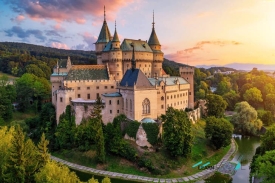
Vajdahunyad Castle is a masterfully executed architectural pastiche. Its popular name comes from its main facade, which is a smaller-scale copy of the Hunyadi Castle in Transylvania (present-day Romania), home of Governor John Hunyadi and his wife Elizabeth Szilágyi.The complex is divided into stylistic sections that guide the visitor through time:.
1. The Romanesque Block
The jewel of this section is the Ják Chapel. Consecrated in 1915 and under the tutelage of the Catholic Church, its façade imitates the famous abbey church of Ják, while its ground plan is based on the church of Lébény. Today, it is an active place of worship and a favorite setting for weddings. Nearby, the Cloister exhibits replicas of pillars and capitals from the Árpád dynasty era, evoking the spirituality of medieval Hungary.
2. The Gothic Group
Crossing the Bridge of Lions and under the Gate of Bridges (Hidas-kapu), we enter the era of chivalry. Highlights include the Apostles' Tower, a replica of the clock tower of Sighişoara, and the imposing Nyebojsza Tower. The inner courtyard, known as the Hunyadi Courtyard, features the Matthias loggia, with reliefs of King Matthias Corvinus and Beatrice of Aragon, recalling the splendor of the early Renaissance at the Hungarian court.
3. Renaissance and Baroque Splendor
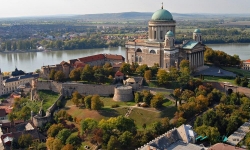
Towards the lake, the architecture softens and becomes more palatial. The German facade, with its sgraffito and 50-meter onion-domed tower, contrasts with the French Tower, which is lower and adorned with dolphins on its crest. The main entrance to the museum is an ode to Austrian Baroque, crowned by a dome inspired by the Charles Gate of Alba Iulia.
Hidden treasures and modern legends
Beyond the architecture, the castle grounds hide figures that attract pilgrims of culture and literature.The castle's most enigmatic statue is a statue of the Austrian monarch.
The most enigmatic statue is that of Anonymus, the notary and chronicler of King Béla III (12th century), whose identity remains a mystery. Depicted with a hood concealing his face, urban legend has it that touching his pen guarantees inspiration for writers and success in the studios.
In a more contemporary twist, one of the castle's niches features a bust of Béla Lugosi, the Hungarian actor who immortalized Dracula, subtly connecting the building's Transylvanian folklore with Hollywood pop culture.
The Interior: Where design meets agriculture
Although the exterior steals the show, the interior of the Agriculture Museum deserves attention for its design. The furnishings and decor, completed in 1912 by Dénes Györgyi, reflect an artistic transition.According to architectural historian Mihály Kubinszky, the furniture is "solid, heavy and richly carved", responding to the monumentality of the surroundings. However, in its simple geometric forms we already glimpse the first glimpses of Cubism and Constructivism that would soon sweep Europe, proving that Vajdahunyad, while looking to the past, always had one foot in the avant-garde.
Visitor's Guide
Location: Városliget (City Park), Budapest. Accessible via the M1 metro line (Széchenyi fürdő station).Hours: The castle courtyards are open 24 hours.
The Hungarian Agricultural Museum is closed on Mondays (all year round).
Open Tuesday - Friday: 10:00 am - 4:00 pm (November 1 - March 31), 10:00 am - 5:00 pm (April 1 - October 31)
Saturday - Sunday: 10 am - 5 pm.
Don't miss: Sunday Mass in the Ják Chapel and the view of the illuminated castle from the lake at night.