About Pannonhalma Archabbey
On a hill above the small Hungarian town of Pannonhalma, a monastery founded more than a thousand years ago remains a working religious community as well as a major cultural destination. The Archabbey’s silhouette is visible across the surrounding countryside, but its story is best understood inside: a Romanesque doorway, Gothic cloister, early Gothic basilica, classical library and newer monastic life occupy one connected landscape. UNESCO inscribed the abbey and its natural environment in 1996. The designation recognizes not a single impressive façade, but a Benedictine institution whose buildings and grounds record centuries of worship, education, rebuilding and adaptation.
A foundation tied to Hungary’s early history
The abbey’s own Hungarian account dates its foundation to 996, when Prince Géza settled monks arriving from Bohemia on the hill known as Pannonia’s Holy Mountain. Dedicated to Saint Martin of Tours, the monastery developed in the period when Hungary’s Christian institutions were taking shape. Its history was never uninterrupted comfort: the community faced invasion, political upheaval and periods of displacement. In the 16th century, the fortified monastery became part of a frontier zone during Ottoman expansion, and monks sometimes had to leave. Such changes help explain why the complex is not architecturally uniform; each generation inherited and modified a place that had to serve both spiritual and practical needs.
In 1514 Pannonhalma became an archabbey, a status that reflected its importance among Hungarian Benedictine houses. Emperor Joseph II suppressed the Hungarian Benedictine congregation’s houses in 1786, but the closure was reversed in 1802 under Francis I. The restored order was assigned a strong educational role, and teaching became an enduring part of its work. The 20th century brought another rupture: after 1945, monastic property and schools were nationalized; from 1950, monastic life was permitted to continue in only two communities, including Pannonhalma. This history is more revealing than a simple tale of uninterrupted survival: the abbey endured by changing its public responsibilities while maintaining communal prayer.
Read the architecture as a sequence
The present Basilica of Saint Martin was consecrated in 1224. The abbey says archaeological evidence points to an earlier stone church of comparable size on the same site in the time of King Stephen. Inside, the basilica’s layered appearance reflects repeated alterations, while a 2012 restoration sought to recover its character as the monks’ own church. It is still used for their common prayer. Visitors may attend the midday prayer at 1 p.m., according to the current visitor information, but should remember that worship is not a performance staged for tourists. The basilica is a sacred space within an active monastery, so silence and posted directions matter.
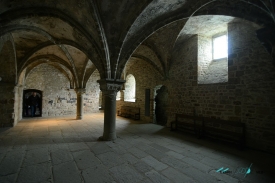
South of the church, the cloister encloses a small garden and links the communal rooms. Its late-Gothic form dates from a rebuilding completed in 1486. The richly carved Porta Speciosa connects cloister and basilica; the monastery’s visitor account describes it as a late-Romanesque portal, with a depiction of Saint Martin above it. Below ground, the crypt is among the oldest coherently preserved parts of the complex, dating to the early 13th century. Together, these spaces invite a slower visit: rather than treating the abbey as a checklist of monuments, follow how thresholds, corridors and courtyards frame a life ordered around worship and shared work.
Library, learning and the landscape
The library gives Pannonhalma another identity: a center of learning that continues to serve its community. The official visitor page describes a classical reading room decorated by Viennese artist Joseph Klieber and a collection of nearly 400,000 volumes, including manuscripts, early printed books and old Hungarian works. The library remains in use and continues to grow, so it is not simply a museum interior. The abbey’s educational tradition also outlasted political restrictions. Today the hilltop complex includes school buildings as well as spaces for worship, linking the contemporary institution to the teaching mission renewed in the 19th century.
The World Heritage property extends beyond the main monastery. Its setting includes the Lady Chapel, Millennium Chapel, arboretum, forest parks and herb garden, features that help explain UNESCO’s emphasis on the relationship between the abbey and its environment. The hill is a vantage point over the Pannonian landscape, but the grounds are not merely a scenic frame: orchards, cultivated areas and gardens are part of the site’s long history of human stewardship. If time permits, combine the historic interior with a walk around the grounds. Seasonal conditions and access vary, and the monastery’s live visitor pages list separate opening details for individual attractions.
Planning a respectful visit
The Archabbey’s current independent-visit schedule lists opening from 10 a.m. to 4 p.m. Tuesday through Sunday between January 2 and February 28, with Monday closure; it warns that events can alter access. Its 2026 ticket page lists a standard adult admission of HUF 3,200 and says the ticket covers one self-guided visit to the 13th-century basilica and crypt, 15th-century cloister and 19th-century library building. These are dated figures, not a promise for 2027: check the official opening and ticket pages shortly before travel, especially because the publication date of this guide is later than the price schedule currently displayed.
Allow time for the abbey itself and its grounds rather than arriving just before the ticket desk closes; the official page says tickets must be purchased at least an hour before closing. The guided tour calendar differs from independent entry, and liturgical events or private functions can change the route. Some centuries-old buildings are only partly accessible, and the abbey asks wheelchair users to arrange assistance in advance. Pannonhalma rewards visitors who bring curiosity as well as a camera: its most compelling feature is the way a living community, architectural layers and a cultivated landscape continue to share the same hill.