About Jerónimos Monastery
A monastery shaped by Lisbon’s maritime age
In Belém, beside the Tagus estuary, Jerónimos Monastery is one of Lisbon’s most consequential historic buildings. Its formal Portuguese name is Mosteiro de Santa Maria de Belém; “Jerónimos” refers to the Order of Saint Jerome, whose monks lived here for centuries. Construction began in 1502 under King Manuel I, in a period when Portugal’s overseas voyages were reshaping royal power, trade and religious life. The monastery’s location near the river connected it to a maritime landscape: sailors prayed at the earlier chapel of Santa Maria de Belém before departure, and the new complex became a monumental expression of the crown’s ambitions.
The UNESCO World Heritage property links Jerónimos with the nearby Tower of Belém, inscribed together in 1983. UNESCO describes the monastery as a major example of Manueline art, a Portuguese style that combines late Gothic forms with maritime, royal and natural imagery. The ornate stonework is not merely a decorative surface: portals, columns and vaults communicate the wealth and religious identity of the early sixteenth-century monarchy. The building took shape over many decades, with different master builders contributing to its design, so details reveal more than one hand and one moment.
Inside the cloister, church and sculpted stone
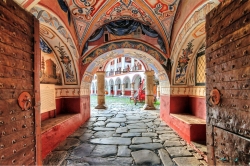
The two-storey cloister is the most celebrated part of the paid visitor route. Its arcades frame an open courtyard, creating changing views of carved stone, light and shadow. Look closely at the columns, tracery, arches and sculptural details: Manueline ornament draws on vegetal forms and maritime references without reducing the structure to a single motif. The cloister was a working monastic space, not originally designed as a modern gallery. Its quiet geometry is best appreciated slowly, including from the upper level where accessible, rather than as a quick circuit for photographs.
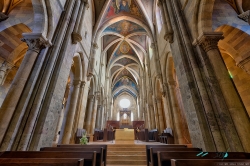
The church has a different relationship to the monument. It remains an active place of worship and is open to visitors on a separate schedule; entry is free under the institution’s current information, though access may be limited during services or when visitor flows are high. Inside, the high nave and branching vaults create a broad, unusually open interior. Tombs associated with figures including Vasco da Gama and the poet Luís de Camões connect the church to Portugal’s maritime narratives and literary memory. These burials are part of a larger national history, not proof that every expedition story belongs to the monastery itself.
Jerónimos also records changing uses over time. The religious orders were dissolved in Portugal in 1834, and the monastery’s spaces passed through new institutional roles while the church continued as a parish church. This later history complicates the image of a building frozen in the Age of Discoveries. Today the monument is managed as a heritage site and the cloister supports a carefully controlled visitor route, while the church retains religious use. Seeing both helps explain how preservation and everyday function coexist within one complex.
Planning the visit in Belém
The official site currently lists the cloister as open Tuesday through Sunday, 9:30 a.m.–5:30 p.m., with last entry at 5 p.m. It closes Mondays and on 1 January, Easter Sunday, 1 May, 13 June and 25 December. The church has separate hours: Tuesday to Saturday, 10:30 a.m.–5 p.m.; on Sundays and religious holidays, 2–5 p.m. Special state events, religious ceremonies, weather or conservation needs can alter access. Check the live institutional notice close to your visit rather than assuming the church and cloister follow the same timetable.
The posted cloister ticket is €18. The institution advises buying ahead when possible because time slots often sell out and same-day purchase may not be available. Tickets are issued for timed entry; the site lists a daily maximum of 3,500 visitors and simultaneous limits of 300 in the cloister and 200 in the church. Those caps protect the monument and help explain why a ticket for a preferred time matters. The church is free, but that does not include the cloister. The Tower of Belém is a separate monument with its own admission and access rules, so verify both if visiting the pair.
Access, etiquette and what to notice
Large bags, wheeled suitcases and bulky backpacks are not permitted inside; food, drink, smoking, selfie sticks and tripods are also prohibited under the current rules. Personal photography is allowed without flash or professional equipment, provided it does not disturb other visitors. The lower cloister and church are accessible to visitors with reduced mobility, but the upper cloister is not wheelchair accessible. The monastery offers a wheelchair and portable seats, with adapted toilets on the ground floor. If step-free access is essential, check with staff before arrival about the route available that day.
Jerónimos sits within Belém’s wider cultural district, where the Tower of Belém and other waterfront landmarks make a natural companion to the monastery. Allow time for queues, security screening and the walk between sites; timed entry does not remove the need to arrive prepared. The monument’s value lies in the balance of carved detail, monumental scale, religious function and historical change. Rather than trying to see every sculpted figure at speed, choose a few architectural details to follow, then step back to take in the cloister’s proportions and the church’s open volume. That slower visit makes the stonework and its history easier to read.