About Mamure Castle
A coastal fortress beside Anamur
Mamure Castle rises on rocky ground beside Türkiye’s Mediterranean coast, near Bozdoğan in Anamur district, Mersin Province. The Ministry of Culture and Tourism places it about six kilometres south-east of Anamur on the Mersin–Antalya highway. Its setting combines a coastal outlook with a defensive position above level ground. The official accounts describe the complex as one of the best-preserved Turkish castles on this stretch of the coast, but its earliest construction date remains uncertain.
The castle covers about 23,500 square metres and occupies the foundations of an earlier settlement identified by the Ministry as Rig Monai, probably a Roman-era site. Rescue excavations in 1988 exposed rooms thought to have served as a bathhouse and residence, with mosaic floors and late Roman pottery. The Ministry says the castle may have begun in the third or fourth century and was enlarged in later periods. These remains show that the promontory had a history before the medieval fortress; they do not establish a precise date for every wall still standing.
Mamure is on UNESCO’s Tentative List, with Türkiye’s submission dated April 2012. That status means it has been proposed for possible World Heritage consideration; it is not the same as inscription on the World Heritage List. The distinction matters for visitors reading signs or planning a heritage itinerary. The site’s significance is already clear from its architecture and historical layers, but its tentative-list status should not be described as a completed UNESCO designation.
Three linked sections and a defensive landscape
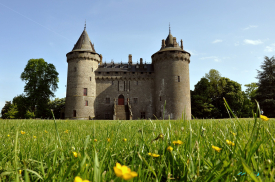
The Ministry describes three connected parts: an inner courtyard to the east, an outer castle to the west and an inner fortress built on rocky ground to the south. The complex is reported to contain 39 towers, galleries, water cisterns, a mosque and a bathhouse. A defensive ditch, about ten metres wide in the official description, surrounds parts of the walls. The present visitor entrance is not the original main gate, which stood between two towers on the north side of the inner courtyard.
The original bridge over the ditch no longer survives. Ministry descriptions explain that a water channel once supplied the castle and that cisterns could store water during a siege. These systems make the fortress more than a line of high walls: they show how access, surveillance and water storage were integrated into its design. Visitors can look for the relationship between the ditch, gates, galleries and towers, while staying on permitted paths and away from fragile masonry.
Inside the outer castle is a single-domed mosque, whose first construction is attributed to the Karamanid period and whose present architectural features also reflect later Ottoman work. The Ministry notes storage areas and cisterns, as well as remains of the bathhouse to the north. Not every room has a settled interpretation: some excavated spaces are thought to have been domestic or public buildings. Treating those identifications as provisional preserves the difference between what the excavations uncovered and what researchers infer from it.
From Roman foundations to the 1450 inscription
The Ministry’s historical account says the present castle was built after Seljuk ruler Alaeddin Keykubad took the site in 1221. It later passed to the Karamanids and the Ottomans. The wording of the official accounts differs on the earliest phases, so it is safer to distinguish the possible Roman settlement from the medieval fortress visible today. Mamure’s history was not one uninterrupted project: later powers occupied, repaired and adapted a strategic coastal stronghold.
A six-line inscription above the original gate records work associated with Sultan Ibrahim, son of Mehmet, of the Karamanid dynasty, and gives the date 854 in the Islamic calendar, corresponding to 1450 CE. The inscription is a tangible chronological anchor amid uncertainty about earlier foundations. Ministry records also document repairs and additions in the mid-sixteenth and late eighteenth centuries, followed by restoration work in the 1960s. The surviving walls therefore combine fabric and alterations from several periods.
Look beyond the exterior silhouette to understand the defensive logic. Towers and galleries offered connected positions along the walls; protected openings faced possible approaches from land and sea; cisterns addressed the practical problem of water. The present entrance differs from the original gate, and the missing bridge changes how the ditch is experienced. These are not defects to be mentally filled in with a romantic reconstruction; they are evidence of a structure that has aged, been adapted and partly lost.
Opening information, tickets and a careful visit
The Ministry’s current fee directory lists Mamure Castle at €3 for foreign visitors and says Turkish citizens may enter with a Museum Card. The Ministry museum portal currently displays opening from 9:00 a.m. to 8:00 p.m., with the ticket desk closing at 7:30 p.m. and Monday shown as a closed day. However, another public government visitor portal lists Tuesday–Sunday hours of 8:00 a.m. to 6:30 p.m. Because official pages do not agree, confirm the day’s schedule with Anamur Museum Directorate before travelling; its published telephone is +90 324 814 16 77.
The castle is on Bozdoğan Mahallesi, beside the D-400 coastal highway, around six kilometres from Anamur. The Ministry’s address and location information can help with navigation, but check a current map for the final approach and parking arrangements. The site has uneven stone surfaces, stairs and exposed areas; wear suitable footwear, carry water in warm weather and supervise children near walls and edges. Do not climb towers or cross barriers to reach viewpoints.
Mamure Castle rewards a slow circuit: compare its separate courtyards, look for the gate inscription, trace how towers and cisterns supported defence, and keep the Roman remains distinct from the medieval fortress. Its coastal setting makes the visit visually striking, while the layered chronology rewards closer reading. Check the latest official schedule and fee before departure, allow enough time for the full circuit, and remember that UNESCO Tentative List status is a proposal—not a completed inscription.