About Jaisalmer Fort
A golden fort that is still a neighbourhood
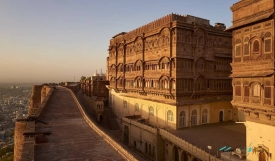
Jaisalmer Fort rises above the city in Rajasthan’s Thar Desert, its yellow sandstone changing tone with the light. Rajasthan Tourism calls it Sonar Qila, or the Golden Fort, and stresses a point that can be missed in a quick photograph: homes, shops, hotels and old havelis remain inside its walls, where generations of residents have continued to live. This is not simply a deserted monument preserved behind a gate. It is a historic urban quarter, and a visit works best when its residents are treated as neighbours rather than part of a display.
The state tourism account traces the city’s foundation to 1156, when Rawal Jaisal established a capital at the site now associated with the fort. Its published narrative also recounts a meeting with a sage and a prophecy about a descendant of Krishna founding a kingdom there. That episode belongs to the regional foundation tradition, not to a claim that can be independently proved as a literal event. Separating the documented date and ruler from the story’s legendary elements lets visitors appreciate both the political memory and the way local history has been told.
The fort’s desert location is central to its design and meaning. UNESCO’s description of the Hill Forts of Rajasthan explains how fortifications across the series used the terrain around them; at Jaisalmer, the desert was part of the defensive setting. The yellow stone seems to merge with the surrounding landscape, especially when sunlight warms the walls. Look beyond the color to the layered approaches, gates and dense urban fabric. They reveal a place built to shelter authority, trade, worship and ordinary life, not merely to create a dramatic silhouette on the skyline.
UNESCO recognition and the history within the walls
Jaisalmer Fort is one of six properties in the serial UNESCO listing called the Hill Forts of Rajasthan, inscribed in 2013. The other sites are Chittorgarh, Kumbhalgarh, Ranthambore, Amber and Gagron. The Government of India’s announcement records Jaisalmer Fort as protected by the Archaeological Survey of India. UNESCO describes the group as fortified centres of Rajput power that developed over centuries, with palaces, temples, settlements and commercial spaces within their defenses. The series is valuable because it shows different ways rulers adapted military architecture to landscape and political life.
The designation does not mean that the six forts are identical. UNESCO notes that the Jaisalmer site takes advantage of the desert, while other members of the group relate to rivers, forests or hills. Within the walls, the architecture reflects courtly culture, trade and religious practice. Some urban settlements and sacred buildings have remained in use. At Jaisalmer, that continuity is visible in streets where visitors pass residences, businesses and places of worship. The fort should therefore be read as a connected townscape, not just as a set of towers to photograph from outside.
Conservation is part of the story too. UNESCO’s documentation has identified water seepage and the needs of individual historic buildings as concerns for the site. This is a recorded management issue, not a claim that every structure is unsafe or that a particular repair is underway now. For visitors, it is a reason to avoid wasting water, putting pressure on fragile surfaces or leaving rubbish. Respect marked access and local instructions, and remember that practical infrastructure in a living settlement has to serve residents as well as protect historic fabric.
Temples, lanes and details worth slowing down for
The Jain temple complex is among the most distinctive places within the fort. Rajasthan Tourism describes seven temples dedicated to Jain tirthankaras and dates the complex broadly between the 12th and 15th centuries. The official account highlights carved stone, detailed surfaces and a sequence of shrines, including temples dedicated to Chandraprabhu, Rishabhdev and other revered teachers. These are active sacred spaces, so opening and visitor rules may vary. Dress respectfully, keep noise low, follow signs and ask before taking photographs. The architecture can be admired without interrupting worship.
Outside the temples, the lanes reward attention to scale and craft. Carved balconies, doorways, courtyards and sandstone façades show how domestic and commercial architecture adapted to a dense settlement. Rajasthan Tourism also points visitors toward havelis elsewhere in the city, the Government Museum and Gadisar Lake, making the fort one part of a broader Jaisalmer itinerary. Allow time to walk without blocking narrow streets or photographing people without permission. The best details are often at eye level: a threshold, a carved screen or the transition from a busy lane into a quieter courtyard.
Sunset changes the appearance of the fort, but it is not the only useful time to look. Morning light can make the streets easier to navigate, while a later visit can reveal how the sandstone shifts from pale yellow to deeper gold. The site’s public lanes and private attractions do not all operate as one museum with one schedule. Because homes and businesses remain inside, check the access hours and entry conditions for any particular temple, palace museum or exhibition you intend to see. Avoid assuming that every interior is open simply because the fort’s streets are active.
Planning a respectful visit
Rajasthan Tourism presents Jaisalmer as a destination within the state’s desert circuit and lists other sites that can be paired with the fort, including the Jain temples, Gadisar Lake and historic havelis. A full day can combine the fort’s lanes with one or two nearby places; a longer stay makes room for the wider desert region. Distances and transport arrangements vary, so confirm local travel options rather than assuming a short walk between every attraction. In busy periods, leave time for narrow streets, crowds and the needs of residents carrying on with daily routines.
Because this is an inhabited heritage area, visitor etiquette has practical consequences. Keep doorways clear, do not enter homes or courtyards unless invited, and ask before photographing residents. Use water carefully and take rubbish back to designated bins; UNESCO has identified water management among the site’s conservation concerns. If visiting a place of worship, observe any rules on footwear, dress or photography posted at the entrance. These are not formalities added to the sightseeing experience: they help balance tourism with the life of a community that continues to occupy the historic fort.
There is no single reliable schedule that covers every lane, shrine, museum and private attraction inside the fort. The main settlement remains in use, while individual institutions set their own hours, ticketing and access policies. Confirm those details with the specific venue close to your visit, and check Rajasthan Tourism or local notices for seasonal events. Jaisalmer Fort is most rewarding when approached as both a major monument and a living place. Its story lies not only in royal origin accounts and UNESCO status, but also in the daily movement of people through streets built centuries ago.