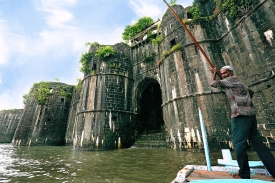
About Mehrangarh fort
A fort above Jodhpur, not just a viewpoint
Mehrangarh dominates Jodhpur from an isolated rocky hill that rises about 400 feet above the surrounding plain. Its position is part of the history: the site offered stronger natural defenses than the Rathore capital at Mandore, and the town that grew below the fortress took the name Jodhpur from its founder, Rao Jodha. Rajasthan’s tourism department dates the beginning of the fort to 1459. The result is not a single building from one moment, but a fortified royal complex shaped by generations of rulers.
The Mehrangarh Museum Trust describes the fort’s walls as more than 500 yards long, reaching as much as 120 feet high and 70 feet thick in places. Those figures help explain why the fort feels like a city above the city. Yet the ramparts are only one part of the visit. Within them are courtyards, gates, palaces, shrines and museum galleries that show how a defensive stronghold also served as a residence and center of court life. The view outward is memorable, but the rooms explain why the site mattered.
The name Mehrangarh is usually translated by the Trust as “fort of the sun,” a reference to the Rathore clan’s traditional descent from Surya, the sun deity. That is a dynastic origin story, not a claim that can be tested as ordinary chronology. The distinction is useful throughout the fort: courtly memory, family tradition and documented political history coexist, but they are not the same kind of evidence. Reading the place carefully means allowing its stories to be present while identifying which ones are traditions.
Rao Jodha and the changing fortunes of Marwar
The Trust’s account places the Rathores in Marwar after political upheaval in northern India and traces their growing power through Pali and Mandore. Rao Chunda established a capital at Mandore in the late fourteenth century; two generations later Rao Jodha chose the rocky site south of it for a new fort. The museum and Rajasthan tourism sources associate the foundation with 1459. That move linked a more defensible hilltop seat to the emerging city at its base, rather than simply relocating a palace from one neighborhood to another.
Mehrangarh’s later history was shaped by negotiation as well as conflict. The Trust records that four successive generations of Marwar rulers, between 1581 and 1678, accepted alliance with the Mughal Empire and retained authority over their ancestral lands as subordinate allies. The relationship did not remain stable: the same account describes periods when the agreement broke down, Jodhpur and the fort were occupied, and Rathore rulers resisted. These shifts are a reminder that the fort’s history cannot be reduced to one continuous story of conquest or independence.
Its functions also reached beyond defense. The Trust describes Mehrangarh as a palace for rulers and their households, a center of patronage for music, literature and the arts, and a place of worship with temples and shrines. The buildings inside reflect those overlapping roles. Rather than treating every decorated chamber as a military relic, visitors can look for the ways residence, ceremony, administration and religion shared the same fortified enclosure. The fort was a seat of authority and a lived environment, not merely a wall built to repel attackers.
Seven historic rooms and six museum galleries
The Mehrangarh Museum Trust organizes the palace museum around seven period rooms: Sheesh Mahal, Phool Mahal, Takhat Vilas, Sardar Vilas, Jhanki Mahal, Dipak Mahal and Moti Mahal. Six galleries focus on howdahs, palanquins, the Daulat Khana, paintings, textiles, and arms. The names are more than a checklist. Together, the rooms and displays provide a route through elite interiors and the material culture of Marwar, from court objects and furnishings to the equipment used in travel and war.
The collections include miniature paintings, arms and armor, textiles, decorative arts and furniture, with examples identified by the Trust from the seventeenth through nineteenth centuries. The museum also highlights a large body of regional material rather than presenting Jodhpur as an isolated royal story. A visitor who moves at a measured pace can compare how materials, images and objects expressed status, devotion and practical life. The trust’s online collection pages provide further context, but rotating displays and conservation work can affect what is visible in the galleries on a particular day.
Among the objects singled out by the Trust is a silver howdah associated with Mughal emperor Shah Jahan. The museum’s gallery text says it was presented to Jaswant Singh on 18 December 1657 along with an elephant and 100 horses. This is a specific provenance claim made by the institution and should be understood as such. It gives the howdah a story that connects courtly exchange, military power and ceremonial display; it does not mean every object in the galleries has an equally complete history.
Hours, tickets and making time for the fort
At the time checked on 8 October 2026, the Trust’s visitor page and official booking portal listed the museum as open daily from 09:00 to 17:00, with ticket sales closing at 17:00. The listed admission was ₹800 for international visitors and ₹200 for domestic visitors; student concessions were ₹500 for international students and ₹100 for domestic students or senior citizens. The official page also listed an audio guide, guide services and a one-way elevator charge. Rates and eligibility can change, so check the Trust’s live booking page before setting out.
Allow enough time to pass through the gates, reach the palace interiors and explore the museum without treating the fort as a quick photo stop. The official museum material names galleries and period rooms, while the Trust’s trail information distinguishes museum audio routes from outdoor walks and other experiences. Some options have separate charges; do not assume every trail, garden or nearby attraction is included in a standard museum ticket. If mobility or heat is a concern, check elevator availability and ask the Trust about current access arrangements before purchasing.
Mehrangarh works best as a planned visit within Jodhpur rather than an isolated stop. Its ramparts provide broad views over the city, but the strongest impression comes from pairing that panorama with the museum’s objects and the fort’s layered architecture. Read the official history before or after the visit, pay attention to which details are family tradition and which are dated institutional records, and leave time for the galleries. That approach turns a famous silhouette into a more complete account of Marwar’s court, craft and political history.