About Hohensalzburg Castle
A fortress that defines Salzburg’s skyline
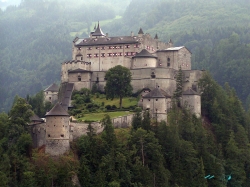
Hohensalzburg Fortress rises above Salzburg’s old town from the rocky Festungsberg, a landmark visible across the city. Its origins date to 1077, when Archbishop Gebhard I began fortifications during the Investiture Controversy between Emperor Henry IV and Pope Gregory VII. The complex expanded in stages as Salzburg’s prince-archbishops strengthened their political seat and its defenses. The official history describes it as one of Europe’s largest intact castle complexes; its buildings and courtyards cover about 32,000 square metres. It is not just a distant silhouette: visitors can enter a layered architectural site and look back over the city it once dominated.
Although built for protection and political authority, the fortress never had to prove its defensive role in a major siege and was never taken by military force, according to its operator. Archbishop Leonhard von Keutschach oversaw a major building campaign around 1500, giving the complex much of the appearance visitors recognize today. His late-Gothic princely rooms, including the Golden Hall and Golden Chamber, survive as unusually rich examples of secular interiors from that era. Their decoration is not merely ornamental: it communicates how Salzburg’s rulers used architecture to stage status and authority.
Rooms, museums and the Salzburg Bull
The fortress is best experienced as a group of related spaces rather than as a single castle room. The Prince’s Rooms and Magic Theatre interpret court life and the building’s history; the fortress museum traces Salzburg and the development of the site; the historic armoury presents weapons and defensive technology. A marionette museum and other exhibitions add collections connected with the city’s cultural history. The exact rooms open can depend on the ticket type or maintenance, so check what is included before buying. The official ticket page currently advertises adult admission from €12 and children’s admission from €4.90, with packages and prices varying according to access and the funicular.
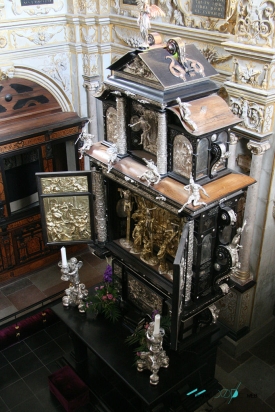
One distinctive object is the Salzburg Bull, a historic hornwork organ with more than 130 pipes. The official history says it was commissioned under Leonhard von Keutschach about five centuries ago and once served as a kind of signal for the town; its name refers to the sound it produced, not to an animal. Today it plays daily at 7 a.m., 11 a.m. and 6 p.m., after the Old Town carillon. The fortress also offers broad views over Salzburg’s rooftops toward the surrounding mountains, making the climb or funicular journey part of the visit rather than simply a way to reach the entrance.
Opening times, tickets and the route uphill
The fortress is open every day of the year. The official schedule lists 9:30 a.m.–5 p.m. from January through April and October through December, and 8:30 a.m.–8 p.m. from May through September; museums, state rooms and the Magic Theatre have shorter hours in summer, generally 9 a.m.–7 p.m. Easter and Advent weekends have special hours, and the interior closes earlier on December 24. These are seasonal rules rather than a guarantee that every gallery is open on a particular day. Review the official calendar just before travelling, especially if a specific interior or exhibition is central to your plans.
For autumn 2026, the operator lists maintenance of the FestungsBahn funicular from November 9 to 13. The fortress grounds and walking path are expected to remain accessible, but museums and indoor areas will be closed during that work. Outside such maintenance periods, the funicular is the fastest and easiest ascent from the old town; visitors can also walk uphill on a steep route. Standard admission, the all-inclusive ticket and funicular options differ, so compare inclusions rather than choosing only by headline price. The official online ticket page is the place to confirm rates, opening conditions and any temporary restriction for your date.
Making the most of a visit
The fortress stands at Mönchsberg 34, 5020 Salzburg. Cars and tour buses do not drive directly to the entrance. The valley station of the funicular is near the old town and can be reached on foot from central Salzburg; public garages are located in the city rather than at the summit. If you choose the walking route, allow for a steep climb and uneven sections. Dogs are permitted in the outdoor areas on a lead but not inside the museums and interiors, except assistance dogs; a muzzle is required on the funicular. Drones are prohibited. Accessibility varies between courtyards, lifts, rooms and routes, so visitors with mobility needs should consult the operator’s detailed access information in advance.
Give yourself enough time to move between courtyards, exhibitions and viewpoints instead of treating the fortress as a quick photo stop. The late-Gothic chambers, the defensive architecture and the panorama each reveal a different layer of Salzburg’s past. The city’s compact historic centre can be combined with the visit, but the fortress itself involves stairs, slopes and several separate spaces. On the way out, notice how the ramparts frame the old town and the Salzach valley: the view helps explain why this rocky height mattered to the archbishops. Check live opening and ticket details before setting off; maintenance, seasonal schedules and access to individual exhibitions can change the practical shape of a visit.