Frederiksborg Castle: Danish history inside a Renaissance landmark
A royal castle built across the lake
Frederiksborg Castle occupies three small islets in Castle Lake in Hillerød, north of Copenhagen. Its setting is part of its appeal: towers and copper roofs rise above the water, while the approach brings visitors through the town toward the castle gardens and courtyards. The royal story began in 1560, when King Frederik II acquired Hillerødsholm Manor and built the first part of Frederiksborg. His son, Christian IV, later demolished much of that complex and raised the Renaissance castle seen today between 1600 and 1620. The scale and decoration were intended to project royal authority, making the building an architectural statement as much as a residence.
Frederiksborg served as a royal residence for roughly a century, then its use shifted as Danish court life changed. Its chapel remained a significant religious and ceremonial space. The castle’s history is not a seamless survival from the Renaissance, however: a major fire in 1859 destroyed much of the interior. The Chapel and Audience Chamber survived, while other rooms and decorations had to be reconstructed. That rupture helps explain why the present visitor route combines original historic rooms, restored interiors and museum displays rather than presenting every space as untouched.
From the 1859 fire to the Museum of National History
After the fire, the rebuilding effort drew support from across Denmark through a national collection and a lottery. Brewer J. C. Jacobsen, founder of Carlsberg, proposed that the castle become a museum devoted to national history and offered to fund restoration and the institution’s future costs. The Museum of National History opened at Frederiksborg in 1878 and remains an independent department of the Carlsberg Foundation. The decision gave a damaged royal residence a new civic purpose: preserving and interpreting Danish history through the art and objects displayed in a setting shaped by the monarchy.
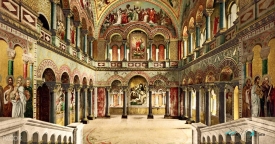
The museum presents around 500 years of Danish history through portraits, history paintings, furniture and decorative art. The route moves through rooms whose architecture is part of the interpretation. The Chapel retains original decoration from Christian IV’s era and includes a 1606 altarpiece; the Compenius organ dates to 1610. The Great Hall, Rose, Audience Chamber and other spaces offer different layers of royal and national history. Not every room is an original survivor: some interiors were reconstructed after the fire, and the museum makes that history part of the visitor’s understanding rather than hiding it.
What to see and what is on now
Begin with the introductory display and follow the chronological galleries to see how Denmark’s story is told across changing periods. Portraits and historical paintings place rulers, public figures and events in view; decorative arts and furnished rooms show how taste and court life evolved. The Chapel is one of the castle’s most consequential surviving interiors, while the Audience Chamber reflects a later Baroque style. The 1610 Compenius organ gives the chapel a living musical link to the past: a 30-minute presentation concert is scheduled every Thursday at 1:30 p.m. and is included with museum admission, subject to the current program.
The museum’s calendar is especially useful because displays and room access change. As of the official schedule checked for October 2026, a new portrait of King Frederik X has been displayed in the Great Hall since September 28, and the exhibition “Modern Middle Ages – Agnes & Harald Slott-Møller” is scheduled from October 8, 2026, through February 21, 2027. The museum also lists the Audience Chamber and adjoining rooms as closed from October 15 to 31, 2026, during preparations for a seasonal installation. These are dated notices, not permanent conditions; check the museum’s live page before choosing a day.
Tickets, opening hours and getting there
The museum says it is open every day of the year, including Mondays, from 10 a.m. to 5 p.m. Its current Danish ticket page lists admission at DKK 125 for adults, DKK 105 for students and visitors aged 65 or older, and free entry for children aged 0–17. The standard ticket includes the museum and special exhibitions; tickets can be bought online or on arrival. Prices and terms can change, so confirm them on the official page before travelling. A Thursday organ concert is included with admission, but the museum advises visitors to check for program changes or cancellations.
Frederiksborg is about 1.5 kilometres from Hillerød Station. Direct S-trains run to Hillerød from central Copenhagen stations; from the station, the walk takes about 15 minutes, either beside Castle Lake or along Slotsgade through the town. Buses 301 and 302 also stop close to the castle and museum. The address is Frederiksborg Slot, 3400 Hillerød, Denmark. Give the visit time for both the galleries and the grounds: the water setting and castle approach frame the museum experience, while the building’s mix of survival, reconstruction and national storytelling rewards a slower route than a quick photo stop.