About Church and Convent of San Francisco, Salvador
Church and Convent of São Francisco in Salvador: Brazil's great golden Baroque monument
In the heart of Salvador's Pelourinho district, the Church and Convent of São Francisco is one of the most extraordinary monuments of Brazilian Baroque. Behind a comparatively restrained stone façade lies an interior historically celebrated for exuberant gilded woodcarving, while the adjoining convent preserves one of Brazil's most important collections of 18th-century Portuguese tiles.
The complex is part of Salvador's historic center, inscribed on UNESCO's World Heritage List in 1985. Its importance extends beyond architecture: for more than four centuries, the Franciscan presence here has been connected with religious life, education, intellectual activity and the history of Brazil's first colonial capital.
There is, however, an essential fact for present-day travelers. The church is currently closed to tourist visitation while major restoration work is underway. On February 5, 2025, part of the ceiling over the nave collapsed, killing one visitor and injuring five other people. Restoration and structural work followed. In July 2026, the Franciscan institution announced that approximately R$20 million in federal funding had been planned for restoration, with reopening forecast for 2029. Visitors should therefore not plan a trip on the assumption that the famous gilded nave can currently be entered.
Franciscans in Salvador since 1587
The official history of the complex dates the Franciscan presence in Salvador to 1587, when the city was still developing as the capital of Portuguese America.
The first Franciscan buildings did not survive as the complex seen today. The present convent began to take shape from 1686, under Frei Vicente das Chagas, as part of a much more ambitious rebuilding program.
Work on the present church began in the early 18th century, with the first stone laid in 1708. The principal structure was completed in 1723, but decoration of the church and construction and embellishment of the convent continued for decades.
This long chronology matters because São Francisco is not the product of a single moment. Architecture, gilded carving, ceiling painting and Portuguese tilework were added in successive campaigns, creating the exceptionally rich ensemble associated with the monument today.
The “golden church” of Salvador
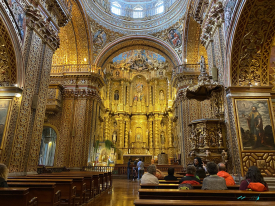
São Francisco is often called Salvador's “golden church” because of the extraordinary quantity of gilded carving that historically covered its interior.
The nave, side chapels, arches and altarpieces were treated as a continuous ornamental environment. Carved foliage, angels, religious symbols and architectural forms create the dense visual rhythm characteristic of the Portuguese-Brazilian Baroque.
The effect was never simply a matter of applying gold to surfaces. Talha dourada — gilded woodcarving — was a highly specialized art involving sculptors, carvers, painters, gilders and other craftsmen. In São Francisco, the technique reached one of its most ambitious expressions in Brazil.
The contrast between exterior and interior is one reason the church became so famous. From the Largo do Cruzeiro de São Francisco, the façade gives only a limited indication of the decorative intensity that historically awaited inside.
A major expression of Brazilian Baroque
Brazil's National Historical and Artistic Heritage Institute, IPHAN, describes the complex as one of the most expressive monuments of Brazilian Baroque and one of Salvador's most important historical and artistic landmarks.
The church also demonstrates the strong cultural connections between Bahia and Portugal during the colonial period. Architectural ideas, devotional practices, tiles and artistic models crossed the Atlantic, while craftsmen working in Brazil adapted them to local conditions and materials.
The result belongs to the broader Portuguese-speaking Atlantic world but also developed a specifically Brazilian identity. Salvador was one of the richest and most important cities in colonial Brazil, and São Francisco reflects the resources and artistic ambition concentrated there.
The Portuguese tiles of the cloister
The convent's azulejos are among its greatest treasures. IPHAN considers the tile ensemble particularly important for understanding the history of 18th-century tile coverings in Brazil.
The lower cloister contains 37 figurative panels, dated approximately to 1746-1748. According to IPHAN, their imagery was based on engravings by the Flemish painter Otto van Veen published in the book Theatro Moral de la Vida Humana.
These blue-and-white panels transform the cloister into a visual sequence of moral allegories. Their importance lies not only in their beauty but also in the way printed European images were translated into monumental ceramic decoration and transported across the Atlantic.
Between 2020 and 2023, IPHAN carried out a major restoration of the cloister tiles. The project addressed deterioration caused by weathering and physical, chemical and biological agents. The restored panels were formally delivered in May 2023.
Ceiling painting and 18th-century decoration
The decorative program continued throughout the 18th century. Historical accounts place the painting and decoration of the church ceiling by Frei Jerônimo da Graça between 1733 and 1737.
Other campaigns added gilding, altarpieces and tilework to the church and convent. Work on the cloister continued into the 1750s, and decorative additions were still being made later in the century.
This extended process helps explain the complexity of São Francisco. Visitors looking at old photographs of the interior are not seeing the work of one architect or one artist but the accumulated result of generations of Franciscan patrons and craftsmen.
The 2025 ceiling collapse
Any responsible contemporary guide to São Francisco must address the tragedy of February 5, 2025. Part of the ceiling of the church nave collapsed while visitors were inside. A 26-year-old tourist died and five other people were injured.
The event led to the interruption of tourist visitation and emergency stabilization work. IPHAN subsequently contracted specialized services for the stabilization, removal and storage of elements from the nave ceiling and roof.
The accident also intensified public discussion about conservation of historic religious buildings in Salvador. For travelers, the practical consequence is straightforward: the church should currently be considered closed for restoration, not a normally operating tourist attraction.
In July 2026, the Franciscan administration launched the “Abrace São Francisco” campaign to support preservation of the complex. Its official announcement states that approximately R$20 million in federal resources through Brazil's Novo PAC program are planned for restoration, with reopening forecast for 2029. That date is a projection and may change as conservation work advances.
How to get to São Francisco in Salvador
The complex is located at Largo do Cruzeiro de São Francisco, S/N, Pelourinho, Salvador, Bahia, 40020-280, according to its official website.
It stands in Salvador's historic center, connected to the Terreiro de Jesus and the network of pedestrian streets and squares that make Pelourinho one of the city's principal sightseeing areas.
For travelers already in Pelourinho, the church is best approached on foot. Visitors coming from other neighborhoods can use a taxi, ride-hailing service or public transportation to reach the historic-center area and continue walking.
Because the interior is closed during restoration, the value of visiting at present is primarily to understand the monument's urban setting and exterior within a broader walk through Pelourinho. Travelers should respect construction barriers and any access restrictions around the building.
Current access and practical information
As of August 2026, no normal tourist opening hours or admission price should be quoted for the church because regular visitation remains interrupted by the restoration process.
The institution's official website publishes the address at Largo do Cruzeiro de São Francisco and the telephone number +55 71 3321-9822. Travelers who specifically want to know whether any portion of the complex, convent or temporary area has become accessible should contact the institution before visiting.
Do not rely on older travel guides that list daily opening hours and entrance fees without checking their publication date. Those schedules describe conditions before the 2025 collapse and are not reliable evidence of current access.
- Location: Pelourinho, Historic Center of Salvador, Bahia, Brazil.
- Address: Largo do Cruzeiro de São Francisco, S/N, Salvador - BA, 40020-280.
- Current status: Church closed for restoration following the February 2025 ceiling collapse.
- Reopening: Currently forecast for 2029 by the Franciscan institution; the schedule may change.
- Official contact: +55 71 3321-9822.
- Highlights: Portuguese-Brazilian Baroque, gilded woodcarving and the 18th-century Portuguese tile cycle of the cloister.
Why São Francisco remains essential to understanding Salvador
The temporary closure does not diminish the historical importance of São Francisco. If anything, the restoration campaign underscores how vulnerable even the most celebrated monuments can be.
The complex records several centuries of Salvador's history: the arrival of the Franciscans in the 16th century, the wealth and artistic networks of colonial Bahia, the development of Brazilian Baroque, the movement of Portuguese tilework across the Atlantic and the continuing challenge of preserving historic architecture in a tropical coastal city.
When the church eventually reopens, its gilded interior will again be the principal reason many travelers enter. Until then, São Francisco should be approached differently: as a major monument undergoing a difficult chapter in its own history.
Seen from Pelourinho, the church and convent remain fundamental to the architectural landscape of Salvador. Their story is not frozen in the 18th century. Conservation, loss and restoration have now become part of that story as well.