About Church of Peace in Jawor
Jawor Church of Peace: timber, clay and a demand for religious freedom
The Evangelical Church of Peace in Jawor is one of Europe’s most remarkable responses to political restriction. From the outside, its timber frame and pale infill resemble an enormous civic building; inside, tiers of galleries and a rich Baroque programme surround a Lutheran worship space built for thousands. Together with the Church of Peace in Świdnica, it entered the UNESCO World Heritage List in 2001.
Built under the terms of the Peace of Westphalia
The Thirty Years’ War ended in 1648, but religious freedom remained severely constrained in the Silesian territories ruled directly by the Catholic Habsburg emperor. After Swedish diplomatic intervention, Protestants received permission to construct three Churches of Peace. The imperial conditions were demanding: the buildings had to stand outside town walls, use perishable materials such as wood and clay, omit towers and be completed within one year.
Architect and engineer Albrecht von Säbisch answered those restrictions with sophisticated timber-frame construction. The Church of the Holy Spirit at Jawor was built in 1654–1655 as a three-aisled basilica with a reduced, three-sided chancel. The third authorised church, at Głogów, was later lost; Jawor and Świdnica are the two survivors.
An interior designed for a community
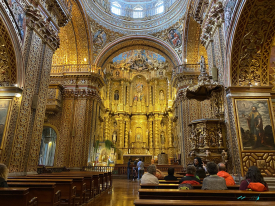
Multi-level galleries expanded capacity to about 7,000 people according to UNESCO’s description of the two churches. Box pews, paintings, inscriptions and heraldic details also recorded social organisation. The decoration developed over decades, combining exuberant Baroque form with Lutheran theology—an apparent contradiction that makes the interior especially compelling.
Do not stop at the central aisle. Look upward along the gallery fronts, where biblical imagery creates a visual teaching programme, and study the relationship among pulpit, altar and congregation. UNESCO regards the churches as the largest timber-framed Baroque ecclesiastical buildings in Europe and an unsurpassed technical achievement in wooden architecture.
Current visiting hours
The Jawor parish lists daily tourist access from 1 April through 31 October. Hours are Monday–Saturday 10:00–17:00 and Sundays or church holidays 12:00–17:00. From 1 November through 31 March, visits are available to groups of at least six people by prior telephone or email arrangement made at least one day ahead.
A typical visit lasts 20–40 minutes. The church offers a recorded history lasting roughly 10–17 minutes, with versions including English, Polish, German, French, Spanish, Japanese and several other languages. Organised children’s and youth groups can arrange a guide under the parish’s published conditions. Because this remains an active Evangelical-Augsburg church, services and religious events take priority.
Planning the visit to Jawor
The church stands at Park Pokoju in Jawor, south-western Poland. The parish identifies car parking on 1 Maja Street about 50 metres away and separate coach stopping points. Rail and bus connections should be checked for the travel date, particularly at weekends. Visitors combining Jawor with Świdnica need to allow for the distance between the two towns rather than treating them as one compact complex.
Confirm the current admission contribution directly with the parish, as the official visitor page publishes hours and contact details but does not display a stable price. Photography rules may vary during services or concerts. A quiet weekday visit is best for studying the galleries; an authorised concert or worship service reveals the building’s continuing acoustic and religious life.
The Church of Peace is not simply a feat of carpentry. Its scale shows the size and determination of a community forced to worship beyond the city walls, and its survival turns a seventeenth-century political compromise into tangible evidence of the long struggle for religious freedom.
- UNESCO inscription: 2001, criteria (iii), (iv) and (vi).
- Built: 1654–1655.
- Apr–Oct hours: Mon–Sat 10:00–17:00; Sun/church holidays 12:00–17:00.
- Winter access: pre-arranged groups of at least six.
- Visit length: normally 20–40 minutes.