About Church of the Society of Jesus, Cusco
Church of the Society of Jesus in Cusco: a Baroque masterpiece on the Plaza de Armas
Facing Cusco's Plaza de Armas, only a short distance from the cathedral, the Church of the Society of Jesus is one of the defining monuments of the historic center. Its elaborate stone façade and twin bell towers rise above a site that had already been important centuries before the Jesuits arrived: the church was built on Amarucancha, traditionally identified with the palace of the Inca Huayna Cápac.
The result is one of Cusco's clearest architectural expressions of the encounter between the Inca city and the colonial city that followed it. UNESCO, which inscribed the City of Cusco on the World Heritage List in 1983, describes the historic center as an exceptional example of the fusion of Inca and Hispanic traditions. La Compañía belongs squarely within that layered landscape.
For travelers interested in architecture, colonial art and the history of the Andes, the church deserves more than a quick photograph from the plaza. Its Baroque façade is only the beginning. Inside are a monumental gilded cedar altarpiece, paintings linked to the Cusco School, side chapels and works that reveal the complex relationship between Jesuit evangelization and the descendants of the Inca elite.
From Amarucancha to a Jesuit church
The Society of Jesus arrived in Cusco in 1571. The Jesuits obtained a prominent site on the main square where Amarucancha had stood, and construction of their first church began in the 1570s.
That first building did not survive intact. On March 31, 1650, a powerful earthquake devastated Cusco and badly damaged the Jesuit church. Reconstruction began soon afterward, creating the building that largely defines the site today.
Sources differ slightly over whether the reconstructed church should be described as completed in 1668 or 1673. The distinction reflects different construction and finishing stages rather than a fundamentally different chronology. What is clear is that the rebuilding after the 1650 earthquake produced one of the most influential Baroque churches in the southern Andes during the second half of the 17th century.
The new church was considerably more ambitious than its predecessor. Its scale and commanding position beside Cusco Cathedral have also given rise to a famous story about rivalry between the Jesuits and the cathedral chapter.
The famous rivalry with Cusco Cathedral
One of the most repeated stories about La Compañía concerns the height and magnificence of its design. According to the traditional account, church authorities objected because the Jesuits' new building threatened to compete visually with the cathedral, the seat of the diocese.
The dispute is part of the historical identity of the church, although simplified versions of the story are sometimes presented more dramatically than the surviving evidence allows. What a visitor can verify directly is the architectural effect: La Compañía occupies an extraordinarily prominent position on the same Plaza de Armas as the cathedral, and its richly modeled façade creates an unmistakable visual dialogue with its larger neighbor.
The church became highly influential in the development of religious architecture in the southern Andes. Its façade is often cited as an important example of mature colonial Baroque in Peru.
A façade designed to command the plaza
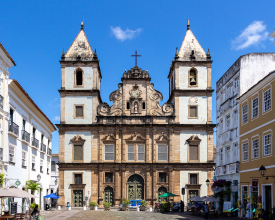
The façade is carved in stone and organized vertically between two bell towers. Columns, niches, cornices and sculptural ornament create a retable-like composition that gives the front of the building both depth and movement.
Unlike a plain structural façade, this is architecture intended to be read almost as a monumental altarpiece. The central section draws the eye upward, while the towers frame the composition and make the church visible across the Plaza de Armas.
The setting is especially important. Cusco's main square had been a central ceremonial space under the Incas and remained the heart of the colonial city. The Jesuits therefore built not on a peripheral site but at one of the most symbolically charged locations in the Andes.
The gilded main altarpiece
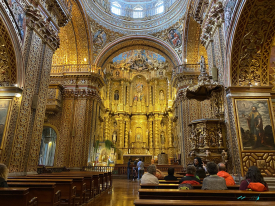
Inside, one of the principal attractions is the enormous main altarpiece carved in cedar and covered with gold leaf. Current Cusco visitor information describes it as approximately 21 meters high and 12 meters wide.
Its Solomonic columns, carved ornament and gilding form a dramatic focal point at the end of the nave. The altarpiece belongs to the decorative campaign that followed reconstruction of the church and demonstrates the importance of carved and gilded woodwork in Andean colonial interiors.
The contrast with the exterior is striking. Outside, the visitor encounters the weight and texture of stone; inside, wood, gold, painting and sculpture dominate the visual experience.
Paintings, Jesuit history and Inca lineage
La Compañía contains important colonial paintings, including works connected with the Cusco School and canvases devoted to the life of Saint Ignatius of Loyola, founder of the Society of Jesus.
One of the church's most historically interesting paintings represents a marriage linking the Loyola family with an Inca noble lineage. The work is commonly discussed in connection with the marriage of Martín García de Loyola and Beatriz Clara Coya, an Inca princess and heiress.
The painting is much more than a family portrait. It visualizes the relationship between two elite genealogies — one connected with the founder of the Jesuit order and the other with the Inca dynasty — and therefore offers a remarkable window into the political, religious and cultural world of colonial Cusco.
Travelers interested in the Cusco School should look beyond individual famous paintings and pay attention to the way European religious subjects were adapted within an Andean setting. The churches of Cusco were not merely repositories for imported European art; they became major centers of local artistic production.
Side chapels and the larger Jesuit complex
The main church is accompanied by adjoining religious spaces, including the Chapel of Our Lady of Loreto and the chapel associated with Saint Ignatius. These spaces form part of the larger Jesuit presence on the plaza and help explain why the site should be understood as more than a single façade and nave.
The Society of Jesus was deeply involved in education as well as evangelization. Its presence in colonial Cusco was therefore architectural, religious and intellectual.
The Jesuits were expelled from the Spanish territories under King Charles III in 1767, an event that profoundly affected Jesuit institutions throughout Spanish America. The order would later return, but the church remains a material record of the extraordinary influence the Society had achieved in Cusco before the expulsion.
How to get to the Church of the Society of Jesus
The church stands directly on the Plaza de Armas in the Historic Center of Cusco. For travelers staying in the historic center, walking is by far the easiest way to reach it.
It faces the main square and is only steps from Cusco Cathedral. This makes the two churches easy to visit on the same walking itinerary, although each deserves enough time to appreciate its very different architecture and collections.
Travelers staying farther from the center can take a taxi toward the Plaza de Armas and walk the final section. Vehicle access around the square may be affected by pedestrian zones, festivals, parades, religious events and traffic controls.
Cusco is approximately 3,400 meters above sea level. Newly arrived visitors should allow for the altitude when planning a day of walking through the historic center.
Opening hours, admission and practical information
Current Cusco visitor information lists tourist access to the Church of the Society of Jesus as Monday through Friday from 8:00 a.m. to 11:00 a.m. and from 1:00 p.m. to 5:00 p.m. On Sundays, published hours are 9:00 a.m. to 10:30 a.m. and 1:00 p.m. to 5:00 p.m.
These hours may change because of Masses, religious festivities or internal church regulations. Visitors should therefore verify the schedule locally before making a tightly timed itinerary.
Current published visitor information lists individual admission at approximately S/10 for adults and S/5 for students. The church may also be included in Cusco's Religious Circuit ticket. Ticket prices and the monuments included in combined passes can change, so the current rate should be confirmed at the entrance.
Because La Compañía remains an active Catholic church, tourist visits should not interfere with worship. Photography rules can also change and should be checked when entering.
- Location: Plaza de Armas, Historic Center of Cusco, Peru.
- Historic site: Built on Amarucancha, associated with Inca Huayna Cápac.
- Jesuits in Cusco: From 1571.
- Major rebuilding: After the destructive earthquake of 1650.
- Highlights: Baroque stone façade, gilded cedar main altarpiece, Cusco School paintings and adjoining chapels.
- Published individual admission: Approximately S/10 adults and S/5 students; verify current rates before visiting.
Why La Compañía is essential in Cusco
The Church of the Society of Jesus condenses several layers of Cusco's history into a single monument. It occupies the site of an Inca palace, records the arrival and influence of the Jesuits, bears the marks of reconstruction after one of the city's great earthquakes and preserves art produced within the distinctive cultural environment of colonial Cusco.
Its location also creates one of the most memorable architectural confrontations in Peru. From the Plaza de Armas, travelers can look from the cathedral to La Compañía and see two monumental expressions of Catholic power facing the same historic civic space.
Yet the church's importance is not simply a matter of scale or rivalry. The gilded altarpiece, colonial paintings, Inca-Jesuit genealogical imagery and Andean Baroque architecture reveal a far more complicated history of cultural transformation.
For anyone trying to understand Cusco beyond its role as the gateway to Machu Picchu, La Compañía is indispensable. It is a church, an art collection and a historical document built into the very center of the former Inca capital.