About Basilica and Convent of San Francisco, Quito
Basilica and Convent of San Francisco in Quito: the cradle of Quito's colonial art
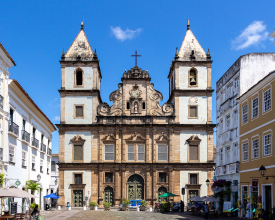
At the western edge of Plaza de San Francisco, in the heart of Quito's historic center, the Basilica and Convent of San Francisco forms one of the great architectural anchors of the Ecuadorian capital. Its long white façade, twin towers and broad stone staircase define one side of the square, but the true scale of San Francisco becomes clear only after entering the complex. Behind the church lies a Franciscan world of chapels, cloisters, religious art and centuries of cultural memory.
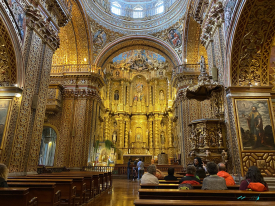
For travelers interested in colonial architecture, sacred art and Andean history, San Francisco is more than another historic church. It was one of the earliest major religious foundations in Spanish Quito and became closely connected with the artistic tradition now known as the Quito School. UNESCO specifically names San Francisco among the outstanding examples of Quito's Baroque school, where Spanish, Italian, Moorish, Flemish and indigenous influences came together.
From a thatched chapel to a monumental convent
According to the Museo Franciscano Fray Pedro Gocial, the first Franciscans arrived in Quito on December 6, 1535, led by Fray Jodoco Rique. On January 25, 1536, they completed a simple thatched-roof chapel for religious services. The friars called it the Chapel of the Conversion of Saint Paul, a historic dedication associated with the Franciscan complex.
The institution soon became important in the cultural life of colonial Quito. In 1551, the Franciscans established the San Andrés School of Arts and Crafts, an educational center associated with the training of artists and craftsmen. This legacy is one reason the convent describes itself as the “Cradle of Quito Art.”
Construction of the principal church and main cloister began in the mid-16th century. A major architectural phase was completed in 1605, while other cloisters, cells, gardens and service areas continued to be added until about 1650. San Francisco therefore developed over more than a century rather than as a single project.
Today the Franciscan institution says the convent occupies approximately three and a half hectares and includes the main church, several chapels, six cloisters, a refectory, the old brewery, gardens and the Museo Franciscano Fray Pedro Gocial.
A landmark of the Quito School
San Francisco is inseparable from the history of the Quito School. UNESCO describes Quito's great colonial religious monuments as products of a fusion of European and indigenous artistic traditions, and the church and convent provide one of the richest places in the city to see that encounter.
The complex preserves works associated with some of the leading names in colonial Ecuadorian art. The museum identifies pieces by or attributed to Miguel de Santiago, Bernardo de Legarda, Manuel Chili “Caspicara,” Bernardo Rodríguez and Manuel de Samaniego.
One of the most celebrated works is Bernardo de Legarda's Inmaculada, closely associated with the image known as the Virgin of Quito. The museum states that the original life-size sculpture was completed in 1734 and is located on the church's main altarpiece. Its dynamic posture and winged form became one of the most recognizable images of Quito's religious art.
The museum also preserves major paintings by Miguel de Santiago and sculptures attributed to Caspicara, making the site particularly valuable for visitors who want to understand the Quito School beyond architecture alone.
The Chapel of Cantuña
The main church is the visual and spiritual center of the complex, but San Francisco rewards visitors who explore its smaller historic spaces. Among them is the Chapel of Cantuña, originally associated with the Virgen de los Dolores and later named for Francisco Cantuña, an indigenous benefactor and skilled 17th-century metalworker.
The chapel contains a notable altarpiece dedicated to the Virgin of Sorrows and a sculptural Calvary attributed by the museum to Bernardo de Legarda. Its single-nave plan creates a more intimate atmosphere than the monumental main church.
Cantuña also has a famous place in Quito folklore. A popular legend tells of a builder making a pact with the devil to complete work at San Francisco. The story belongs to oral tradition, not documented construction history. The historical Francisco Cantuña was a real person associated with the chapel; the supernatural episode is one of Quito's best-known legends.
The Fray Pedro Gocial Museum
A visit can include the Museo Franciscano Fray Pedro Gocial, the religious art museum inside the convent. Formally established in 1938 and belonging to the Franciscan Order of Ecuador, it is custodian of approximately 250 heritage works of Quito art.
Its galleries display paintings, sculptures and devotional objects that help visitors understand the artistic world surrounding the church. The museum's visitor information also highlights the cloisters, church choir and, through special experiences, the bell towers and historic brewery.
Access to special areas can vary. Travelers particularly interested in the towers, treasury rooms, brewery or other restricted convent spaces should confirm availability directly with the museum before visiting.
How to get to San Francisco
The Basilica and Convent of San Francisco stands on Plaza de San Francisco in Quito's UNESCO-listed historic center. The museum lists its address as Cuenca 477 and Sucre.
For visitors already touring the colonial center, walking is the most natural approach. The complex can easily be combined with nearby plazas, churches and museums, and arriving on foot gives a better sense of the historic street plan.
Travelers coming from other parts of Quito also have a convenient public-transport option. The Quito Metro has a San Francisco station serving the historic center, with access associated directly with the plaza area. This makes the metro one of the simplest ways to reach the monument while avoiding central-city traffic.
Taxis and ride-hailing services are another option, although vehicle access can be affected by pedestrian activity, religious events or traffic controls. Completing the final section on foot is often practical.
Quito stands at approximately 2,850 meters above sea level. Visitors newly arrived at this altitude may prefer a slower pace, particularly when combining several churches and museums in one day.
Opening hours and visitor information
The current homepage of the Museo San Francisco de Quito lists regular museum hours as Monday through Saturday from 9:00 a.m. to 5:00 p.m., and Sunday from 9:00 a.m. to 1:00 p.m.
The museum's official homepage does not currently display a standard admission tariff. Because prices and special-tour charges may change, travelers should confirm the current fee directly rather than relying on older listings.
The museum publishes the telephone numbers (02) 295-2911 and 098 729 9479 and the email address museopedrogocial@hotmail.com. Contacting the museum in advance is especially advisable for special visits to the towers, brewery or other areas outside the standard route.
San Francisco remains an active religious complex, so tourist access may also be affected by Masses, feast days, Holy Week events or other liturgical activities. Visitors should check photography rules on site and behave respectfully in worship areas.
- Location: Plaza de San Francisco, Quito Historic Center.
- Address: Cuenca 477 and Sucre.
- Museum hours: Monday-Saturday 9:00 a.m.-5:00 p.m.; Sunday 9:00 a.m.-1:00 p.m.
- Highlights: Quito School art, Cantuña Chapel, cloisters, choir and Fray Pedro Gocial Museum.
- Public transport: San Francisco station on the Quito Metro.
Why San Francisco deserves time
Many travelers first see San Francisco as a monumental façade across one of Quito's most famous plazas. Its real importance, however, extends far beyond that first view: more than a century of construction, an early Franciscan educational tradition, the formation of Quito's colonial arts, multiple chapels and cloisters, and a museum preserving works by some of the city's defining artists.
San Francisco also offers an ideal counterpoint to the nearby Church of the Society of Jesus. La Compañía impresses through concentrated gilded decoration; San Francisco unfolds as a much larger religious landscape, linking church, convent, museum, courtyards, art, legends and continuing devotion.
For travelers who want to understand why Quito became one of Latin America's great historic cities, the Basilica and Convent of San Francisco is essential. It is not simply a surviving colonial monument. It is one of the places where the artistic identity of Quito was formed, preserved and passed from one generation to the next.