San Lorenzo de Carangas in Potosí: a church carved from local history
A church with a story rooted in Potosí
San Lorenzo de Carangas stands in the central area of Potosí, Bolivia, a city whose historic identity is inseparable from silver mining and colonial rule. The municipal tourism authority identifies the building as a museum church and describes it as one of the city’s early parishes. Its history is more specific than a general account of colonial architecture: the institution served a community of Carangas people, and its name preserves that connection.
The city’s tourism page says the church was originally called La Anunciación. After a heavy snowfall caused the temple to collapse, it was rebuilt and renamed San Lorenzo de Carangas. The same account notes that the parish served the Indigenous Carangas community. These details come from the municipal tourism record; they are more responsible than repeating an exact construction date or dramatic story that the source does not establish.
Potosí itself became one of the most consequential mining cities in the Spanish colonial world. UNESCO’s account of the City of Potosí describes a historic urban landscape shaped by silver extraction, civic institutions and religious buildings. San Lorenzo belongs to that wider setting, but its distinctive interest lies in the local community it served and in a façade where Indigenous artisans made their presence visible in stone.
The Baroque-mestizo portal and its carved figures
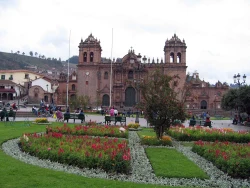
The municipal tourism account dates the present dome and the church’s celebrated Baroque-mestizo portal to 1728–1744. It says Indigenous stonemasons worked on the portal, whose sculptural program includes figures described as “indiátides,” sirens playing charango and local plant forms. The term Baroque-mestizo signals an artistic language formed through colonial-era exchange and local authorship; here the stone surface is not merely imported ornament but a record of regional makers and imagery.
The sirens are among the details that reward a close look. Their instruments are identified as charangos, bringing a local musical form into the church’s carved decoration. The municipal page also points to flora from the region. Rather than treating these motifs as exotic curiosities, they can be read as evidence that local references entered a Catholic architectural setting through the choices of Indigenous artisans and workshop traditions.
The portal should be approached as a work of sculpture whose meaning unfolds in details: figures, plants, columns and the relationship between the façade and the street. Photographs often flatten that depth. On site, changing light makes relief and shadow easier to see, while the surrounding historic streets provide a sense of how the building belongs to the city rather than standing as an isolated attraction.
From parish church to museum collection
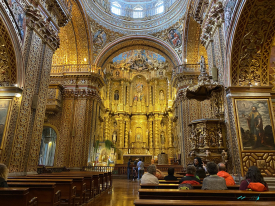
San Lorenzo now functions as a museum church, according to the municipal tourism page. Its collection includes colonial religious sculpture, with works by Gaspar de la Cueva specifically mentioned by the city. That collection complements the exterior: the portal records the work of Indigenous stonecutters, while the interior preserves devotional objects produced for worship and the region’s religious life. Together, they offer a fuller account than an outside-only stop.
The museum setting also helps explain how a church can remain a sacred building while presenting heritage to visitors. The public tourism page lists the collection as a museum attraction, but it does not give a detailed inventory of every work or guarantee access to all rooms. Visitors should ask which areas are open on the day and follow staff instructions, especially if religious activity or conservation work is underway.
San Lorenzo’s place in Potosí becomes clearer when paired with the city’s broader mining history. UNESCO’s World Heritage description places the historic town within a landscape transformed by the Cerro Rico and the silver economy. The church is one of several religious monuments in that urban fabric. A visit can therefore connect close observation of its carved façade with a wider walk through the old town, where wealth, labor, faith and local identity shaped the built environment.
Hours, access and practical advice
The municipal tourism page currently lists visiting hours of 9 a.m. to 4 p.m. and gives the address as Calle Héroes del Chaco, between Chayanta and Bustillos, in central Potosí. It also publishes a telephone contact, +591 69628986. The page does not list an admission price. Confirm hours and access before setting out, since the online schedule may change and the museum’s operation can be affected by local events or religious use.
The location makes San Lorenzo a practical stop during a walk through central Potosí, but the city’s elevation can affect visitors who have just arrived. Take time to acclimatize, move at a comfortable pace and carry water. If you plan to visit several churches or museums in one day, check each site’s hours rather than assuming they all keep the same schedule. The municipal tourism directory can help identify other sites, but it is not a substitute for confirming access at each venue.
Photography, restricted rooms and worship etiquette are best handled by following the instructions posted on site. The church’s value is not only visual: it remains part of the city’s religious and community history. A respectful visit gives space to both the museum interpretation and any ongoing activity. Ask before photographing people or ceremonies, and do not touch sculptures or architectural details.
San Lorenzo de Carangas is a compelling stop because it brings together a specific parish history, Indigenous workmanship and a museum collection inside Potosí’s larger heritage landscape. Its portal’s sirens, charangos and local plants reward attention, while its history connects the building to the Carangas community it served. Check the municipal tourism page for current hours, confirm the admission arrangement locally, and leave time to see the façade from the street. The church tells its story most clearly through both its carved stone and its place in the city.