Cusco Cathedral: an Andean landmark built across centuries
A cathedral rooted in the city’s central square
Cusco Cathedral stands on the Plaza de Armas, the civic heart of a city whose streets preserve both Inca foundations and Spanish colonial planning. UNESCO inscribed the Historic City of Cusco on its World Heritage List in 1983, recognizing the way the old capital retains evidence of these successive eras. The cathedral is one of the most visible landmarks on the square, but its history is also tied to the ground beneath it and to the city that grew around it.
Peru’s national tourism portal describes a two-stage building story. The first was the Chapel of Triumph, raised on the site of Suntur Wasi, a former Inca sanctuary. The later cathedral was built over the palace associated with the Inca ruler Viracocha. This account makes clear why a visit is not simply an encounter with a European church transplanted to the Andes: its location overlays an earlier sacred and political landscape.
The municipal heritage history records a long process of planning and construction. After the Diocese of Cusco was established in 1536, church authorities considered locations before settling on the present site in the mid-sixteenth century. A construction agreement followed in 1559, and the foundation stone was laid in 1560. The plans later expanded to a five-nave design. The sequence spans generations, so the cathedral should be understood as a project shaped by changing architects, resources and ambitions rather than a single building campaign.
Architecture shaped by Andean materials and workshops
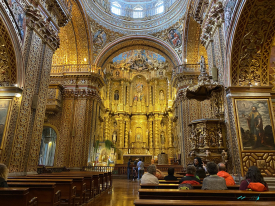
The cathedral’s exterior and interior combine Renaissance planning with the dense ornament that developed in colonial Cusco. PROMPERÚ describes carved cedar and alder within the building and identifies an important collection of paintings associated with the Cusco School, as well as repoussé silver objects. These materials reveal the meeting of European forms and local craft. They also show why the cathedral functions as a major art collection as well as a place of worship.
The broader complex is often experienced as a group of connected religious spaces around the main cathedral. Local visitor information distinguishes the central Basilica Cathedral from the Church of El Triunfo and the Temple of the Holy Family. Their proximity helps explain how the plaza’s religious landscape developed through additions and adjoining structures. Visitors should check which areas are included in a particular ticket or route, because descriptions of the cathedral can refer either to the principal church or to the wider ensemble.
Inside, the collection rewards looking beyond the most prominent altar. Paintings, carved furnishings, silverwork and chapels form a layered record of devotional life in the former Inca capital. Some works are associated with artists of the Cusco School, whose workshops combined European techniques with local visual language. Rather than treating each object as a stand-alone curiosity, visitors can read the interiors as evidence of how religious institutions commissioned and preserved art in a city transformed by conquest and colonial rule.
From Inca capital to a living heritage center
Cusco’s importance predates the cathedral by centuries. The city was the political and ceremonial center of the Inca state before Spanish rule, and UNESCO’s description emphasizes the surviving relationship between Inca structures and later colonial buildings. The cathedral’s placement over an earlier palace site makes that continuity particularly visible. Its architecture records colonial power, while the underlying urban geography preserves older layers that cannot be erased by the later façade.
That history should not be reduced to a simple story of replacement. Construction involved local labor, materials and artistic traditions, while the resulting institution became part of the city’s religious calendar and civic identity. The museum-like qualities of the interior exist alongside living worship. This is why a visit is best approached with attention to both the art and the setting: the cathedral is not only a repository of objects but also a place where people continue to gather for religious observances.
The cathedral also sits among other important destinations within walking distance, including churches, museums and streets that reveal Cusco’s layered architecture. A visit to the Plaza de Armas can be paired with a slow walk through adjoining blocks, where stone walls and colonial balconies provide context for the larger urban story. The UNESCO designation applies to the historic city as a whole; it is not a separate inscription for the cathedral alone. That distinction helps place the monument within the wider heritage landscape.
Visiting hours and respectful planning
PROMPERÚ’s visitor page lists visiting hours for the cathedral from 10 a.m. to 6 p.m., Monday through Sunday and on public holidays. An archdiocesan bulletin also publishes a daily visiting window for the religious heritage circuit. Schedules may change for services, ceremonies, conservation work or special events, so confirm the latest notice before planning around a fixed time. A tourist visit and a religious service are different activities and may have different access arrangements.
The tourism listing consulted for this guide does not state a current admission price. Local visitor information may describe tickets for the cathedral or a broader religious circuit, and conditions can change. Check with the official ticket office before you arrive, especially if you are comparing a single-site visit with a multi-site pass. Do not assume that a general Cusco tourist ticket includes the cathedral; verify exactly which places and spaces the ticket covers.
Plan for an unhurried visit. Cusco sits at high altitude, and time spent walking around the square can be more demanding than it appears on a map. Move slowly, carry water, and follow instructions on photography and access inside the church. During worship, keep voices low and avoid interrupting ceremonies. If a particular chapel or gallery is closed, respect the restriction; availability can change without the building itself being closed to every visitor.
Cusco Cathedral is most revealing when read at several scales: as a work of architecture, a collection of Andean colonial art and a building set over an older sacred landscape. Its construction unfolded over generations, while its present-day role remains both cultural and religious. Check the current schedule and ticket details, then give yourself time to study the square and surrounding streets. The cathedral’s story is inseparable from the city that grew around it.