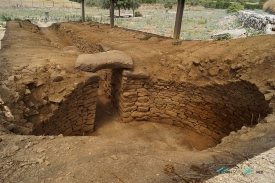
Ancient Isthmia sits on the narrow land bridge linking the Peloponnese with central Greece, a strategic corridor between Corinth and the Saronic Gulf. Its position made the sanctuary of Poseidon more than a local religious site. People, armies and traders moving between regions passed through this landscape, and the sanctuary became known for the Isthmian Games, one of ancient Greece’s major Panhellenic festivals. Today, the archaeological site and its small museum let visitors approach that history through visible remains and excavated objects rather than through a single reconstructed monument.
The sanctuary was dedicated to Poseidon, the sea god and patron deity of the Isthmus. Archaeological research has identified religious activity here by at least the seventh century BCE. The American School of Classical Studies at Athens describes a Doric temple built around 465 BCE and rebuilt after a fire roughly 75 years later. That sequence belongs to a longer history of rebuilding, not one stable temple. The remains offer fragments of changing architecture and ritual, while the museum helps explain the finds that are no longer in their original locations.