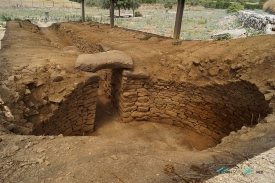
On the edge of Greece’s Argolid plain, near the village of Elliniko and southwest of Argos, a compact stone building has attracted outsized claims. It is commonly called the Pyramid of Hellinikon, but the name should not be mistaken for proof that it was a pyramid in the Egyptian sense. The monument is a low, roughly rectangular structure built from large blocks, set amid the countryside of the northeastern Peloponnese.
The site stands close to the ancient road that connected Argos with Tegea and the interior of the Peloponnese. That location gives the building a plausible relationship to movement through the landscape, but it does not settle what happened inside. The responsible Ephorate of Antiquities of Argolida describes a structure made with polygonal masonry and says its date and function remain uncertain. The official account treats the uncertainty as a live archaeological question, not a mystery solved by a single dramatic theory.