Tsaritsyno Palace, Moscow: The Residence Catherine Never Used
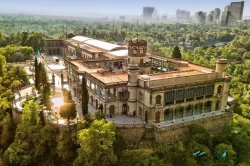
Beyond the ponds in southern Moscow, Tsaritsyno’s red brick and white stone come into view through the trees. Towers and pointed arches suggest a storybook castle, yet the symmetry of the Grand Palace belongs to another architectural language. Its most revealing fact is less visible: Catherine the Great commissioned this country residence but never lived in it. The building that visitors enter today is also a museum shaped by a twenty-first-century reconstruction, not a preserved imperial interior.
An empress changes the plan
The story begins in 1775, when Catherine II bought the Chyornaya Gryaz estate from the Kantemir family and renamed it Tsaritsyno. She wanted a residence outside the city. Architect Vasily Bazhenov designed an ensemble rather than a single monumental block: palaces, service buildings, bridges and gates set within a landscape of water and paths. Red brick, white stone and playful Gothic details gave the project a character unlike the more familiar neoclassical imperial palaces.
For a decade the work advanced. Then, in 1785, Catherine came to inspect the nearly completed residence. According to the museum’s account, she found its rooms too confined and its ceilings too low. She ordered the main palace pulled down and dismissed Bazhenov from the commission. His pupil Matvey Kazakov received the task of designing its replacement. It is the rare palace whose decisive historical event was a royal visit that led to demolition, not occupancy.
Kazakov’s Grand Palace kept pointed windows, towers and Gothic accents but organized them within balanced classical proportions. The central gallery and broad wings made a much more imposing composition. The project was simplified as finances tightened during the Russo-Turkish war. By 1796 the palace was close to complete, with a temporary roof and interior finishing still underway. Catherine died that year; construction stopped. Neither her court nor the imperial family took up residence here. For generations, the palace’s unfulfilled purpose became part of its identity.
A park grows around a ruin
Tsaritsyno did not disappear when the builders left. In the early nineteenth century, the park became a place for Moscow’s excursions. Paths, ponds and pavilions kept drawing people even as the unfinished palace deteriorated. By the later nineteenth century a dacha settlement had grown nearby, and the picturesque ruin acquired a second life in the landscape. The museum’s history records that a local-history museum appeared in 1927; the present museum institution was established in 1984.
Walk the grounds and Bazhenov’s broader idea becomes easier to read. The Bread House, originally a kitchen and service building, carries sculpted bread-and-salt emblems. Bridges and smaller palaces break up the route between the Grand Palace and the ponds. The greenhouses recall the estate’s cultivated side, while the park offers long views across water and woodland. This is not simply a palace with a garden attached: the spaces between buildings are part of the design.
Restoration came in stages. Russian and Polish specialists worked on much of the ensemble from 1987 to 1995, but the Grand Palace and Bread House remained outstanding. Moscow then undertook a far larger restoration and reconstruction in 2005–2007. The Grand Palace, long a ruin, acquired a roof and museum interiors behind surviving historic walls; the Bread House and park were also transformed. The reconstructed palace complex officially reopened on 2 September 2007. The museum itself acknowledges that the intervention drew criticism from scholars and conservationists. A visitor should understand the finished rooms as a modern interpretation of an eighteenth-century project that Catherine never saw completed.
What the museum is today
Tsaritsyno now combines historical interpretation with decorative arts, archaeological material, temporary exhibitions, concerts, guided tours and educational programs. The Grand Palace and Bread House are the central indoor pair, linked by an underground visitor area; a ticket to both is the clearest starting point. A walk afterward can connect the Figured Bridge and smaller buildings to the ponds. Those interested in the nineteenth-century afterlife of the estate can look for the Third Cavalier Building, whose current exhibition examines Tsaritsyno’s dacha years. Exhibition programs change, so the museum’s own calendar is the place to check a particular date.
The site remains a working museum rather than a frozen monument. As of 31 October 2026, the museum warns that repairs to the Grand Palace towers have left part of the exterior behind scaffolding and may bring noise into some galleries. It also posts temporary room closures. Such notices are worth reading before paying for a timed visit, especially if a particular hall or an unobstructed palace photograph matters to you.
Hours, tickets and access
The museum lists the palace complex as open Tuesday to Thursday and Sunday from 10:00 to 18:00, and Friday and Saturday from 10:00 to 20:00; it is closed Monday. The greenhouses close Monday and Tuesday. The park opens daily from 06:00 to midnight and admission to the park is free. Museum hours can change on holidays, and the ticket offices close before the buildings. The address is Dolskaya Street 1, Moscow. For public transport, the museum directs visitors to Tsaritsyno or Orekhovo stations on the green metro line, both using exit 2; Tsaritsyno leads toward the central gate and ponds, while Orekhovo approaches the park gate.
On the museum’s price list checked 31 October 2026, a standard ticket covering the Grand Palace and Bread House costs 900 rubles, approximately US$11.17 at the Bank of Russia reference rate of 80.5573 rubles per dollar that day. A six-entry combination ticket costs 1,220 rubles, approximately US$15.14. These dollar amounts are illustrations, not a guaranteed card or cash exchange price. Reduced admissions have eligibility rules. Buy through the museum’s official online ticket page or at its ticket offices; verify the chosen date, special closures and final price before checkout. The museum telephone is +7 495 322 44 33.
Travel conditions require a separate check. As of 31 October 2026, the UK Foreign, Commonwealth and Development Office advises against all travel to Russia. The practical information above serves local visitors and future planning; it is not a recommendation to travel against current official advice. Tsaritsyno’s strongest story can be understood from afar as well: a project interrupted by an empress’s verdict, suspended by her death and reimagined centuries later for the public.