Sintra National Palace: Portugal’s royal rooms, history and visit tips
A palace that grew with Portugal’s court
In the historic centre of Sintra, the National Palace is easy to recognize by the two monumental conical chimneys rising above its kitchens. The building is also known locally as the Paço da Vila, or Town Palace. It is not a single-period monument: successive Portuguese rulers adapted and expanded a royal complex over centuries, leaving Gothic, Manueline and Mudéjar features side by side. That layered character is more revealing than the familiar silhouette alone, because the palace records changes in court life, artistic taste and political power.
The site’s earliest history remains partly uncertain. The managing organization, Parques de Sintra, says a tenth-century account by the Arab geographer al-Bakrī mentions a palace at Sintra, while the exact location of a possible residence of Muslim governors beneath the present complex has not been identified. The first document confirming a palace at Chão da Oliva dates to 1281, when King Dinis agreed with the free Muslims of Colares that they would maintain the building in exchange for a tax reduction. The distinction between an early reference and surviving archaeological proof matters: the palace’s past is old, but not every stage is fully documented.
Dinis granted the palace, town and surrounding territory to Queen Isabel in 1287, although ownership remained with the Crown. Over time, Sintra became closely associated with the households of Portuguese queens as well as kings. The palace’s growth was therefore not only a sequence of royal construction campaigns; it depended on a court community of noblewomen, officers, servants and enslaved people. Naming that wider household helps readers see the residence as a place of work and administration as well as ceremony.
Rooms, tiles and the famous chimneys
Major building campaigns under Dinis, João I, Manuel I and João III shaped the complex that visitors encounter today. Under João I, the central courtyard became a focus of the palace, and the Swan Room was among the new spaces associated with the court of Queen Philippa of Lancaster. The large kitchen and its two conical chimneys also belong to this phase. Their scale is practical and architectural: from outside they form the palace’s most recognizable profile, while inside they point to the labor and provisioning needed to sustain a royal household.
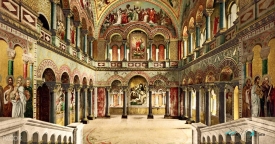
Manuel I’s reign added features now central to the palace’s visual identity. Hispano-Moorish tilework gives many rooms a Mudéjar character, a synthesis of Christian and Muslim artistic traditions described by the palace’s own historians. The Hall of Coats of Arms, or Sala dos Brasões, carries the arms of Manuel I, his sons and 72 leading noble families on its dome. It is a room about rank made visible: the decoration turns a royal interior into a record of alliances and hierarchy, not simply a richly patterned backdrop.
The palace continued to change under João III, who connected the principal southern rooms with the north-western wing. Its history also includes less celebratory chapters. Afonso VI was confined in the room that bears his name from 1674 until his death in 1683, according to Parques de Sintra. The 1755 earthquake severely damaged the complex, but reconstruction retained a silhouette that had taken shape by the mid-sixteenth century. Conservation therefore preserves a building that is itself the result of repeated alteration, rather than restoring it to one imagined original moment.
From royal residence to a living museum
Sintra Palace remained in royal use until the revolution of 1910. Queen Maria Pia, widow of King Luís, was the last monarch to live there before leaving Portugal; that same year, the palace was declared a National Monument. It did not become a systematic museum immediately. Parques de Sintra says it opened regularly to the public only toward the end of the 1930s, after substantial work that presented a particular image of Portugal’s past. The institution now acknowledges that this interpretation underplayed the full impact of Portugal’s colonial expansion, a reminder that museum narratives also have histories.
The palace forms part of the Cultural Landscape of Sintra, inscribed on UNESCO’s World Heritage List on December 6, 1995. Parques de Sintra has managed it since 2012. Recent interpretation work has brought previously inaccessible rooms and collections into the visitor route; the manager reports eight additional spaces and roughly 100 objects, including furniture, paintings and decorative arts. It also identifies the restored Jardim da Preta as a free-to-enter garden. These additions mean that even returning visitors may find a route different from older guidebooks.
Digital tools can help visitors prepare without replacing the rooms themselves. The palace offers a 360-degree virtual visit and free digital interpretation, including the Zoomguide audio guide in Portuguese, English, Spanish and French. These resources are especially useful for understanding collections and details that can be difficult to take in during a crowded visit. The palace is still best approached as a sequence of rooms with different histories, rather than as a checklist of famous features to photograph and leave behind.
Tickets, timing and getting to the palace
At the time of research, Parques de Sintra listed the Essential Visit from 9:30 a.m. to 6:30 p.m., with the last ticket and admission at 5:30 p.m. The palace ticket office closes from noon to 1 p.m., although an automated ticket machine remains available. The listed adult Essential Visit cost was €13; youth aged six to 17 and visitors over 65 paid €10, children under six entered free, and a family ticket for two adults and two youths was €35. Prices and opening times can change, so check the official calendar and ticket page before travelling.
The Essential Visit is unguided and includes the rooms open to visitors and the gardens; other experiences, including guided or staged visits, have separate prices and schedules. The manager’s pages do not all present garden last-entry information identically, so confirm the specific space and date when buying. Advance online tickets require a date reservation, according to the current hours-and-prices page. If a timed booking is available, build the rest of a Sintra day around it rather than assuming that a ticket guarantees entry at any hour.
The palace stands at Largo Rainha D. Amélia in Sintra’s historic centre. Parques de Sintra recommends buses 434 and 435 from Sintra railway station and warns that private-car circulation in the historic centre is restricted to residents; use marked parking and continue on foot or by public transport. From Lisbon, trains on the Sintra line serve the town, but local onward transport and road access can change. Check the operator’s current travel notices, leave time for the walk through the historic centre and verify the palace’s official updates before setting out.