Schloss Drachenburg: a Rhine castle with an extraordinary second life
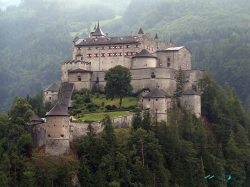
The first glimpse of Schloss Drachenburg can be deceptive. Turrets rise from a wooded slope above the Rhine, suggesting a medieval fortress, yet this lavish residence was built in the late nineteenth century. Its real story is more surprising than the silhouette: the financier who commissioned it never lived there, a nephew turned it into an attraction, and later owners and institutions gave the building lives its first designers could scarcely have imagined.
Above Königswinter in the Siebengebirge, Drachenburg combines a castle’s dramatic outline with the comforts and display of a grand villa. Today its restored interiors and landscaped park welcome visitors who come for architecture, history and views across the river valley. It is a rewarding stop on the way up the Drachenfels, provided you give the house time beyond the photograph.
A financier’s dream above the Rhine
Stephan Sarter, born in Bonn in 1833, made his fortune as a financial analyst. In 1882 he laid the foundation stone for a residence that combined the forms of a villa, palace and castle. Architects Leo von Abbema and Bernhard Tüshaus prepared the first designs; Wilhelm Hoffmann revised them. Construction took place from 1882 to 1884.
The result belongs to the nineteenth-century taste for historic styles rather than to the Middle Ages. Its towers, decorative interiors and terraces express an age fascinated by older architecture and by the romantic landscape of the Rhine. Sarter, however, remained in Paris and never occupied the house. When he died in 1902, his nephew Jakob Biesenbach acquired the property.
Biesenbach developed it for visitors in the early twentieth century. The estate became a place of leisure, with rooms open for a fee, a restaurant and holiday accommodation in the park. The idea of coming here for the landscape and architecture is therefore not new; tourism is itself part of Drachenburg’s history.
From boarding school to threatened monument
The castle’s later history is not a simple tale of aristocratic residence. In 1931 the Brothers of the Christian Schools opened St Michael’s boarding school here. The school closed in 1938 under pressure from the Nazis. In 1942 a Nazi elite school occupied the building; alterations changed its entrance, and during the Second World War shelling badly damaged the art hall and destroyed much of the stained glass.
After the war the building served as accommodation for refugees and then as a railway training centre. When the railway left in 1960, the property stood empty and deteriorated. A demolition proposal was stopped in 1963, but decay continued until textile merchant Paul Spinat bought the ensemble in 1971.
Spinat repaired and refurnished the house and opened it to the public in 1973. Some missing paintings were recreated with creative freedom, a distinction that matters when looking at the interior today: the rooms reflect both historic evidence and later interventions. The property was listed as a protected monument in 1986.
A broader restoration began under the North Rhine-Westphalia foundation in cooperation with the state and Königswinter. The castle rooms were restored and refurnished for reopening by 2010, while the landscape park was completed in 2011. The house visitors see is thus both an example of nineteenth-century ambition and the result of a long effort to preserve it.
What to see inside and outside
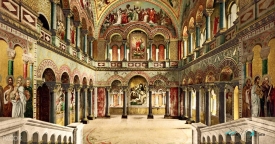
The visit includes the historic rooms of the principal and private floors, the permanent exhibition on the castle’s history and the north tower. Look for the way decorative schemes and views work together: this was a residence intended to make an impression as well as a place from which to enjoy the Rhine. The exhibition helps explain the changes of use and the restoration behind the apparent unity of the building.
Outside, terraces and paths lead through the landscaped park. The official estate describes the park as part of the experience, not simply a route to the front door. Weather and individual access restrictions can affect the visit, and the north tower, terraces and parts of the grounds involve stairs. Visitors requiring step-free access should consult the castle’s accessibility guidance before arriving.
Drachenburg stands on the Drachenfels slope, with the older Drachenfels castle ruins farther up the hill. They are distinct sites. Combining the two offers a useful contrast between the nineteenth-century residence and the older ruins, but allow time for the journey and check the conditions for each separately.
Tickets, opening hours and the climb
For the 2026 season, the castle lists standard admission at €10 for adults, €8 for eligible concessions and €25 for a family ticket. Children under six enter free. Tickets are available at the entrance during normal opening or through the official visitor and ticket page; special events have separate conditions and prices.
The castle publishes winter hours of 12 noon to 5 p.m. from 2 November to 28 February and summer hours of 11 a.m. to 6 p.m. from 1 March to 31 October. For 2026 it lists closures on 20–22 November, 16 December, 21–24 December and 31 December. The four Advent weekends operate as a separately ticketed event, and the official page reports those dates sold out. Recheck the calendar before travelling: events and closures override the ordinary timetable.
The address is Drachenfelsstraße 118, 53639 Königswinter. The castle’s directions describe car parks in Königswinter and routes uphill, including the Drachenfels railway. Check the official directions for current construction and railway arrangements; the last part of the visit is on a hillside, so comfortable footwear is useful.
From the park, the Rhine provides the setting that inspired the building’s romantic image. Inside, its successive uses tell a less picturesque but richer story: a dream house without its intended owner, a school, a damaged monument and a residence restored for a new public.