About Royal Palace Amsterdam
A palace that began as a city hall
On Dam Square, the Royal Palace Amsterdam can look like a sealed royal residence, but its original purpose was civic. Construction of a new city hall began in 1648, when Amsterdam’s commercial power was at its height. Architect Jacob van Campen designed a monumental classicist building that presented the city as prosperous, orderly and influential. The Amsterdam City Archives notes that contemporaries called it the “eighth wonder”; the phrase was rhetoric, but it conveys the scale of the ambition behind the project.
The building was not initially planned as a royal home. For roughly a century and a half it served as Amsterdam’s town hall, housing civic institutions and the offices of city government. The City Archives records that the new hall was ready for inauguration in 1655, although work and decoration continued beyond that opening. Its position on Dam Square made it a working center of municipal life as well as an architectural statement. This civic history changes how visitors read the grand rooms: they were made for a city and its institutions before they became royal reception spaces.
The shift came under Louis Napoleon, brother of the French emperor Napoleon Bonaparte, who became King of Holland in 1806. He took the former town hall into use as a palace in 1808. After Napoleon’s fall, William of Orange initially returned the building to Amsterdam, then accepted it again as a royal residence after his inauguration as William I. The Dutch Royal House says the state became its owner in 1936 and made it available to the King by law. Today its role is representative, not a private family home.
Architecture built to project Amsterdam’s power
Van Campen’s design draws on classical forms and uses the building’s size to communicate the city’s place in seventeenth-century Europe. The City Archives describes a project approved in the hopeful months after the 1648 Peace of Münster, which ended the war with Spain. Amsterdam’s leaders wanted a town hall larger and more ambitious than originally conceived. The imagery inside and outside turns that civic aspiration into stone, sculpture and painting, though the language of power should also be read critically rather than accepted as a neutral portrait of history.
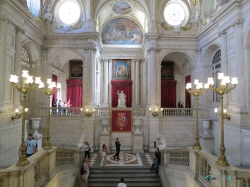
The Citizens’ Hall, or Burgerzaal, forms the building’s central space. Its broad marble floor carries maps and images that place Amsterdam within a world imagined through trade and maritime connections. The Royal Palace’s official Dutch overview highlights the hall and its marble galleries as defining interiors. Visitors should look up and across as well as down: the room’s scale, ornament and sightlines were designed to make the city’s ambitions feel almost cosmic. It is one of the clearest places to see architecture serving as civic argument.
Other rooms layer different stories onto that civic shell. The official visitor information lists the Throne Room, Balcony Chamber and Moses Hall among the public spaces on the main floor, as well as the Tribunal on the ground floor. Sculptures by Artus Quellinus and paintings associated with artists such as Govert Flinck and Ferdinand Bol add political, moral and artistic messages. The palace’s current use means some rooms may be adapted for exhibitions or official functions; the visitor route is therefore a curated view of a working state building, not access to every room at all times.
A living royal venue with a civic past
The Palace remains closely tied to public ceremony. The Dutch Royal House describes it as a representative venue used for state visits, official receptions, New Year gatherings and award ceremonies. The palace’s own history also connects the building to major moments of the monarchy: Queen Wilhelmina signed an abdication act there in 1948, Queen Juliana in 1980 and Queen Beatrix in 2013. These events give the building a current constitutional role, but they do not erase its earlier life as a city hall.
The palace belongs to the Dutch state and is made available to the King for official use. For much of the year, the Royal Palace Amsterdam Foundation opens it to visitors, but official events can require closures. The visitor site’s 2026 program described more than 230 public opening days that year and said the calendar displays dates up to six months in advance. At the time checked on 8 October 2026, the page showed an October drawing program and an opening period through 11 November. Those details are a dated snapshot; they should not be carried forward as a promise for a later visit.
This balance between a public museum visit and official state use is part of what makes the palace distinctive. Visitors walk through rooms where royal guests are received, while the building continues to serve ceremonies that may change the schedule. Exhibitions can add a temporary theme without replacing the historic interiors, and the agenda is the best source for knowing which days are open. Do not assume that a palace listed in a city guide is open every day or that an online travel article has the latest schedule.
Tickets, access and a practical route
At the time checked, the palace’s official ticket page listed admission at €13.50 for adults, €9 for students and free for visitors aged 17 and under; the audio tour was included. Tickets are sold online or at the palace desk, and visitors select a date and starting time. The FAQ says only debit or credit card is accepted at the desk, online tickets are non-refundable, and the I Amsterdam City Card is not valid. Prices and rules can change, so use the live official page before paying.
Plan for about an hour, the average visit time given by the palace. A free multimedia tour is available in Dutch, English, German, French, Spanish, Italian, Chinese and Russian, subject to availability. The route covers the principal rooms, including the Citizens’ Hall and the Tribunal, rather than every working space. Bags are limited to 30 by 30 by 15 centimeters; larger hand luggage can be left at the free cloakroom, but large backpacks and rolling suitcases cannot. There is no café inside, although cafés and restaurants are nearby.
The official FAQ says the palace has a lift, accessible toilets and wheelchairs, and allows photography without flash; filming, tripods and selfie sticks are not permitted. Guide dogs are the only animals allowed inside. Its location on Dam Square places it within walking distance of central Amsterdam streets, tram stops and other museums, making it easy to add to a day in the city. The most useful plan is simple: check the opening calendar, reserve a timed ticket, travel light, and leave enough time to look closely at a building that has served both city government and the Dutch monarchy.