La Condomina Bullring in Murcia: architecture, memory and live events
A landmark built by a city cooperative
La Condomina, officially the Plaza de Toros de Murcia, is a working arena east of Murcia’s historic centre. Its brick-and-masonry character and unusual polygonal outline distinguish it from the more familiar Neo-Mudéjar bullrings found elsewhere in Spain. The venue opened in 1887, but the story began two years earlier, when municipal employees and dependents formed a cooperative that set out to fund a new place for recreation and public events. The project joined civic initiative, private shareholding and the city’s expanding eastern edge.
The operator’s historical account dates the cooperative’s creation to December 14, 1885. In 1886 it commissioned architect Justo Millán Espinosa, whose design was selected in August; work began on October 11 on land in the district of La Condomina. The cooperative raised capital by issuing 6,000 shares at 48 pesetas each, a total of 288,000 pesetas. That funding model is a revealing detail: the arena was not simply commissioned as a municipal monument but built through a local association that sought to create a durable venue.
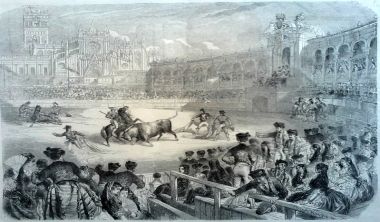
Construction lasted about eleven months, and the arena opened on September 6, 1887. The first programme featured bulls from the Murube stock, with Rafael Molina “Lagartijo,” Murcia-born Juan Ruiz “Lagartija” and Luis Mazzantini. The operator says the opening event sold out several days in advance. Parts of the building were still unfinished: the sun-side upper seating and boxes had not been completed, and temporary wooden benches filled their place. The official history preserves their nickname, “localidades de longaniza,” a reminder that even a major inauguration can carry a practical, improvised side.
Justo Millán’s eclectic architecture
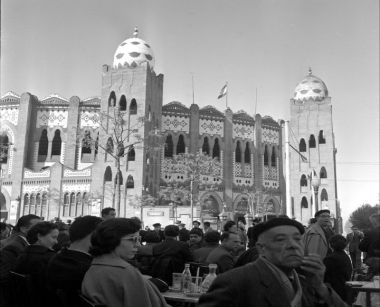
Millán’s design rejected the Neo-Mudéjar style then common in bullrings and instead used an eclectic vocabulary drawing on classical architecture, Byzantine medievalism and Neo-Egyptian references. The official venue history describes a structure of masonry and iron whose exterior combines segmented and circular openings. The result is less a decorative costume than a carefully composed urban façade: repetitive bays establish rhythm, while the principal entrance projects from the central body and gives the building a clear point of arrival.
The polygonal plan has 80 sides, according to the operator’s architectural notes and Onda Regional. The central section advances six metres and contains the main entrance, described as 3.5 metres wide and 5.5 metres high. A zinc roof rests on an iron framework, and the interior height reaches about 18.5 metres. These measurements help explain how the arena turns a large circular spectacle into a sequence of thresholds, corridors and seating levels. They also make La Condomina legible as a work of late nineteenth-century engineering, not only as a venue for a particular tradition.
Alterations became part of the building’s history. In 1906, the diameter of the ring was reduced to 53 metres; the operator says the change left one of Spain’s widest passageways around the arena. The regional broadcaster reports an original capacity of around 15,000 people, although capacity and seating arrangements can vary with event configuration and safety requirements. The 1987 centenary renovation repaired the façade and exposed original brickwork inside. A later visit can therefore reveal layers: the original eclectic design, practical changes, restoration choices and ongoing use.
From September fair to a broader event calendar
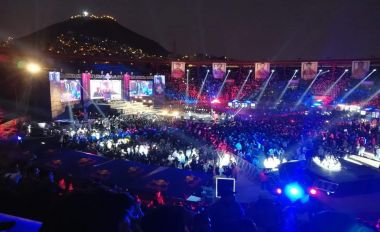
La Condomina remains an operating venue. The operator’s website presents bullfighting programmes, ticket information, event announcements and a current news feed. In September 2026, for example, the venue published reports from Murcia’s annual fair. The same arena also hosts concerts and other public events, a use noted by the regional broadcaster and reflected in the operator’s event calendar. The programme changes from year to year, so an old listing should not be treated as a promise that the same show, access or seating will be available on a later date.
That distinction matters for travellers. The official site provides ticket links for scheduled events, but its historical pages do not establish regular daily sightseeing hours or promise a standing guided tour of the arena. Visitors who want to see the interior should first check whether an event, announced visit or other access opportunity is listed for their date. If no programme is published, contact the operator rather than arriving expecting the doors to be open. An active venue can have rehearsal, setup, maintenance and safety closures between public events.
The arena is also part of a wider story of bullfighting in Murcia, a subject that local institutions preserve and interpret. The municipal tourism service describes the Bullfighting Museum as founded on September 7, 1887, the day after La Condomina’s inauguration. It is a separate attraction, located at Travesía Francisco Rabal, 2, not an automatic extension of an arena ticket. The city tourism page lists a collection of more than 3,500 objects, including posters, paintings, textiles, tools and historical documents. Check that museum’s own opening information before planning a combined visit.
Planning a visit and reading the building today
La Condomina is in Murcia, in the Región de Murcia, within reach of the city centre, but the best arrival plan depends on the event. The official venue site is the reliable place to check date-specific tickets, start times and any special entry instructions. The arena’s historic page is useful for understanding the building; it is not an admission calendar. Confirm whether tickets are mobile or collected at the box office, when doors open, and whether bag or accessibility conditions apply to the particular event.
When the arena is in use, approach it as a working event space rather than an open monument. Entry points, security screening, seating sections and accessible routes may differ between a bullfight, concert or other show. If you have mobility requirements, contact the organiser before buying a ticket and ask about step-free access, companion seating and toilets; do not infer accessibility from the building’s age or from general event advertising. For an exterior-only visit, respect barriers and private activity around the perimeter.
For a visitor, the strongest approach is to pair a confirmed event or museum visit with time to notice the building’s setting and design. Check the operator’s current calendar, verify the separate museum’s details, and allow for event-specific access rules. La Condomina’s significance comes from the civic cooperative that financed it, Millán’s distinctive eclectic composition, the layers of repair and the venue’s continuing public role. Whether encountered from outside or during a scheduled event, it reveals how Murcia has kept adapting a nineteenth-century landmark to the needs and debates of the present.