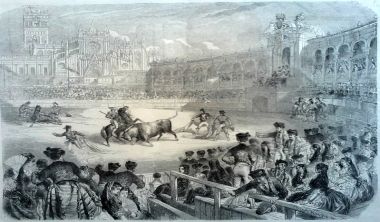
La Petatera: inside Colima’s hand-built, temporary bullring
A bullring that returns for the festival
La Petatera is not a permanent stadium. Each year, Villa de Álvarez, in the Mexican state of Colima, raises this temporary arena for the Fiestas Charrotaurinas, then dismantles it when the season ends. Its changing presence is part of the attraction: the visitor is seeing a building made for a particular moment in the town’s calendar, not a monument kept open every day. La Petatera sits within a living local celebration whose program can include religious, civic and popular events; the arena is one expression of that wider tradition.
The name comes from the petates, woven mats that cover parts of the structure. The cultural inventory of Mexico’s Secretariat of Culture describes an assembly made with otate canes, regional timber and bindings of ixtle fiber. Rather than relying on a conventional permanent frame, builders fit and lash components together so the structure can be erected, used and taken apart. These materials are not decorative details added after the design: they are the practical means by which the arena takes shape and the reason its construction depends on knowledge passed from one building season to the next.
That knowledge is still embodied by local workers. In May 2026, Villa de Álvarez’s municipal government reported that ICOMOS Mexico recognized 52 tabladeros and builders as “Living Human Treasures” for their role in transmitting the skills used to construct La Petatera. ICOMOS Mexico is an organization affiliated with UNESCO; this recognition is not the same as inscription of the arena on UNESCO’s World Heritage List. The distinction matters because the value here lies in a living practice and the people who sustain it, not in a claim of international listing that the available record does not support.
Origins, records and a tradition still debated
Accounts of the festival’s beginnings do not give a single uncontested year. The federal cultural inventory links the festivities in honor of Saint Philip of Jesus to 1658, while a Colima state tourism publication gives 1668. These dates concern the tradition of the celebrations and should not be casually presented as the construction date of the arena now known as La Petatera. The difference is a reason to be precise: official sources preserve more than one chronology, and the record does not justify smoothing that discrepancy into a falsely certain origin story.
The history of the structure has its own documentary trail. Academic research on La Petatera cites an archival record dated 9 February 1854, an important reference for the arena’s documented history. That surviving evidence does not prove that the building began in that year; it establishes that the tradition was already being recorded by then. Researchers also describe an architecture developed without a conventional set of original architectural plans. Its geometry is marked out on the ground, and the work depends on coordinated measurements, embodied skill and repeated procedures rather than a single architect’s finished drawing.
Construction dates change by edition. Mexico’s cultural inventory describes a cycle in which work traditionally began around mid-January and the arena was ready near 5 February, with assembly taking about 15 days and dismantling taking only a few hours after the festivities. A municipal account of the 2025 edition, however, reported that the ground layout began in December and set a target completion date of 25 January. These are dated examples, not a standing timetable. They show why visitors should check the current festival program instead of assuming that the structure will be present on the same dates every year.
How the temporary architecture works
The cultural inventory describes a circular arena about 60 metres in diameter and a constructed area of roughly 3,000 square metres. It also records approximately 70 tablados, the numbered stands or sections associated with the arena, and a capacity that can reach around 5,000 people. Those are inventory figures rather than a promise about every event configuration. Actual seating, admission and safe capacity depend on the edition and the event, so visitors should follow the organizer’s current rules instead of treating an old maximum as a ticket guarantee.
Each section is part of a larger system of components, materials and responsibilities. The inventory describes otate supports, wooden elements, petate coverings and plant-fiber ties. Local tabladeros take part in the construction and care of the components between seasons; the work is therefore both a building process and a community organization. The result is not a conventional arena built once and left unchanged. It is a structure whose form is recreated through annual labor, with each edition translating inherited methods into a usable venue for that year’s festivities.
Research on the traditional setting-out process helps explain how a complex circular structure can be built without treating a standard blueprint as the sole source of precision. Measurements and lines are transferred to the ground, and the sequence of assembly relies on shared rules and experience. Academic descriptions also note that published measurements can differ, depending on what is measured and how. This guide follows the federal inventory’s approximately 60-metre figure rather than combining incompatible estimates. The essential point is not a record-breaking dimension, but the construction logic: local materials and practiced coordination make a large temporary space possible.
Planning a visit to La Petatera
La Petatera is seasonal, not a year-round museum with reliably published daily opening hours. Its access is tied to the Fiestas Charrotaurinas and to the events scheduled in the arena. Villa de Álvarez’s official festival portal and municipal announcements are the best places to check for the next edition’s dates, program, ticket arrangements and any access conditions. The 2026 municipal notices describe that year’s 169th edition and its February celebrations; those dates are a record of a past season, not a forecast for 2027.
Before setting out, confirm that the arena has been erected and that the event you want to attend is open to visitors. The sources consulted do not establish a regular, free sightseeing schedule or daily interior tours. Admission, seating and event rules may differ from one program item to another. If your interest is architectural rather than tied to a particular performance, a municipal announcement or a current local tourism contact can help establish whether construction is under way and whether the site can safely be approached. Do not rely on old listings for live access information.
Allow time to look beyond the ring itself. La Petatera brings together craft, temporary architecture, festival organization and a chronology whose details remain open to careful interpretation. Its strongest story is not an invented legend but a documented and continuing practice: builders prepare a seasonal structure from regional materials, pass skills among generations and make a venue that disappears after its work is done. Seen that way, the visit becomes a chance to understand how a town’s celebration can be built—literally—by the people who keep its knowledge alive.