Real Maestranza of Seville: history, architecture and visitor guide
On the Arenal side of Seville, close to the Guadalquivir, the Real Maestranza is more than a setting for the city’s bullfighting season. Its oval-looking ring, tiled royal box and covered galleries reflect a building project that unfolded over generations. Construction began in the eighteenth century and was not fully closed until 1881; today the site includes a museum and a visitor route through parts of the arena. Travelers can visit outside a bullfight, but the experience is shaped by the day’s events and by a tradition that remains culturally important and publicly debated.
A project built in stages over 120 years
The Real Maestranza de Caballería is a historic Sevillian institution with roots in equestrian practice. It received royal privileges in 1730, and its interest in public and equestrian events gave rise to the bullring project in the Arenal. The owner’s history records work beginning on the permanent structure in the mid-eighteenth century, after earlier temporary wooden rings had occupied the site. The construction was not one uninterrupted campaign: phases advanced, paused and resumed as finances, royal prohibitions and the shape of the site affected the project.
The arena’s upper enclosure was finally completed in 1881, about 120 years after the main masonry work began. This extended chronology helps explain why the Maestranza is not a mathematically perfect circle. It grew through successive decisions rather than from one finished blueprint. The owner’s historical timeline also records later reforms to the seating in 1914–15. Rather than erase the building’s layered character, those interventions helped shape the venue that visitors see today.
An irregular ring and the Prince’s Box
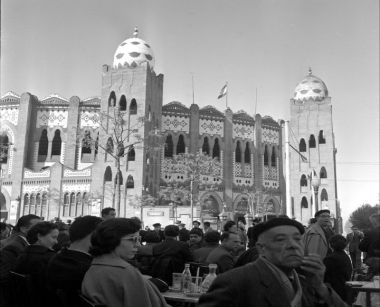
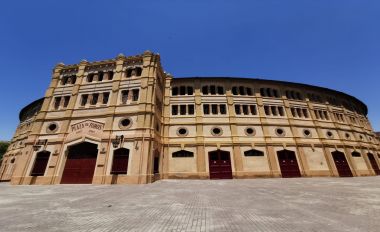
The official description calls the building an irregular polygon of 30 unequal sides. From outside, the late-Baroque façade combines exposed stone around the main entrance with pale, mostly whitewashed surfaces. The ring sits on the rise known as Monte del Baratillo, close to the Guadalquivir; the surrounding block is bordered by Paseo de Cristóbal Colón, Adriano and Antonia Díaz. That location connects the arena to Seville’s riverfront and the Arenal neighborhood, not just to the spectacle inside.
One of the most recognizable architectural features is the Palco del Príncipe, completed in 1765. It includes a ceremonial doorway and a box reserved for the Spanish royal family; the upper section is finished with blue-and-white tiles. The ring’s internal layout includes the lower barrier and tendido seats, covered upper galleries and working areas such as corrals, the infirmary and spaces used by the bullfighters’ teams. These are functional parts of a venue, not all necessarily included in every visitor route. The irregular form and long building history give the plaza a character different from a modern, uniformly circular stadium.
The museum and Seville’s bullfighting calendar
The Taurine Museum is housed within the complex and forms part of the regular visitor experience. Seville’s tourism authority describes the Maestranza as the oldest bullring in Spain and connects it with the city’s April Fair. Its account of the building records the interruption of construction after royal restrictions on bullfighting in the late eighteenth century, one of the reasons the site took so long to complete. The museum helps place the ring within that history, while the architectural route lets visitors see features that are difficult to understand from the street alone.
Seville’s current tourism information says the season begins on Easter Sunday and continues with events during the Feria de Abril. A bullfight or another scheduled activity can shorten the visiting window or close parts of the complex, so the ordinary museum schedule should not be treated as guaranteed on event days. The official tourism page lists a reduced visit period for bullfighting days. If you are in Seville during a major festival, check the current calendar before booking the visit and do not assume that a museum ticket also grants entry to a separate performance.
Hours, prices and practical details
The city tourism authority currently lists visits Monday through Sunday from 9:30 a.m. to 9:30 p.m. On days with bullfights, the visiting window is 9:30 a.m. to 3:30 p.m.; ticket offices close 30 minutes before the stated end time, and the site is closed on 25 December. The listed admission is €10 for general entry, €6 for seniors, students and young visitors, €3.50 for children aged 7 to 11, and free for children aged 0 to 6. Prices and access rules can change, so confirm the booking page before setting out.
The listed address is Paseo de Cristóbal Colón, 12, in the Arenal area. Buying through the official visit channel is the clearest way to check whether the museum and arena route are available on your chosen date. Leave extra time during festival periods, when crowds and event preparations affect the neighborhood. The Maestranza is both a working bullring and a monument; its visitor appeal rests on the architecture and museum as well as on the season it hosts. A thoughtful visit can explain that history without requiring agreement with bullfighting itself, a practice that continues to prompt discussion about heritage, ethics and animal welfare.